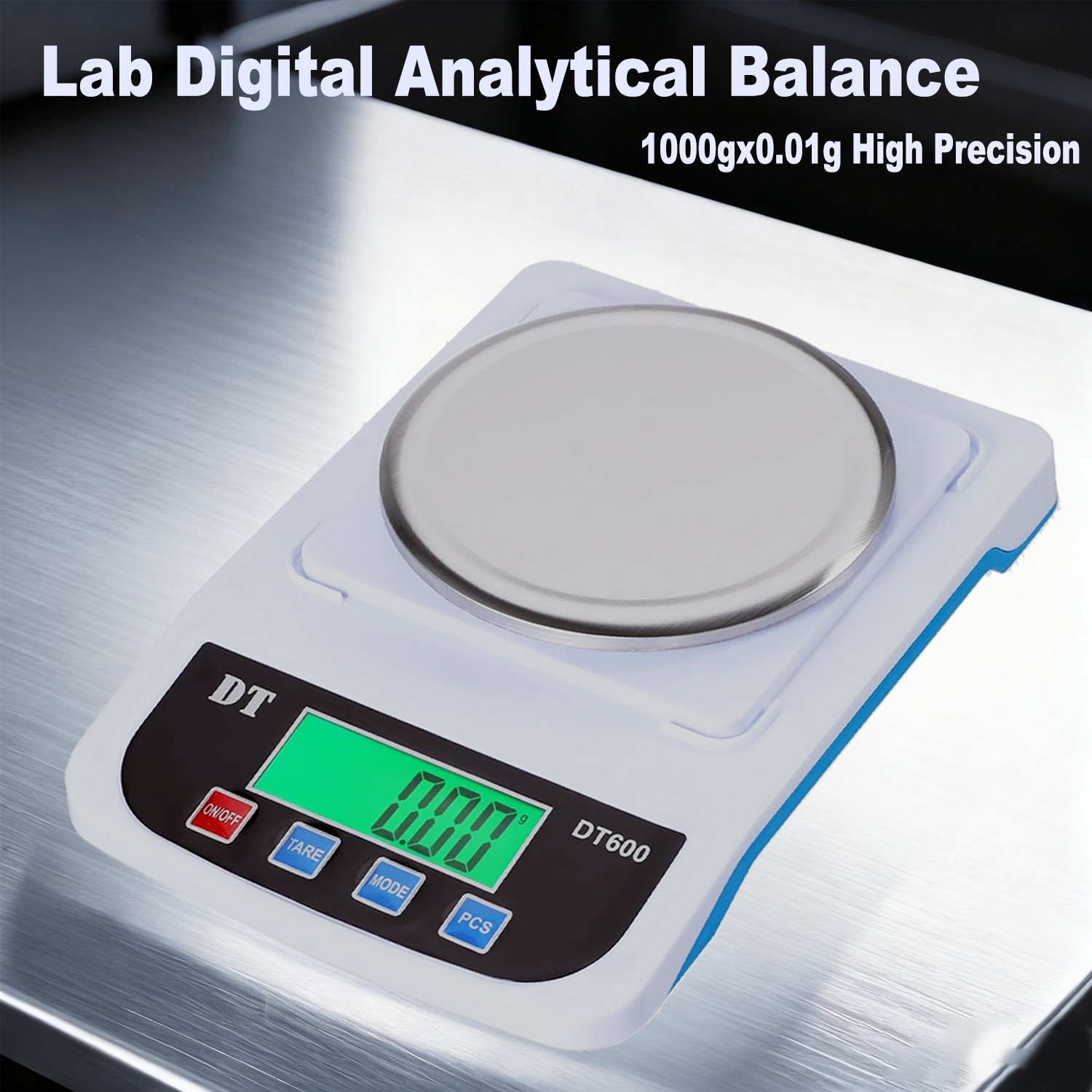

Photos from current listings. Actual item, color, and included accessories may vary.
Portable Electronic Scale Buying Guide
Portable electronic scales are compact battery-powered instruments that convert load-cell deflection into a digital mass readout, spanning pocket jewelry scales to bench-top lab units. The core trade-off is resolution versus capacity and stability: higher readability (0.001 g) demands tighter temperature compensation and draft shielding, while higher capacity (5 kg+) sacrifices precision. Decide by your heaviest single sample and the smallest increment you must trust—never buy a scale whose capacity you exceed or whose resolution you don't need.
Median $41.99
Key takeaways
- Load-cell type dictates drift: strain-gauge cells suit 0.1 g–0.01 g general use; force-motor (electromagnetic) cells hold 0.001 g readability with far lower linearity error.
- Readability vs capacity is a hard ratio: a 0.001 g scale typically caps at 50–200 g; 0.01 g units reach 500–2,000 g; 0.1 g units handle 5–10 kg platforms.
- Calibration is external for most portables—buy one with a user-calibration mode and a stated calibration weight class (OIML F1/F2 or ASTM Class 1–2) for trustworthy readings.
At a glance
- Category
- Lab Balances & Scales
- Last updated
- Nov 28, 2026
Current offers
Highlights
- Load-cell type dictates drift: strain-gauge cells suit 0.1 g–0.01 g general use; force-motor (electromagnetic) cells hold 0.001 g readability with far lower linearity error.
- Readability vs capacity is a hard ratio: a 0.001 g scale typically caps at 50–200 g; 0.01 g units reach 500–2,000 g; 0.1 g units handle 5–10 kg platforms.
- Calibration is external for most portables—buy one with a user-calibration mode and a stated calibration weight class (OIML F1/F2 or ASTM Class 1–2) for trustworthy readings.
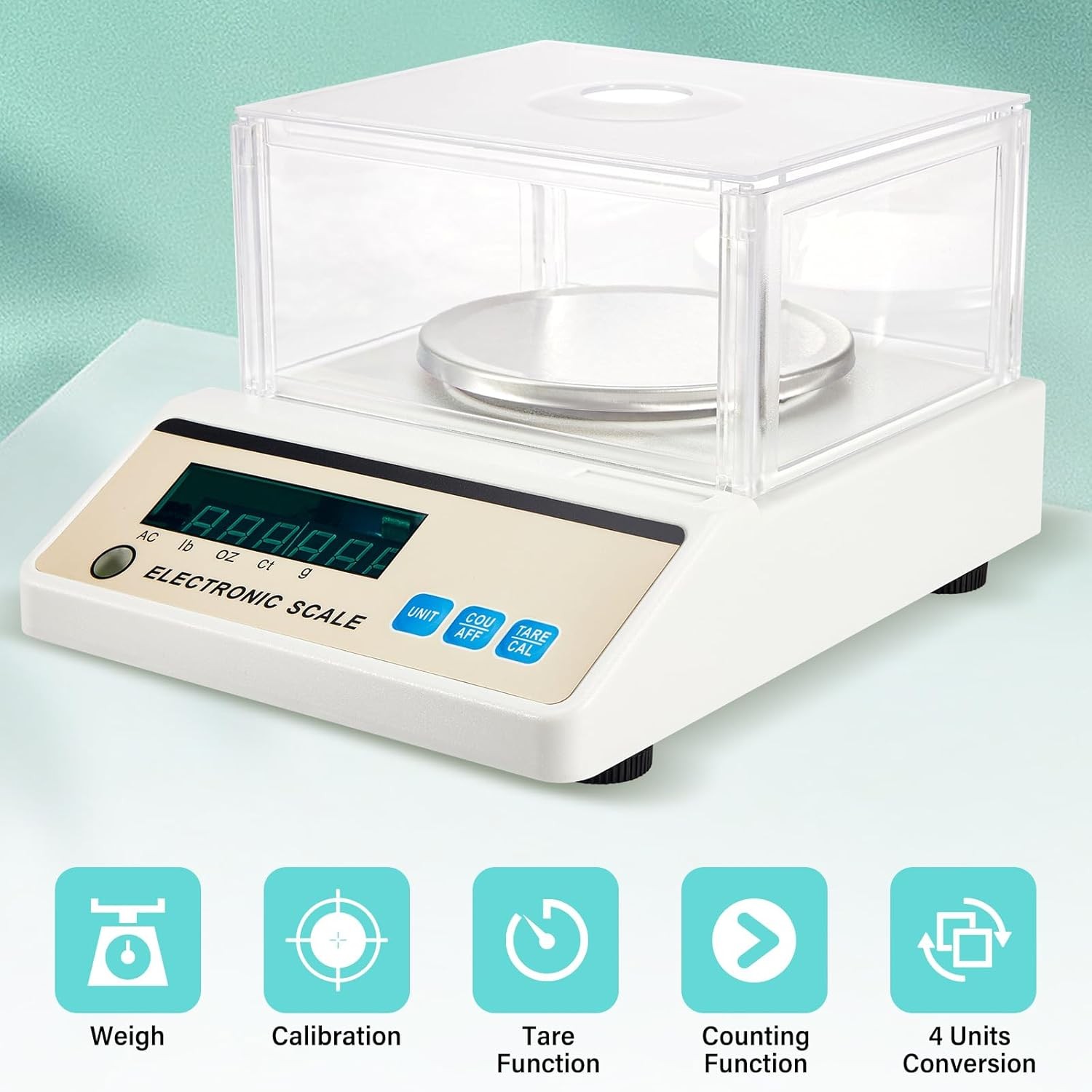
- Battery and display architecture separate tiers: AA/USB-C rechargeable with auto-off and backlit LCD is the practical minimum; AC-adapter-only units are bench instruments, not portable.
Best use cases
- Jewelry, gemstones, or reloading powder: pick 0.001 g readability with a 50–100 g capacity, draft shield, and calibration-weight inclusion; skip 0.1 g kitchen-style units that cannot resolve small increments.
- Coffee, baking, and portioning: pick 0.1 g readability with 2–5 kg capacity, tare function, and a removable stainless platform; skip 0.001 g units that overload at a few hundred grams.
- Field sampling, shipping, or livestock feed: pick 0.05–0.1 g readability at 5–10 kg with a hold function and rugged ABS housing; skip glass-top lab scales that crack under rough handling.
Buying tips
- Size the platform to your container: a 100 mm pan handles most beakers and bowls; 150–200 mm pans add stability for 1 kg+ loads but reduce portability.
- Match readability to tolerance, not aspiration: choose 0.1 g if your acceptable error is ±0.5 g; move to 0.01 g only when each reading must be trusted to ±0.05 g.
- Demand linearity and repeatability specs, not just resolution: a scale advertising 0.001 g but ±0.005 g linearity is effectively a 0.01 g instrument.
- Confirm the calibration standard: units shipping with a 100 g or 200 g OIML F2/ASTM Class 2 weight are field-calibratable; those requiring factory service are not portable-friendly.
Specs
| Readability Tier | 0.001 g / 0.01 g / 0.1 g |
|---|---|
| Capacity Range | 50 g – 10 kg by tier |
| Load Cell Type | Strain-gauge vs force-motor |
| Calibration | External F2/Class 2 weight |
Related searches
What to check before buying
- Weigh your heaviest sample plus container tare; add 20% headroom so the scale never runs at its capacity limit.
- Measure your bench or field footprint: pocket scales fit under 150 mm; bench portables need 200 mm depth and a level, vibration-free surface.
- Check power: USB-C rechargeable or AA cells for field use; confirm 100–240 V adapter compatibility if the unit ships AC-only.
- Verify the draft environment: 0.001 g models need a shield or still-air enclosure; open-bench use caps practical resolution at 0.01 g.
FAQ
Data sources: eBay / Amazon listings and product attribute feeds. Updated Nov 28, 2026.
Some links on this page are affiliate links. If you buy after clicking one, we may earn a commission at no extra cost to you. This does not change which products appear here or their order. Affiliate disclosure.