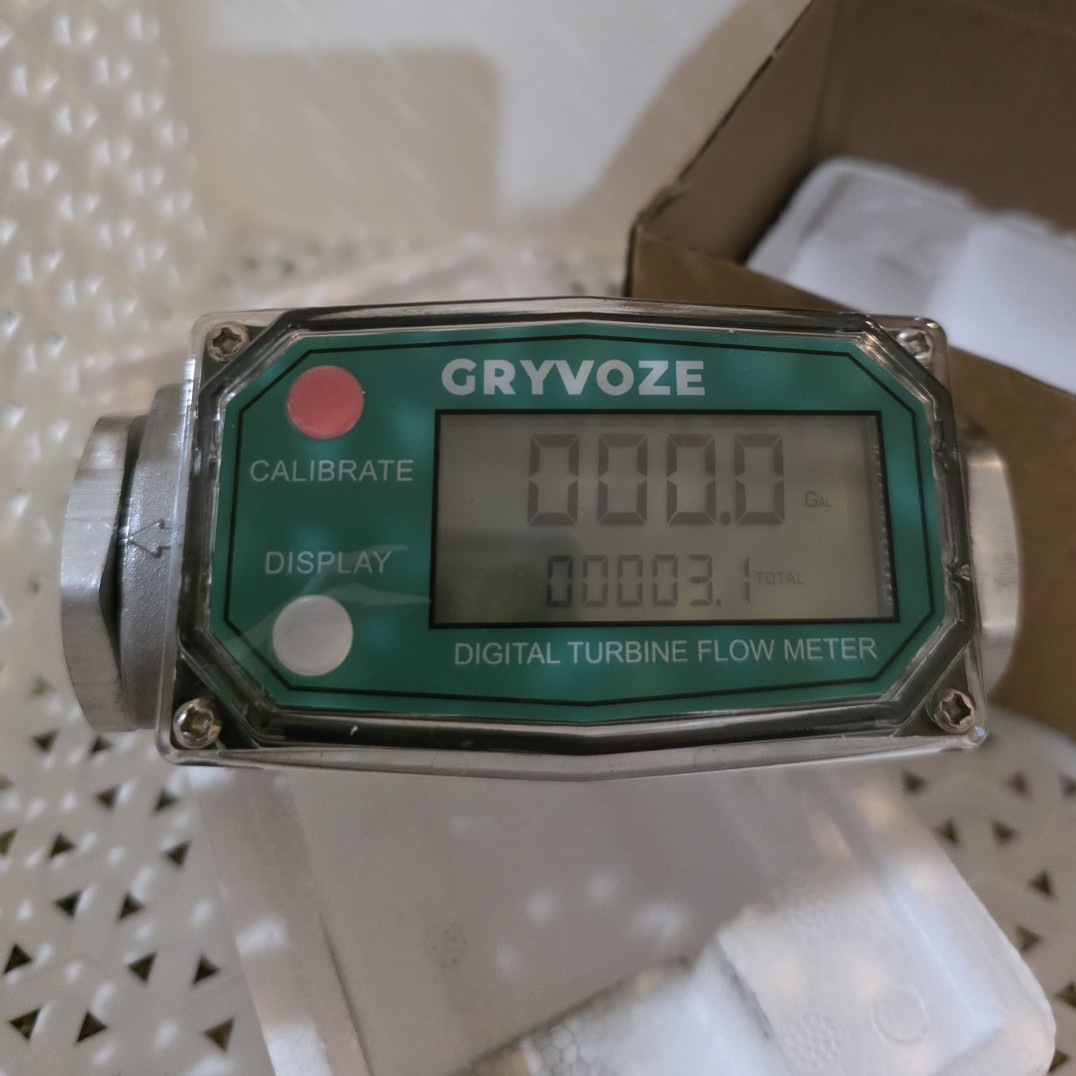

Photos from current listings. Actual item, color, and included accessories may vary.
GRYVOZE Digital Turbine Flow Meter Buying Guide
The GRYVOZE Digital Turbine Flow Meter is an inline turbine sensor with a local digital display, used to measure instantaneous flow and total volume of low-viscosity fluids. The core trade-off is between a low-cost plastic-body turbine with limited chemical and pressure tolerance versus a metal-body meter with proper bearing and seal specifications for continuous duty. Buy plastic only for ambient-temperature water and occasional verification; choose a metal-body or industrial turbine meter whenever the fluid is hot, pressurized, or chemically active.
Key takeaways
- Turbine meters are inferential: a rotor spins in proportion to velocity, and the electronics convert pulses to liters or gallons, so accuracy depends on a clean, fully developed flow profile.
- Typical small turbine meters require roughly 10×D straight pipe upstream and 5×D downstream to avoid swirl and reading error.
- Plastic (POM/nylon/PP) bodies suit water and mild fluids at low pressure; brass or stainless bodies are needed for higher pressure and temperature.
At a glance
- Category
- Pressure, Flow & Process Measurement
- Status
- Listings available
- Last updated
- Nov 27, 2026
Current offers
Highlights
- Turbine meters are inferential: a rotor spins in proportion to velocity, and the electronics convert pulses to liters or gallons, so accuracy depends on a clean, fully developed flow profile.
- Typical small turbine meters require roughly 10×D straight pipe upstream and 5×D downstream to avoid swirl and reading error.
- Plastic (POM/nylon/PP) bodies suit water and mild fluids at low pressure; brass or stainless bodies are needed for higher pressure and temperature.
- Pulse output (often NPN/open-collector or reed switch) is what allows logging to a PLC or controller; the local LCD is a convenience, not the measurement source.
Best use cases
- Best fit: inline water dosing, irrigation, hydroponics, and coolant monitoring at ambient temperature with a plastic-body digital turbine and battery-powered display.
- Best fit: process skids and machine coolant lines where the pulse output feeds a PLC counter and the display is only for local verification.
- Wrong fit: hot water, steam, or aggressive chemicals with a plastic-body unit; select a stainless or brass turbine rated for the temperature and fluid instead.
- Wrong fit: very low flow rates or gravity-fed trickle lines; turbine meters have a minimum flow threshold below which the rotor stalls and totalizes nothing.
Buying tips
- Size by flow range, not pipe diameter alone: confirm the meter's minimum and maximum flow and that your normal flow sits in the middle third of that band.
- Match body and seal material to the fluid: POM/nylon for water, brass for neutral water lines, 304/316 stainless for mild chemicals and higher temperatures.
- Check the pulse specification before wiring: NPN open-collector, push-pull, or reed contact determines whether your PLC or counter needs a pull-up resistor.
- Verify the display unit and totalizer behavior: some units show only instantaneous flow, while others totalize in liters or gallons and retain the total across power cycles.
Specs
| Body Material | Plastic POM/nylon vs brass/SS |
|---|---|
| Flow Range | Min-max band; size to mid-range |
| Output Signal | Pulse/frequency + local LCD |
| Connection Type | NPT, BSPP, or hose barb |
Alternatives to compare
Related searches
What to check before buying
- Measure the actual pipe OD and thread standard (BSPP, NPT, or hose barb) at the install point before ordering, because GRYVOZE variants differ by connection type.
- Confirm the line pressure and maximum fluid temperature are below the meter's body and seal ratings, with margin for water hammer.
- Plan straight-pipe runs of about 10 diameters upstream and 5 diameters downstream, plus a strainer or filter ahead of the rotor.
- Confirm the controller or PLC input type matches the meter's pulse output, and that the display's battery or supply voltage is available at the install point.
FAQ
Data sources: eBay / Amazon listings and product attribute feeds. Updated Nov 27, 2026.
Some links on this page are affiliate links. If you buy after clicking one, we may earn a commission at no extra cost to you. This does not change which products appear here or their order. Affiliate disclosure.