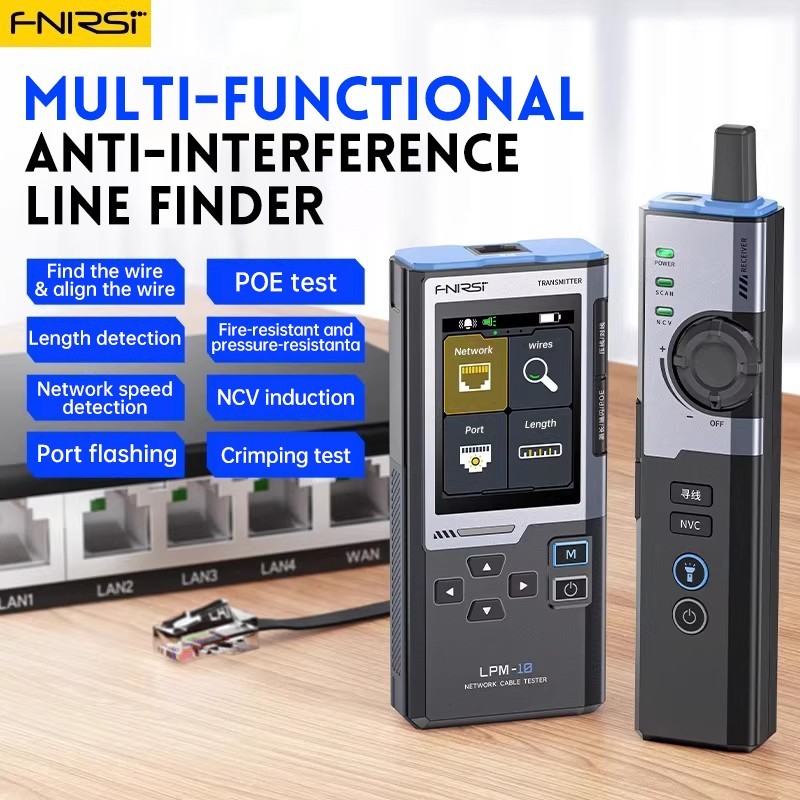

Photos from current listings. Actual item, color, and included accessories may vary.
Cable Finder Tool Buying Guide
A cable finder tool encompasses two distinct device families: underground cable locators for buried utilities and line finders/toners for low-voltage network and telecom cabling. The primary trade-off is detection depth and length versus interference rejection and connector support; durable tools specify detection depth/length and proper tone frequencies, while compromises omit these metrics. Decide by cable environment: buried and long runs require a locator with sufficient depth and length ratings, while in-building network/telecom needs a toner with RJ45/RJ11 support and anti-interference circuitry.
Key takeaways
- Underground locators differentiate by max detection depth (3 ft vs 6.5 ft) and max detection length (1,000 ft vs 3,280 ft), directly limiting which buried runs and soil conditions they can trace.
- Line finders like the FNIRSI LPM-10A support RJ45/RJ11 termination and anti-interference tone generation for identifying cables within active network bundles.
- TDR-based fault finders such as the Fluke Networks TS-100 measure cable length and distance to fault, unlike simple toners that only trace continuity.
At a glance
- Category
- RF, Network, Cable & Telecom Test
- Last updated
- Nov 28, 2026
Current offers
Highlights
- Underground locators differentiate by max detection depth (3 ft vs 6.5 ft) and max detection length (1,000 ft vs 3,280 ft), directly limiting which buried runs and soil conditions they can trace.
- Line finders like the FNIRSI LPM-10A support RJ45/RJ11 termination and anti-interference tone generation for identifying cables within active network bundles.
- TDR-based fault finders such as the Fluke Networks TS-100 measure cable length and distance to fault, unlike simple toners that only trace continuity.
- Receiver sensitivity and earphone output determine usability in noisy environments; buried locators often include an earphone jack for audible signal discrimination.
Best use cases
- Best fit: buried pet fence, sprinkler valve, or irrigation wiring—choose an underground locator rated for at least 6.5 ft depth and 3,280 ft length if runs are long or deep; skip short-depth 3 ft/1,000 ft models for deep or long runs.
- Best fit: identifying RJ45/RJ11 lines in network closets or telecom rooms—pick a line finder with anti-interference tone and both connector types; skip underground locators, which are not designed for terminated network cables.
- Best fit: locating breaks or faults in copper cable—use a TDR fault finder with distance-to-fault readout; skip basic toners if you need numeric distance to the fault rather than just signal presence.
- Wrong fit: energized AC power cables—these tools are for low-voltage/telecom or de-energized buried lines; do not use on live mains wiring, as none of these devices are rated for line voltage.
Buying tips
- Match detection depth to burial depth: for cables buried deeper than 3 ft, choose a locator rated 6.5 ft or more; a 3 ft model will miss deeper runs.
- Check maximum detection length against your longest run: 1,000 ft models suit short residential runs, while 3,280 ft models handle long irrigation or fence loops.
- For network/telecom, require RJ45 and RJ11 ports plus anti-interference tone; this separates line finders from generic wire tracers that lack modular connector support.
- For fault location rather than tracing, choose a TDR tester that displays distance to fault; simple toners cannot quantify break location.
Specs
| Tool Type | Underground locator vs line finder vs TDR |
|---|---|
| Detection Depth | 3 ft vs 6.5 ft (underground locators) |
| Detection Length | 1,000 ft vs 3,280 ft max |
| Connector Support | RJ45/RJ11 vs bare clips |
Related searches
What to check before buying
- Measure the deepest buried cable run and longest loop length; select a locator whose depth and length ratings exceed both.
- Confirm cable termination type: RJ45/RJ11 for network/telecom line finders; bare copper or alligator clips for underground locators.
- Verify soil and environment: locators are for buried non-energized lines; do not use on live power, and check earphone use for noisy sites.
- Ensure you have any required companion parts: test leads, earphone, and case are often needed for field use and may not be included with every model.
FAQ
Data sources: eBay / Amazon listings and product attribute feeds. Updated Nov 28, 2026.
Some links on this page are affiliate links. If you buy after clicking one, we may earn a commission at no extra cost to you. This does not change which products appear here or their order. Affiliate disclosure.