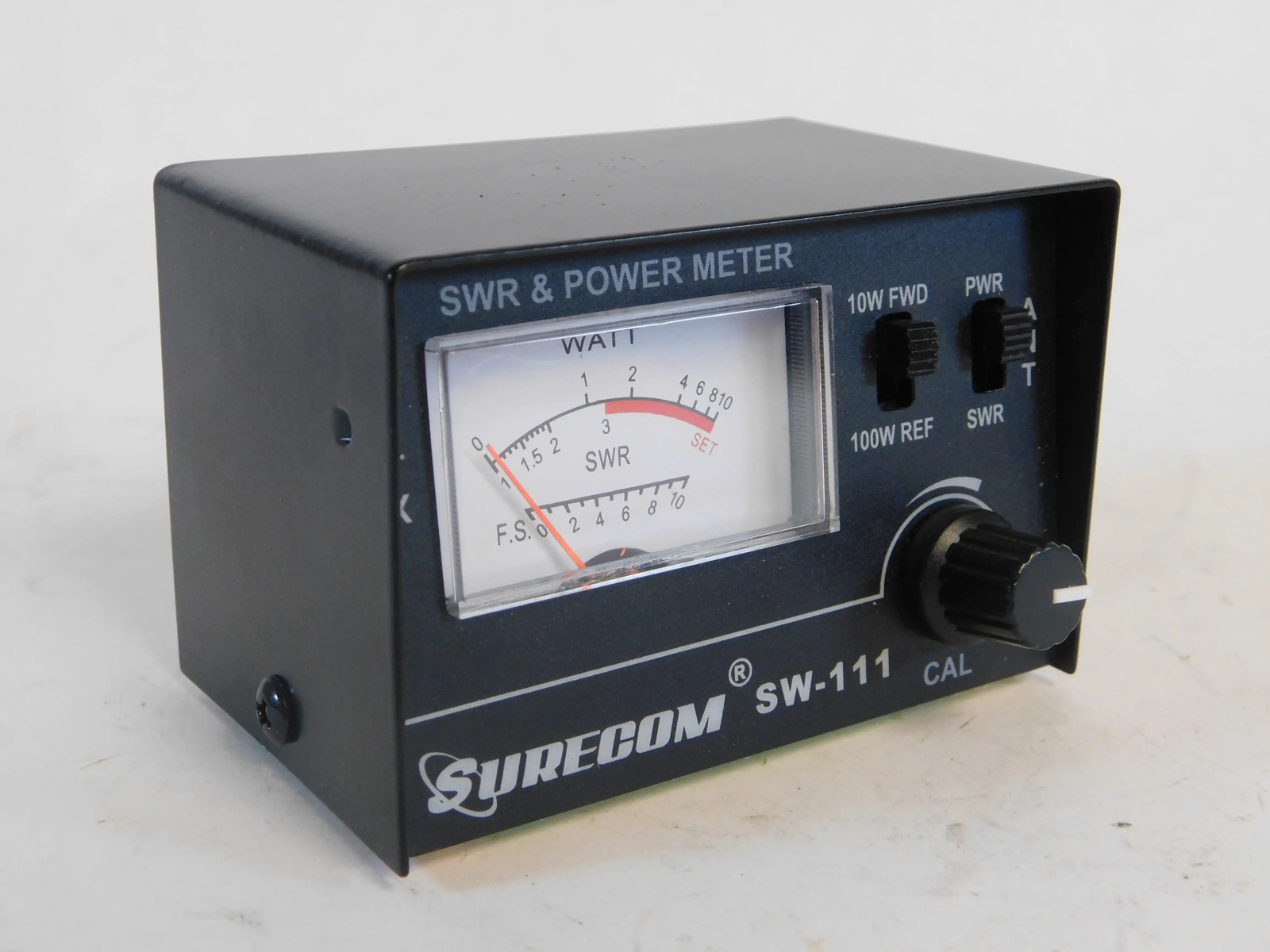

Photos from current listings. Actual item, color, and included accessories may vary.
Ham Radio Swr Meter Buying Guide
An SWR meter measures the standing wave ratio between a transmitter and antenna, revealing mismatch that wastes power and stresses the radio's final amplifier. The key trade-off is analog cross-needle simplicity versus digital precision and band coverage — cheap meters often have poor calibration and limited frequency range. Choose a meter rated for your exact bands and power level from a brand with published accuracy specs; skip unbranded units with no calibration data.
Key takeaways
- Cross-needle analog meters (e.g., Daiwa CN-101L, Surecom SW-111) display forward and reflected power simultaneously without switching, letting you read SWR directly at the needle intersection.
- Frequency coverage is the first spec: HF-only meters (1.8–30 MHz) like the Diamond SX-100 won't work on VHF/UHF; dual-band models add 144/430 MHz but often with reduced accuracy.
- Power rating must exceed your rig's output with headroom: typical ham transceivers run 100 W HF / 50–75 W VHF, so a 200 W meter prevents overload damage during tuning.
At a glance
- Category
- RF, Network, Cable & Telecom Test
- Last updated
- Nov 28, 2026
Current offers
Highlights
- Cross-needle analog meters (e.g., Daiwa CN-101L, Surecom SW-111) display forward and reflected power simultaneously without switching, letting you read SWR directly at the needle intersection.
- Frequency coverage is the first spec: HF-only meters (1.8–30 MHz) like the Diamond SX-100 won't work on VHF/UHF; dual-band models add 144/430 MHz but often with reduced accuracy.
- Power rating must exceed your rig's output with headroom: typical ham transceivers run 100 W HF / 50–75 W VHF, so a 200 W meter prevents overload damage during tuning.
- Digital meters with PEP (peak envelope power) hold and backlit LCDs cost more but give repeatable readings; analog meters need zeroing and are sensitive to needle parallax.
Best use cases
- HF base-station operator with a 100 W transceiver and wire/dipole antenna: pick a 1.8–30 MHz cross-needle meter rated 200 W, skip VHF/UHF coverage you won't use.
- VHF/UHF mobile or handheld user on 2 m/70 cm: choose a dual-band meter covering 144–450 MHz rated for at least 50 W, skip HF-only models.
- QRP operator running 5–10 W: select a meter with a low-power range (e.g., 0–20 W forward) for readable resolution; a 200 W-only meter will barely move the needle.
- Antenna experimenter who needs PEP readings and precise digital SWR: buy a digital meter with PEP hold, skip budget analog units with vague accuracy claims.
Buying tips
- Match frequency range to your bands: HF-only 1.8–30 MHz for base rigs, 144/430 MHz coverage for VHF/UHF, or a dual-band meter if you operate both.
- Pick a power rating at least double your transmitter output — a 200 W meter for a 100 W rig — so reflected power spikes during tuning don't damage the sensor.
- Verify the meter's accuracy spec (typically ±5–10% of full scale) and prefer brands that publish it; unbranded meters often lack calibration data.
- For digital models, confirm PEP (peak) reading capability and battery type; analog cross-needle meters need no power but require zero adjustment before use.
Specs
| Frequency Range | HF 1.8-30 MHz / VHF-UHF 144-450 MHz |
|---|---|
| Power Rating | 100-200 W typical; 20 W QRP range |
| Display Type | Cross-needle analog vs digital LCD |
| Connector | SO-239 (UHF female) standard |
Related searches
What to check before buying
- Confirm your transceiver's maximum output power (e.g., 100 W HF, 50 W VHF) and choose a meter rated above it.
- List the exact bands you operate (HF 1.8–30 MHz, 2 m/70 cm) and verify the meter's frequency range covers all of them.
- Check connector type: most ham meters use SO-239 (UHF) female; confirm your coax jumpers match or budget for adapters.
- Decide whether you need PEP/digital readout or accept analog cross-needle; analog needs no batteries but digital adds backlight and hold.
FAQ
Data sources: eBay / Amazon listings and product attribute feeds. Updated Nov 28, 2026.
Some links on this page are affiliate links. If you buy after clicking one, we may earn a commission at no extra cost to you. This does not change which products appear here or their order. Affiliate disclosure.