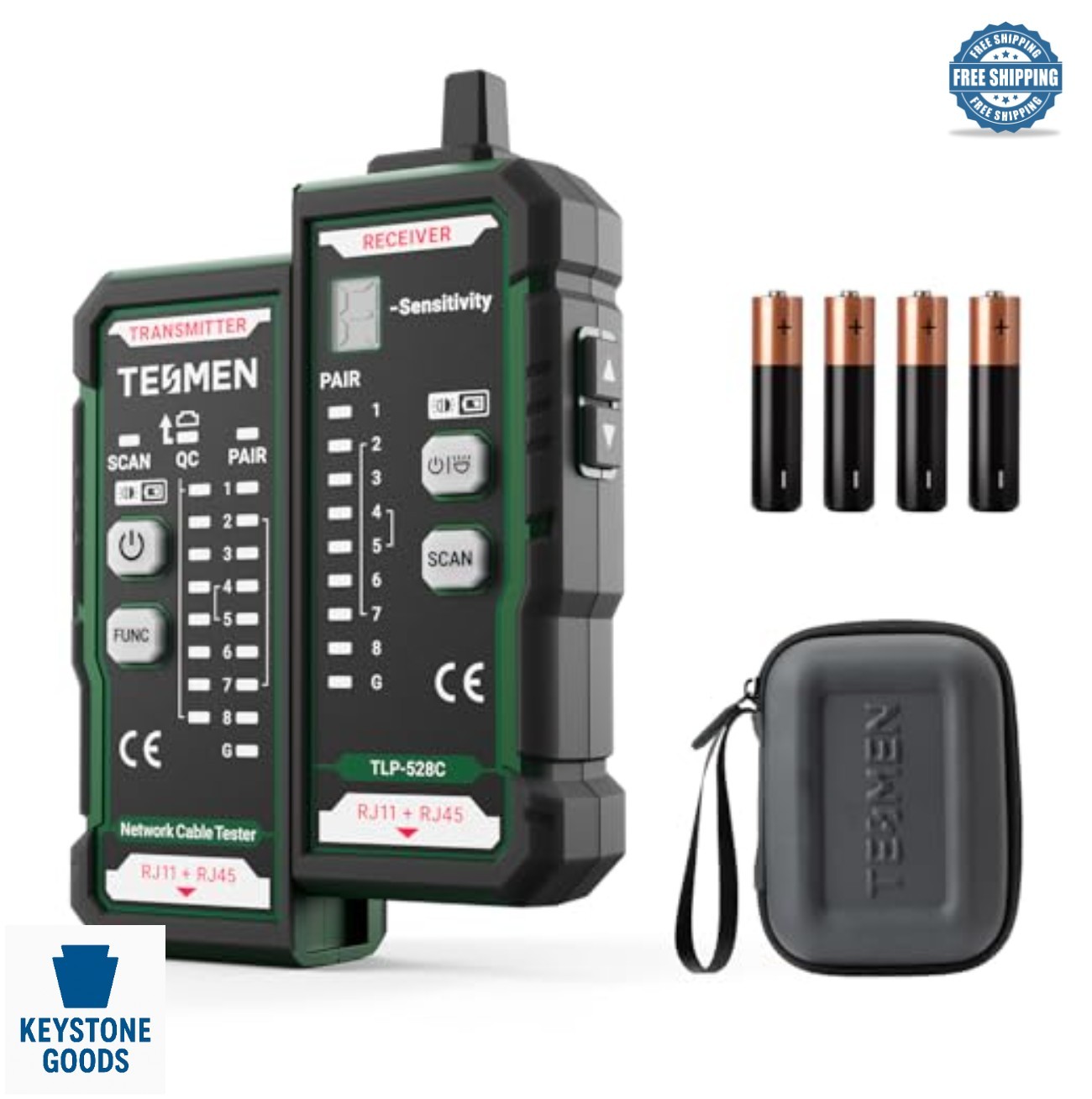

Photos from current listings. Actual item, color, and included accessories may vary.
LAN Cable Buying Guide
A LAN cable tester verifies continuity, pinout, and fault location on twisted-pair Ethernet and telephone cabling. The core trade-off is basic LED continuity testing versus advanced TDR length/POE diagnostics. Choose a simple known-good verifier for pass/fail termination checks; step up to TDR or POE-capable units only when you must locate breaks or validate powered links.
Key takeaways
- RJ45 continuity testers verify pin-to-pin mapping and detect opens, shorts, and crossed pairs but cannot report cable length or distance-to-fault.
- TDR (time-domain reflectometry) testers measure cable length and locate faults by reflecting a pulse; accuracy typically within a few percent of total length.
- PoE testers detect and display voltage/current on powered pairs, confirming whether a switch is delivering power before connecting a device.
At a glance
- Category
- RF, Network, Cable & Telecom Test
- Last updated
- Nov 28, 2026
Current offers
Highlights
- RJ45 continuity testers verify pin-to-pin mapping and detect opens, shorts, and crossed pairs but cannot report cable length or distance-to-fault.
- TDR (time-domain reflectometry) testers measure cable length and locate faults by reflecting a pulse; accuracy typically within a few percent of total length.
- PoE testers detect and display voltage/current on powered pairs, confirming whether a switch is delivering power before connecting a device.
- Klein Tools LAN Scout Jr. 2 supports CAT5e/CAT6/CAT6A RJ45 with tone generation; budget LED testers commonly cover CAT5-CAT7 continuity only.
Best use cases
- Home or office installer terminating patch cables: pick an RJ45/RJ11 continuity tester with remote terminator; skip TDR unless you also run in-wall cabling.
- Network tech troubleshooting long horizontal runs: choose a TDR tester with length readout and distance-to-fault; basic LED units leave you guessing where the break is.
- PoE camera or access-point deployment: select a tester with PoE voltage/current detection; a plain continuity tester cannot confirm power delivery.
- Telephone/DSL wiring work: ensure RJ11/RJ12 support alongside RJ45; RJ45-only testers cannot verify phone pair pinouts.
Buying tips
- Match tester category rating to the cable you install: CAT6A links need testers rated to CAT6A or higher; CAT5e-only testers may not verify 10G-relevant pair mapping.
- For runs over roughly 30 m, choose TDR with length display; continuity-only testers cannot distinguish a far break from a near one.
- Confirm the tester includes a remote terminator unit; single-ended testers require walking to both ends, doubling labor on long runs.
- Check connector support: RJ45 plus RJ11/RJ12 covers Ethernet and phone; add BNC or coax only if you also service CCTV or video cabling.
Specs
| Test Method | Continuity LED vs TDR length/fault |
|---|---|
| Cable Categories | CAT5e / CAT6 / CAT6A / CAT7 |
| Connector Support | RJ45 + RJ11/RJ12 (combo units) |
| PoE Testing | Voltage/current detect vs continuity only |
Related searches
What to check before buying
- Count the cable types you service (RJ45 Ethernet, RJ11/RJ12 phone, coax) and confirm the tester lists every needed connector.
- Measure your longest run; if over 30 m, require TDR length and distance-to-fault readout.
- If deploying PoE devices, confirm the tester displays PoE voltage and current, not just continuity.
- Verify the tester ships with a remote terminator and battery type; rechargeable units need USB-C or included charger.
FAQ
Data sources: eBay / Amazon listings and product attribute feeds. Updated Nov 28, 2026.
Some links on this page are affiliate links. If you buy after clicking one, we may earn a commission at no extra cost to you. This does not change which products appear here or their order. Affiliate disclosure.