The decision: drying with hot air or evaporating under vacuum
When you're organizing lab heating, cooling, and vacuum equipment, the first real fork is process: do you need to dry and heat items in a hot-air stream, or do you need to remove solvent under reduced pressure? The forced-air convection drying oven and the rotary evaporator both sit in that lab workflow family, but they solve entirely different problems. Pick by process, not by price, and you'll end up with the tool that actually fits your bench.
Quick verdict
If your daily bottleneck is drying glassware, powders, or small parts, the forced-air convection drying oven is the more direct pick. It lists at USD 299.00 and has an idealized 250°C ceiling. If your daily bottleneck is solvent removal, the rotary evaporator lists at USD 516.99 and is built to work with a vacuum pump and chiller. The listed-price gap is USD 217.99, but the functional gap is much wider.
Comparison at a glance
| Decision point | 16L Drying Oven | 2L Rotary Evaporator |
|---|---|---|
| Listed price | USD 299.00 | USD 516.99 |
| Process | Forced-air convection drying | Rotary evaporation under reduced pressure |
| Working capacity | 16L effective volume; 25 x 25 x 25 cm chamber | 1L evaporation flask; 1L collecting bottle |
| Heat handling | RT+10 to 250°C; 0.1°C resolution; ±0.2°C fluctuation | High-temperature-resistant glass |
Where each product wins
Where the drying oven wins
The drying oven wins whenever your deliverable is a dry sample, clean glassware, or a heat-treated part. The timer can be set from 0 to 999 minutes or left on continuous operation, so you are not tied to a stopwatch. For labs already on 110V/60Hz mains, the listed power input is a direct fit. And with 0.1°C resolution and ±0.2°C fluctuation, you get temperature control that is useful when a drying process needs repeatable heat.
Where the rotary evaporator wins
The rotary evaporator wins when the task is concentrating a solution or removing solvent under reduced pressure. The manual lift gives you direct control over raising and lowering the flask assembly. The 1L evaporation flask and 1L collecting bottle keep batch sizes predictable, and the high-temperature-resistant glass is appropriate for heated solvent work. If your lab's output is concentrated solutions or recovered solvent, this is the tool that matches that workflow.
Product notes
16L Digital Forced Air Drying Oven
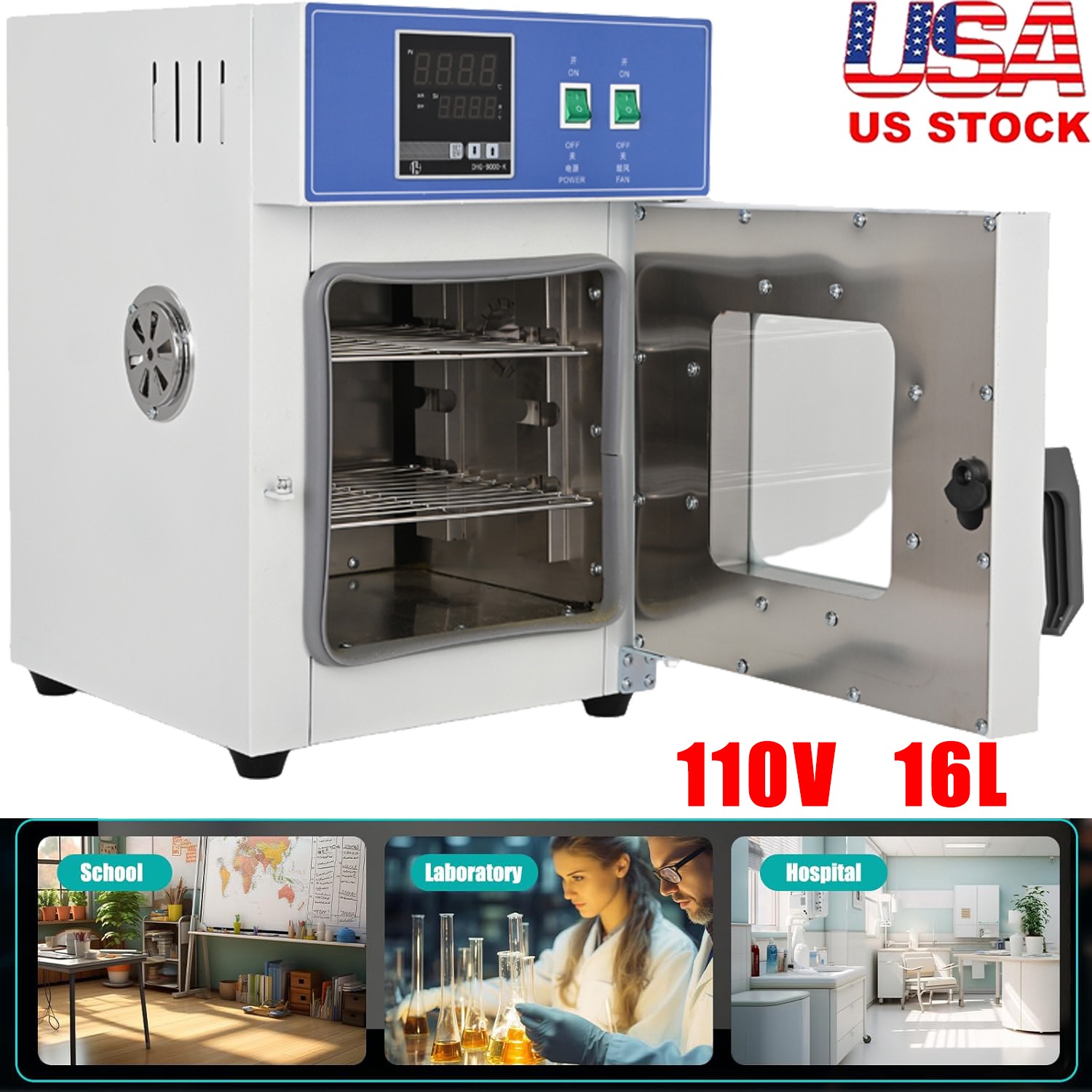
If your lab's routine is drying and heating through hot-air circulation, this oven is the direct tool. The inner chamber is stainless steel and the outer frame is spray-coated steel plate. The digital controller includes a timing range from 0 to 999 minutes or continuous operation, so you can run a drying cycle and walk away. Stainless steel shelves sized at 24 x 24 cm give you a flat, clean surface for trays and parts. The listed power input is AC 110V, 60Hz at 500W, so it is built for that electrical standard rather than a universal 220V bench. Choose it when your goal is a dry, heat-treated result rather than solvent recovery.
2L Rotary Evaporator with Manual Lifting
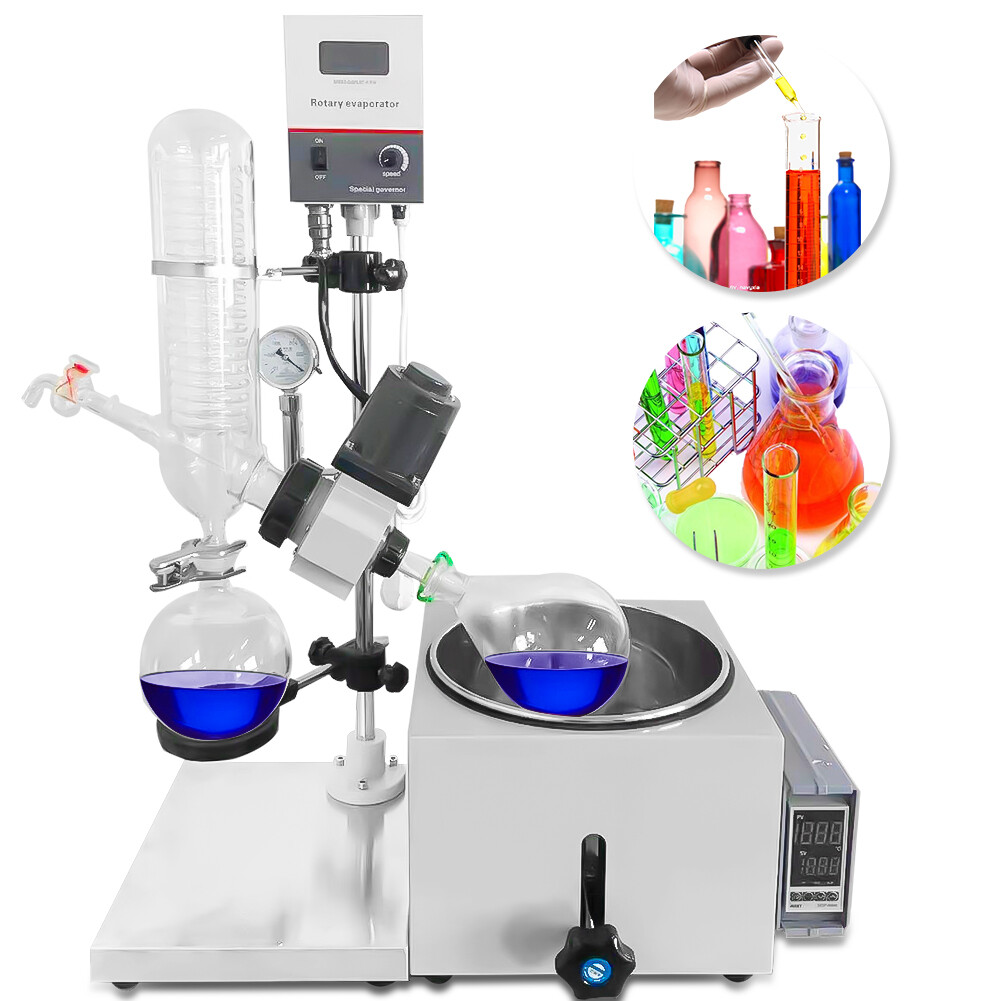
If your process is solvent removal, this rotary evaporator is built for the job. The stainless steel bracket holds the assembly while the manual lift lets you raise and lower the flask setup, giving you hands-on control during evaporation. It is designed to connect to a vacuum pump and chiller, which is the practical core of a rotovap workstation. The Taishi name gives you a manufacturer to research, and the overall design is aimed squarely at gentle solvent recovery. The limitation is scale: this system is sized for small-batch work, not for concentrating large volumes. Choose it when you need to pull solvent off a reaction mixture rather than dry items in a hot-air chamber.
Final choice by use case
Pick the forced-air drying oven for hot-air drying and heating of glassware, powders, and small parts. Pick the rotary evaporator for solvent removal and concentration in small-batch work. There is no single winner because the two tools handle different processes; the right choice depends on which operation you run most often.