When you're shopping for environmental indoor air measurement, the first fork in the road is broad versus focused. Do you want one sensor that covers a handful of gas and particle indicators, or a dedicated device that zeroes in on three specific particle sizes? That tension is exactly what separates these two monitors: the 9-in-1 Air Quality Monitor and the PM0.3/2.5/10 Dust Particle Counter.
Quick verdict
Choose the 9-in-1 Air Quality Monitor if you want CO2, PM2.5, TVOC, and formaldehyde readings from a single device with an LED display, and you don't need a full PM0.3/PM10 breakdown. Choose the PM0.3/2.5/10 Dust Particle Counter if you're more worried about airborne particles-especially tiny PM0.3-and you want a dedicated three-channel particle monitor.
At a glance
| Consideration | 9-in-1 Air Quality Monitor | PM0.3/2.5/10 Particle Counter |
| Price | USD 38.80 | USD 159.99 |
| Named sensors | CO2, PM2.5, TVOC, HCHO | PM0.3, PM2.5, PM10 |
| Device type | Air Quality Monitor | Air Particle Counter |
Read the two approaches differently: the 9-in-1 monitor is a broad environmental indoor air measurement tool, while the particle counter is a specialized instrument. If you want to know whether a room feels stuffy or smoky, the 9-in-1 is the quicker read. If you want to know how many particles are floating in a specific size range, the particle counter is the clearer data source.
The particle counter's feature set includes laser-scattering measurement, temperature and humidity sensing, and a 999-data trend chart. The 9-in-1 monitor keeps the cost down and spreads its readings across gases and PM2.5.
Where each product wins
Where the 9-in-1 monitor wins
It covers more types of indoor irritants in one purchase. You can watch CO2 build up in a bedroom and check TVOC or formaldehyde after painting, while also seeing PM2.5. For someone who wants a broad air-quality overview, this is the natural fit.
Where the particle counter wins
It delivers a more granular view of the particles that often trigger allergies: PM0.3, PM2.5, and PM10. The device is built around particle-size detail, so it gives you a clear picture of fine dust that the 9-in-1 monitor's PM2.5-only snapshot cannot provide.
Product notes
9-in-1 Air Quality Monitor
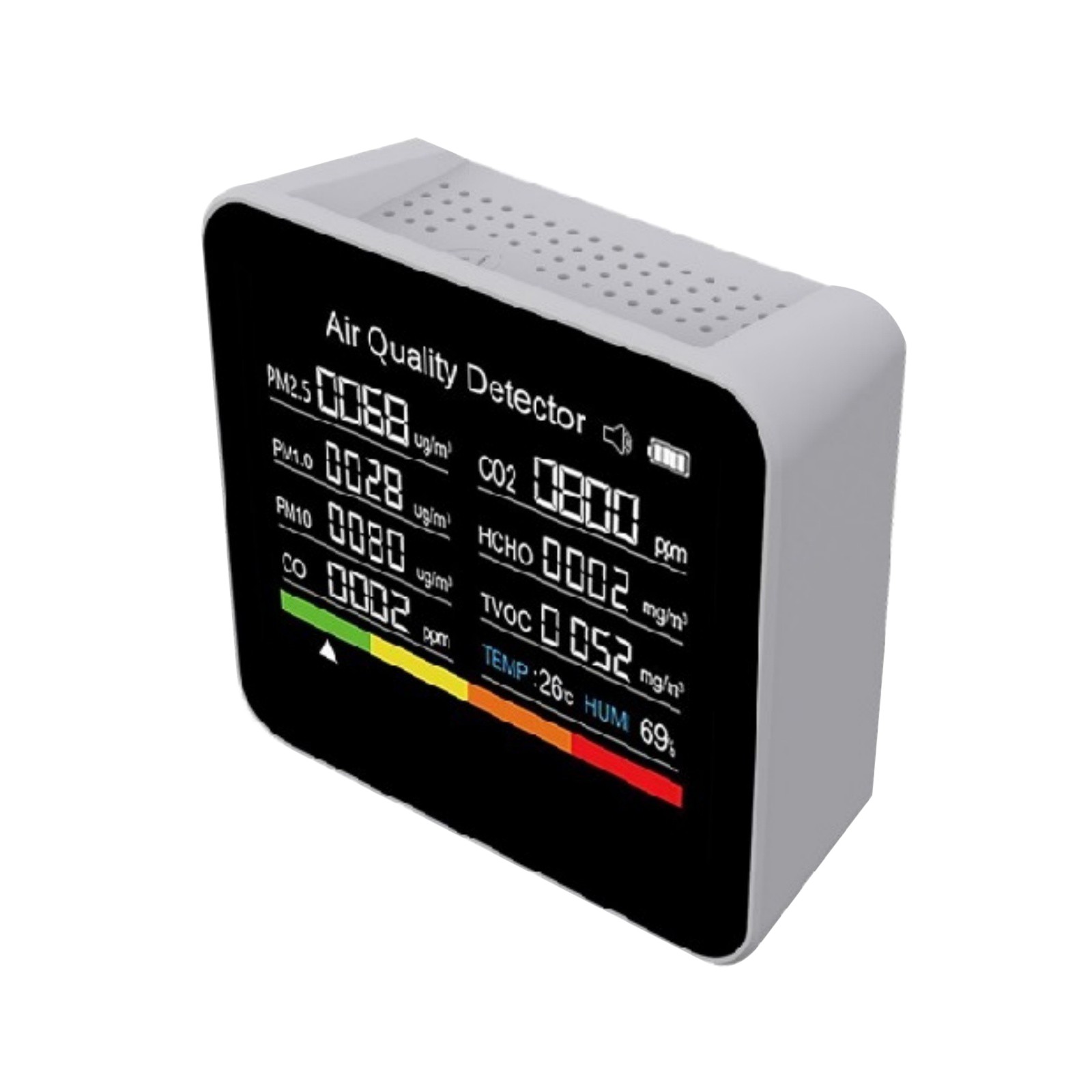
The 9-in-1 monitor combines CO2, PM2.5, TVOC, and formaldehyde sensing in one unit, with an LED display for quick glances. That makes it a sensible first monitor for a nursery, living room, or rental apartment where you want a quick sense of air quality without obsessing over fine particle counts. The LED readout keeps the interface straightforward, and the multi-sensor approach reduces the number of devices you need. Its main limitation is the particle-size story: it names PM2.5 but not PM0.3 or PM10, so you won't get the full size distribution. If your concern is a mix of gases and dust rather than ultrafine particles, this is the simpler, more compact answer.
PM0.3/2.5/10 Dust Particle Counter
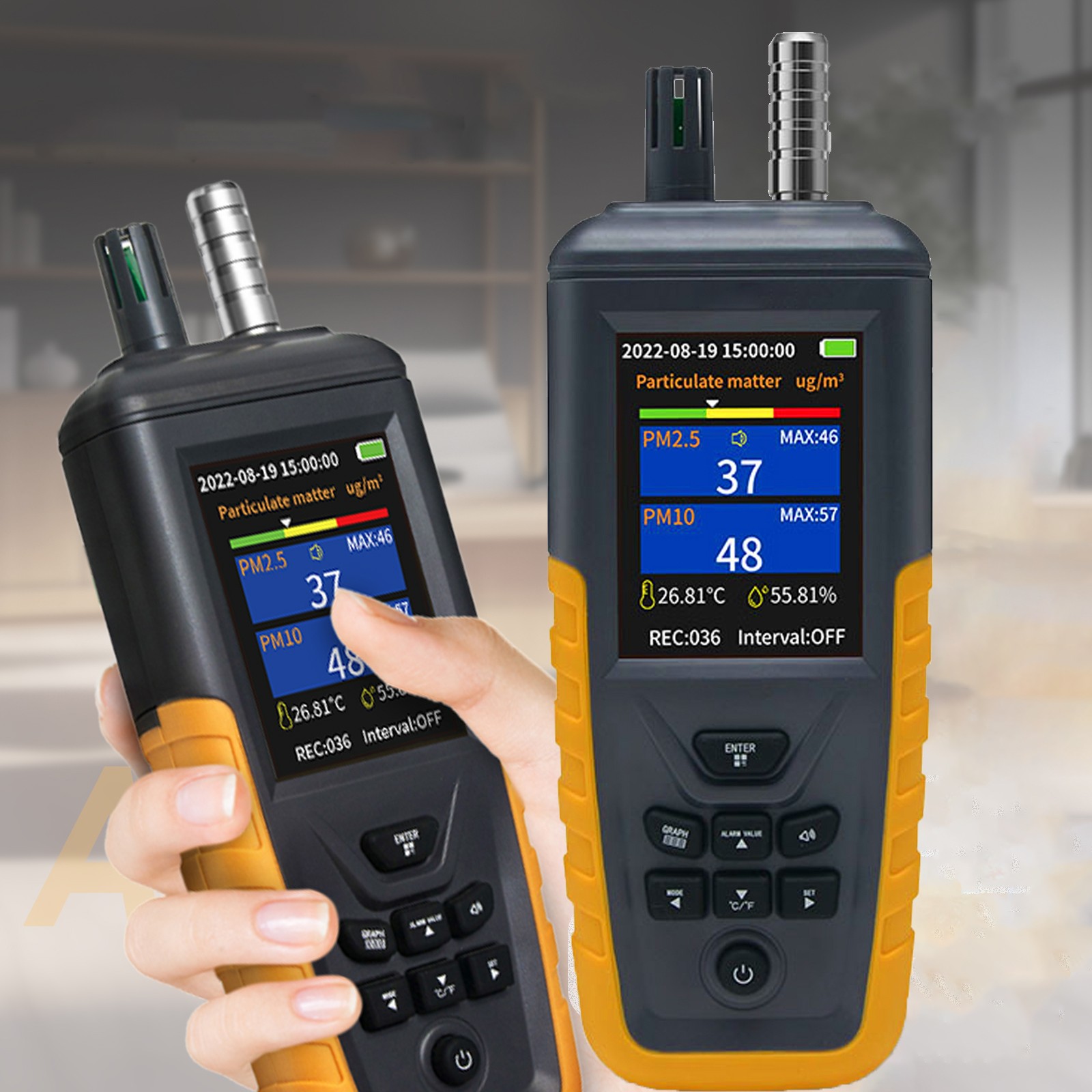
This counter is for anyone who has graduated from "is the air okay?" to "exactly what is in it?" It uses laser scattering to measure the smallest particles, PM0.3, plus PM2.5 and PM10. It also logs temperature and humidity, stores 999 data sets, and sounds an adjustable alarm, so it's easy to watch particle changes over time. The trend chart and alarm are especially useful if you're running an air purifier and want evidence that it's working. The trade-off is scope: this device is all about particles, not gases. It won't tell you about CO2, TVOC, or formaldehyde. Choose it when you need particle data to back up decisions about air purifiers, dust control, or allergen management.
Final choice by use case
- If you want mixed gas and particle monitoring for a home, bedroom, or office, and you prefer to spend only $38.80, pick the 9-in-1 Air Quality Monitor.
- If you're tracking fine particle trends, want three particle-size channels plus logging and a threshold alarm, and you can invest $159.99, choose the PM0.3/2.5/10 Dust Particle Counter.