Centrifuges are the quiet workhorses of labs and clinics, spinning samples to separate liquids from solids, emulsions into layers, or wet solids from excess fluid. The decision problem is usually speed: do you need a high-revving microcentrifuge for delicate cell pellets, or will a basic desktop machine cover your everyday runs? The Segawe Desktop 800-1 Electric Centrifuge Machine sits on the lower end of the speed range, so the question is whether its top speed is enough for your work.
Quick verdict
The Segawe Desktop 800-1 is a straightforward centrifuge for routine lab separation. At USD 56.19, it packs a 4,000 rpm motor, a timer, and a compact desktop design into one unit. It won't handle high-g work, but for separating suspended solids, breaking emulsions, or removing water from wet materials, it's a functional choice. If you're looking for a simple first centrifuge or a dedicated spinner for routine tasks, this model delivers the basics without a steep learning curve.
Who it suits
This centrifuge fits small labs, medical office settings, teaching spaces, and production departments that need a no-fuss spin for liquids and solids. Its gentle spin makes it well suited to sedimentation and emulsion separation, especially when you want to keep run lengths consistent without monitoring. It's also a good match for applications where you're working with larger volumes of suspension and don't need the forces of a high-speed unit.
What stands out from the listed details
Desktop 800-1 Electric Centrifuge Machine
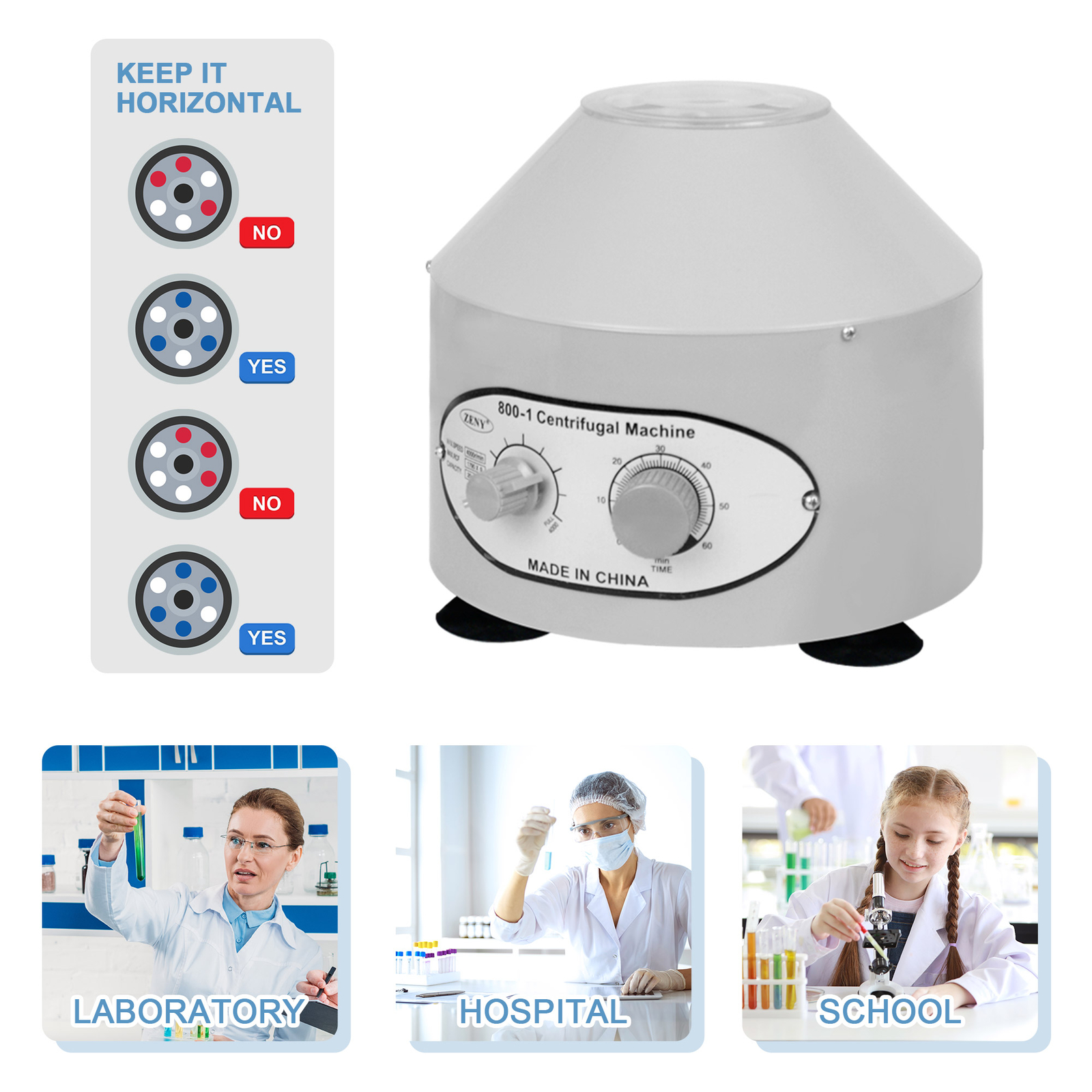
This Segawe model combines a 4,000 rpm low-speed motor with a built-in timer in a desktop package. It separates solids from liquids, handles emulsions like cream and milk, and can remove wet solid from liquid through centrifugal force. Designed for medical laboratory settings, it comes in new condition and is priced at USD 56.19.
If you need a basic centrifuge for routine low-speed separation, the price alone is a strong reason to choose it. The timer adds convenience for repeatable runs, and the compact footprint fits on a bench without needing special installation. The 4,000 rpm speed is appropriate for coarse separations where you're letting settling do the work-just at a faster rate.
The limiting factor is the top speed of 4,000 rpm. This is a low-speed centrifuge, not a high-speed research machine. It won't produce the high relative centrifugal force needed to pellet fine particles or process dense samples quickly. For that kind of work, you'd need a faster unit.
Meaningful trade-offs
The trade-off is between speed and simplicity. The motor handles basic separations but can't tackle tasks that need high centrifugal force. For everyday wet-solid removal and liquid-suspension separation, this desktop centrifuge is a practical choice. The speed limitation is the main constraint to plan around.
Bottom line
The Desktop 800-1 Electric Centrifuge Machine is a reasonable purchase for a lab or medical workspace that needs basic low-speed separation. Its speed and price make it easy to get started. Just keep its speed ceiling in mind: it's a simple workhorse, not a high-performance research tool. If your daily work only needs gentle, repeatable low-speed spins, this centrifuge offers a solid entry into lab separation.