If you're researching centrifuges mixers shakers, the first fork in the road is usually between an overhead stirrer and an orbital shaker. Both move liquids, but they do it in completely different ways. An overhead stirrer spins a shaft and impeller directly in the fluid, making it a natural fit for thicker, larger-volume mixtures. An orbital shaker moves a platform in a circular motion, creating a gentle wave that suits cell cultures, dissolving solids, and temperature-controlled experiments. The price spread in this comparison is wide, and the best choice depends on the kind of motion your work actually needs.
Quick Verdict
Choose the Electric Overhead Stirrer Max.40L Digital Lab Mixer when you're blending heavy materials, need high torque, and want to work with volumes up to 40 liters. Choose the Digital Orbital Shaker Oscillator Adjustable 40-200 RPM when you need low-speed, gentle oscillation that can fit inside an incubator. If price is your primary constraint, the overhead stirrer is the lower-priced of the two.
Comparison Table
| Consideration | Electric Overhead Stirrer | Digital Orbital Shaker |
|---|---|---|
| Price | USD 89.02 | USD 259.99 |
| Price bar | ||
| Motion type | Overhead stirring | Orbital shaking |
| Best for | Heavy, large-volume mixing | Gentle, low-speed shaking |
Where Each Product Wins
- The Electric Overhead Stirrer wins when the job demands pushing a stirring shaft through viscous, heavy liquids. It is built around a powerful motor and a large mixing volume, which makes it the more capable tool for serious benchtop mixing.
- The Digital Orbital Shaker wins when you need a compact, controlled shaking platform. Its low RPM ceiling is a feature, not a flaw, for protocols that call for gentle motion at a steady speed inside a confined space.
Product Notes
Electric Overhead Stirrer Max.40L Digital Lab Mixer Time & Speed Adjustable 120W
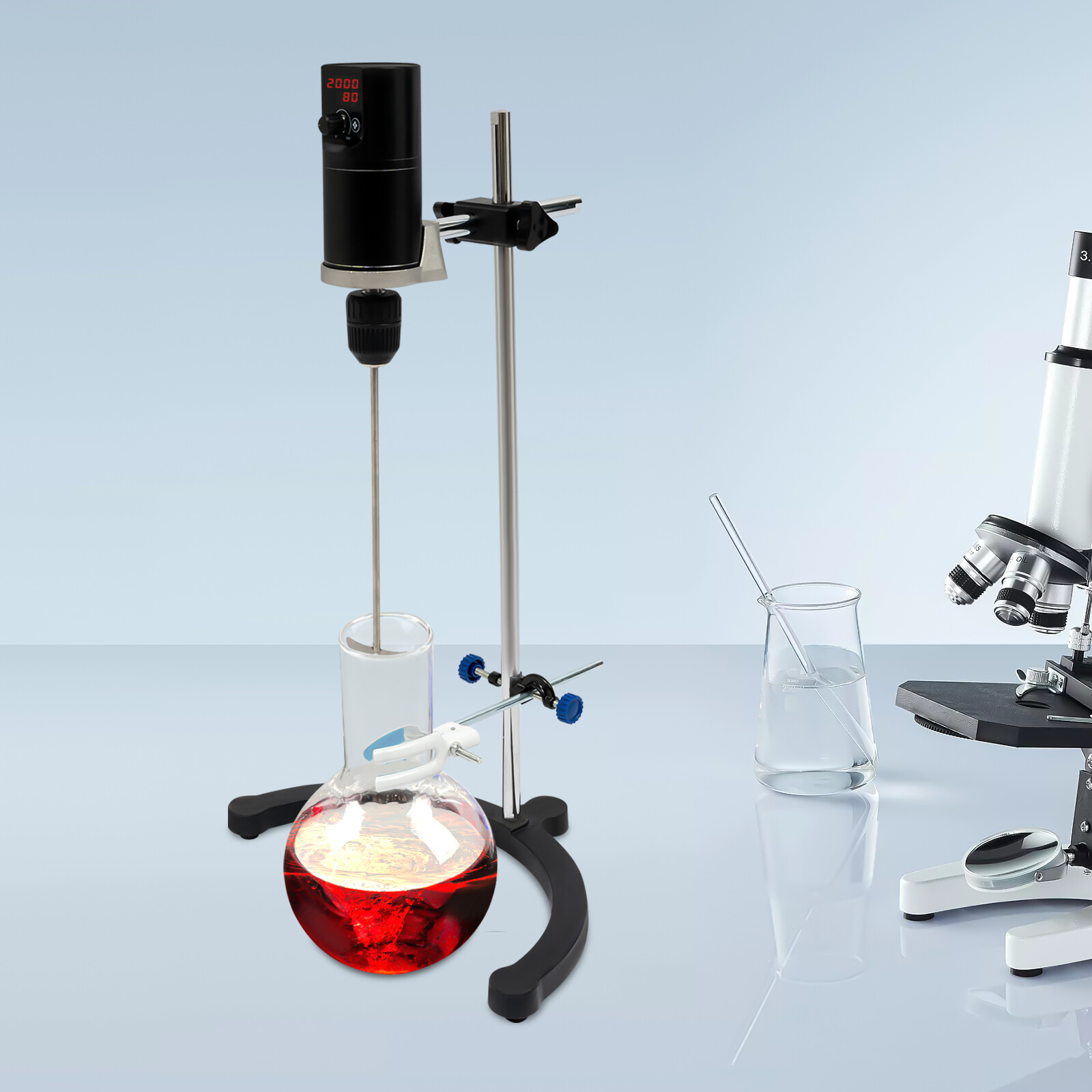
At its $89.02 price, this overhead stirrer is the more affordable way to take on substantial mixing projects. The 120W DC permanent magnet motor, 40L/10.57gal maximum mixing volume, and 40N·cm torque rating all point toward large-scale work with thicker liquids. The maximum viscosity of 30000mPa.s is a useful reference if you work with thicker liquids. The digital tube screen and time/speed adjustments give you direct control, and the drill clamping diameter range of 0.8-10mm/0.03-0.39in accommodates a variety of standard stirring shafts. If your experiments require high-speed stirring rather than gentle rocking, this is the unit to keep on the bench. The main limitation is its motion type: because it stirs in place, it cannot provide the orbital shaking action needed for cell cultures, incubator work, or low-speed sample mixing.
Digital Orbital Shaker Oscillator Adjustable 40-200 RPM Lab Oscillating Shaker
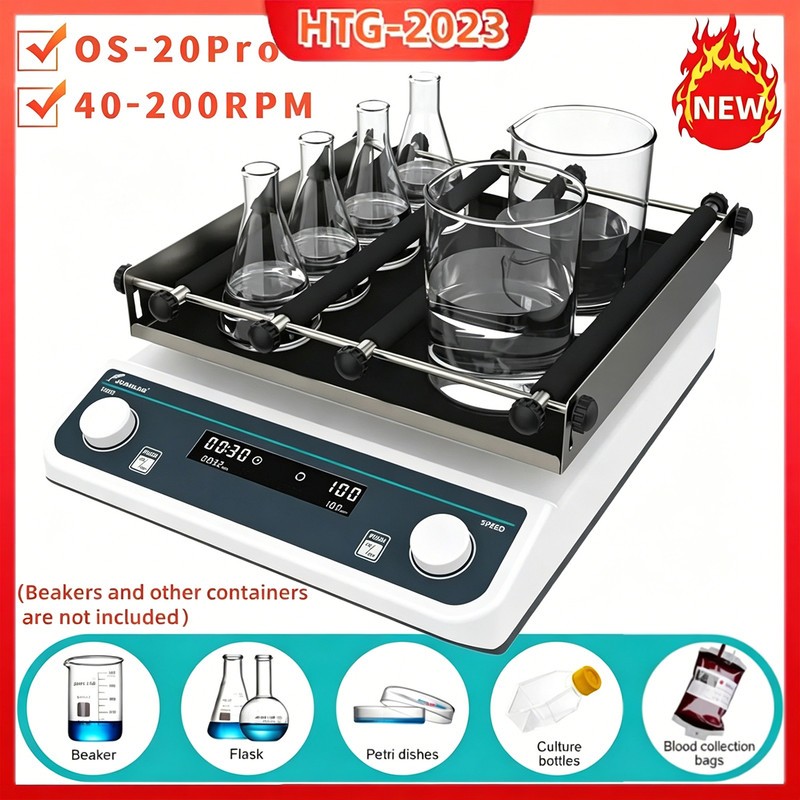
The JOANLAB OS-20Pro is built for the opposite end of the motion spectrum. Its speed range is deliberately held to 40-200 RPM, which makes it a good match for gentle, uniform shaking rather than high-speed blending. The DC brushless motor keeps the unit operating quietly and stably, and the compact design allows it to be placed inside an incubator or oven for temperature-controlled runs. The digital panel provides both speed and time control, so you can set a steady oscillation and let it run. If your work involves dissolving, mixing in flasks, or maintaining cultures at low speeds, this shaker delivers that motion with less stress on the samples. The trade-off is that its 200 RPM ceiling is far below what the overhead stirrer offers, so it will not handle thick, high-torque mixing tasks.
Final Choice by Use Case
- For large-volume, high-viscosity mixing: choose the Electric Overhead Stirrer Max.40L Digital Lab Mixer.
- For gentle, low-speed orbital shaking in an incubator: choose the Digital Orbital Shaker Oscillator Adjustable 40-200 RPM.
- If your daily work is stirring and you want the lower-priced option, the overhead stirrer is the straightforward pick.