Choosing between a lab stirrer and a lab shaker comes down to motion, not just price. An overhead stirrer drives a shaft down into a vessel to mix thick liquids, while an orbital shaker moves an entire platform in a horizontal circle for gentler, smaller-scale work. The two bench tools here are only $13.92 apart in listed price, but they serve very different mixing jobs.
Quick verdict
Pick the overhead stirrer if you need to move larger volumes and thicker liquids. Pick the orbital shaker if your samples are lighter and need gentle horizontal motion. Both are new, adjustable-speed lab mixers, but they are not interchangeable.
Comparison at a glance
| Feature | Overhead stirrer | Orbital shaker |
|---|---|---|
| Listed price | USD 135.00 | USD 148.92 |
| Motion | Overhead shaft stirring | Horizontal orbital oscillation |
| Speed range | 100-2000 RPM | 0-210 r/min |
| Max capacity | 40L | 1kg/2.2 lbs |
| Weight | 11.9 lb | 7.94 lb |
Where each product wins
The overhead stirrer wins for heavy, high-volume mixing. It is rated for up to 40L and 10000 mPa·s, with a 40N·cm max output torque and a 100-2000 RPM speed range. The adjustable stand height, from 11.8 to 23.6 inches, lets you position the shaft over different vessel sizes without dedicating a permanent rig.
The orbital shaker wins for gentle, small-sample shaking. Its 0-210 r/min range is oriented toward slower horizontal motion, and its 1kg/2.2 lbs maximum sample processing capacity fits smaller containers. The large workbench and DC gear motor make it a convenient bench-side companion for jobs that do not need a high-torque shaft.
A closer look at each mixer
Overhead stirrer
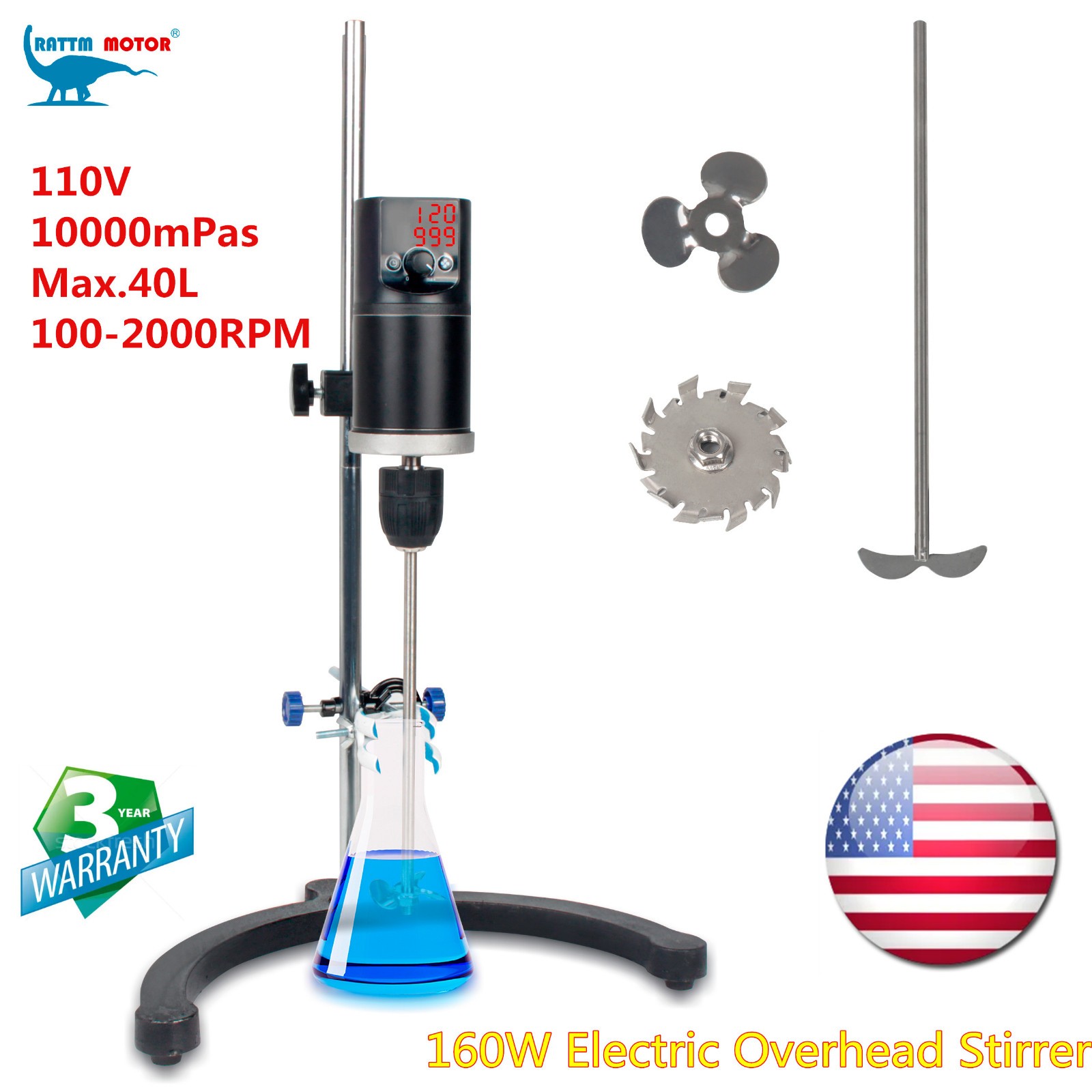
The overhead stirrer earns its place by taking on thicker, larger-volume mixing jobs. If your process revolves around big batches of thick liquids, this is the direction to look. Its high-viscosity rating and output torque are backed by an adjustable motor stand, letting you raise or lower the shaft to match the vessel height. The main limitation is geometry: it mixes at one central shaft, so the workflow is centered on a single vessel rather than a tray of samples. It is also the heavier unit of the pair, which suits a taller stand but makes it less portable.
Orbital shaker

The orbital shaker earns its keep with gentle horizontal motion across a whole platform at once. A DC gear motor and eccentric ball bearings support stable oscillation, and the large workbench lets you place several small containers in a single run. Its main limitation is load: it is not built for high-viscosity liquids or large volumes, so you would be overreaching if you tried to use it for heavy mixing. It also draws modest power, which keeps it economical for bench-side shaking but reinforces that it is a small-sample tool.
Final choice by use case
Choose the overhead stirrer when your work centers on thick liquids and larger batches. Choose the orbital shaker when your samples are small and need gentle horizontal motion. The two mixers overlap in being adjustable and new, but the motion type and load capacity put them in different lanes.