When you're comparing environmental indoor air measurement tools, price is one of the first things that separates them: the options here run from USD 30.00 to USD 159.99. The real question is whether you need deep particle data or broad pollutant visibility. These two units take opposite approaches, so the right pick depends on what you plan to track and how you want to see the results.
Quick verdict
Go with the Air Quality Monitor, PM0.3/2.5/10 Dust Particle Counter if precise particle readings and data history matter most. Go with the 16-in-1 Air Quality Monitor if you'd rather have broad readings and alert buzzers on one screen.
If you want to see the exact differences side by side, here's a compact comparison of the two units.
At a glance
| PM0.3/2.5/10 Counter | 16-in-1 Monitor | |
|---|---|---|
| Listed price | USD 159.99 | USD 30.00 |
| Listed condition | New | New - Open box |
| Measurement focus | PM0.3, PM2.5, PM10 plus temperature and humidity | CO2, TVOC, PM2.5, PM1.0, PM10, HCHO, temperature, humidity, AQI, and time |
| Notifications | Adjustable audible alarm | Seven AQI alert buzzers |
| Display and history | 999 timestamped readings with trend chart | 7-inch display |
Where each product wins
The PM0.3/2.5/10 counter wins when you're tracking allergen particles and want a stored history of readings. The 16-in-1 monitor wins when you want a single screen that covers common indoor pollutants and gives you direct alerts. For a household focused on one type of measurement, the counter gives more depth; for a household that wants a dashboard, the monitor gives more breadth.
Air Quality Monitor, PM0.3/2.5/10 Dust Particle Counter
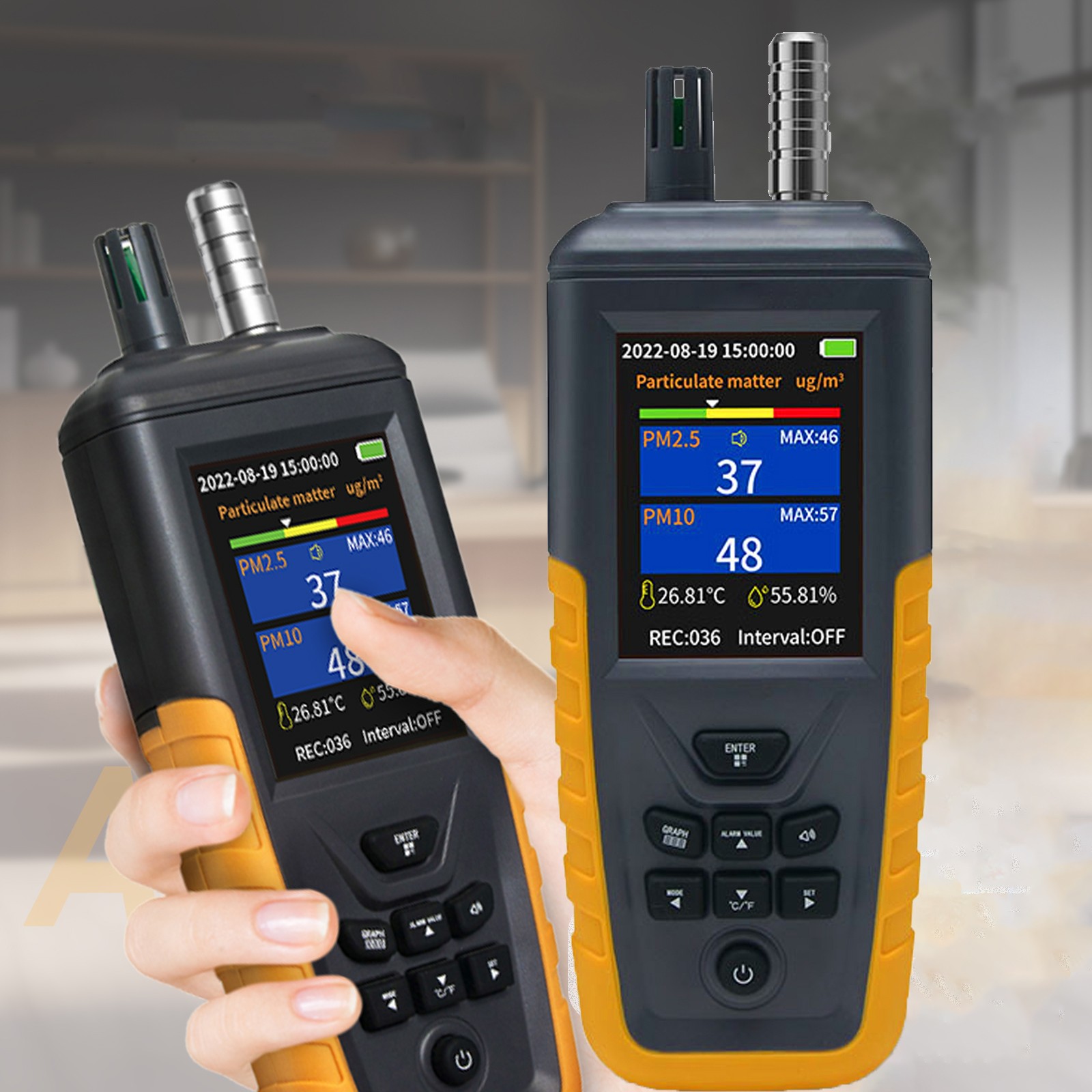
This is the unit to pick when you want measurements centered on particles. It uses laser scattering to report PM0.3, PM2.5, and PM10 in real time, with an accuracy of ±12μg/m³. It also tracks temperature and humidity, stores 999 timestamped measurements, and shows trends on a chart, so you can spot patterns rather than just react to a number. The audible alarm can be set to trigger when your chosen thresholds are exceeded, which is helpful for allergy season or room-by-room checks. The trade-off is scope: its described three-in-one function is about particles, temperature, and humidity, so you won't get the same broad pollutant panel that the 16-in-1 offers. If you're already thinking about CO2, TVOC, and HCHO, this counter is more specialized than multipurpose.
16-in-1 Air Quality Monitor
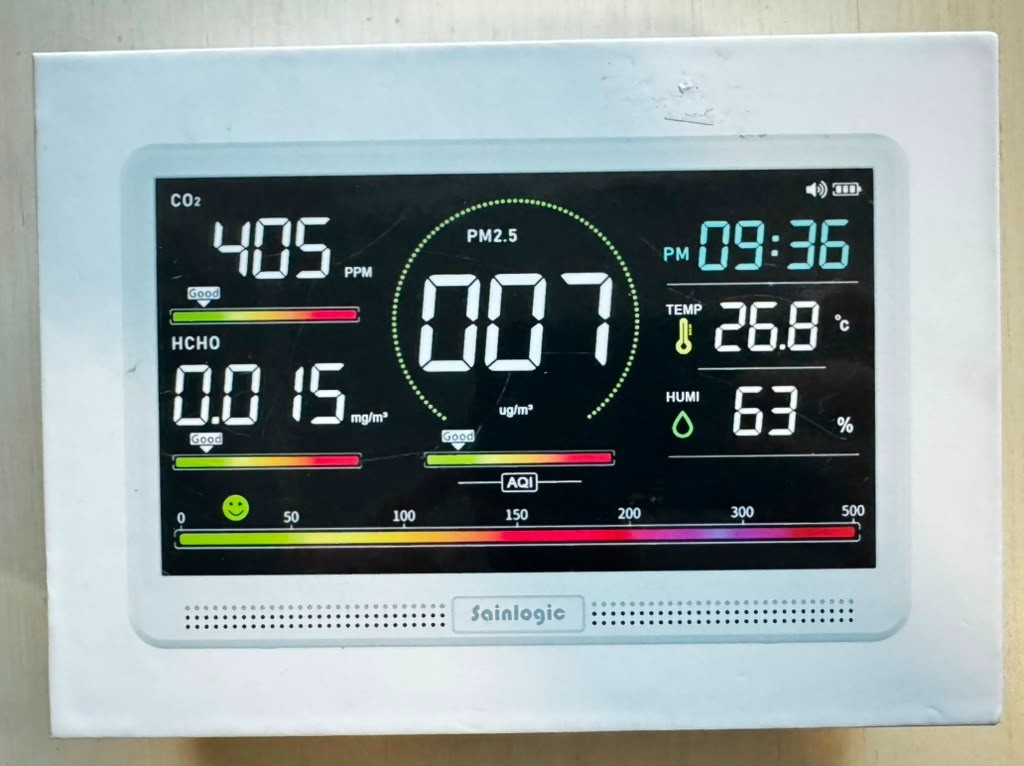
This monitor is the pick if you want a quicker, broader look at your indoor environment. It offers a 7-inch display and covers CO2, TVOC, PM2.5, PM1.0, PM10, HCHO, temperature, humidity, AQI, and time, with seven alert buzzers for AQI-related changes. That makes it easy to glance at multiple common readings without digging into a data chart. Its practical weakness is the opposite side of that trade-off: it's not built around particle-level precision or 999-point logging the way the PM0.3/2.5/10 counter is. The unit also arrives as new open-box, so the packaging may not be factory-sealed. For someone who wants a straightforward home overview and easy-to-read multiparameter readout, this monitor covers more ground in one screen.
Final choice by use case
For fine-dust and allergen tracking, or for building a particle history over time, the Air Quality Monitor, PM0.3/2.5/10 Dust Particle Counter is the one to start with. For everyday awareness of common pollutants and an easy-to-read overview, the 16-in-1 Air Quality Monitor is the more practical fit.