Choosing an environmental indoor air measurement device usually comes down to what you are actually trying to catch: fine dust and allergens, or a broader mix of gases and particles. These two monitors sit at very different ends of that spectrum, and the right choice depends on which problem you live with.
Quick verdict
The particle counter is the one to pick when your main interest is fine dust and airborne particles. The 6-in-1 monitor is the one to pick when you want gas readings and particle readings in a single desktop-sized screen.
At a glance
| Particle Counter | 6-in-1 Monitor | |
|---|---|---|
| Price | USD 159.99 | USD 16.99 |
| Particle readings | PM0.3, PM2.5, PM10 | PM2.5, PM10 |
| Other readings | Temperature and humidity | CO2, HCHO, TVOC, CO |
| Extra features | 999 data sets with trend chart, adjustable audible alarm | Four-color alarm, large display, 1200mAh battery, Type-C charging |
Where each product wins
The particle counter wins when you care about small-particle detail and a long-term record. The 6-in-1 wins when you want broad awareness in a portable package, with color-coded alarms and a single screen.
Product notes
Dust Particle Counter
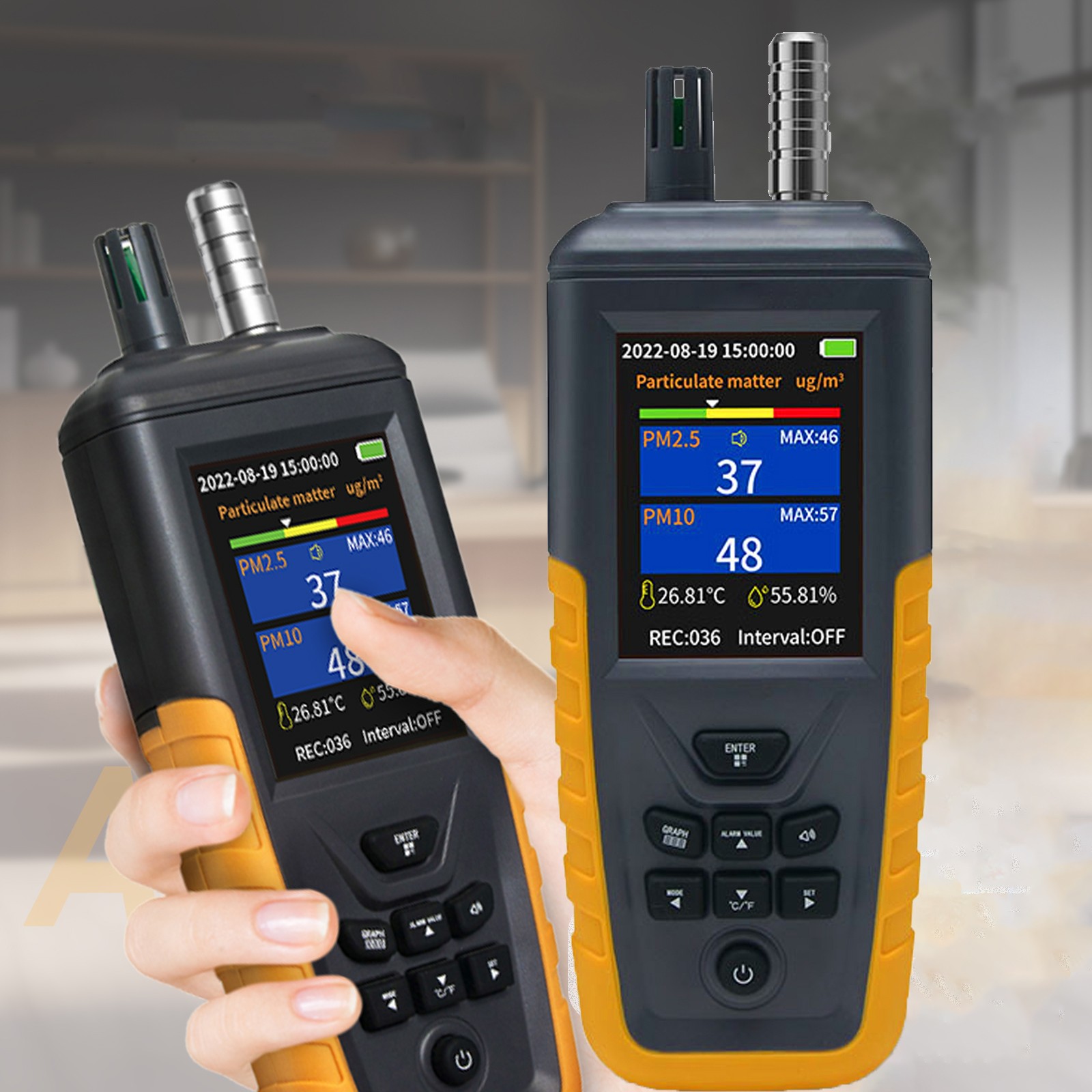
If dust and allergens are your main concern, this is the more serious tool. The laser-based measurement reports PM0.3 in real time with an accuracy figure of ±12μg/m³, and it also reads temperature and humidity. The 999 timestamped data sets give you a trend chart, which is useful when you want to see how a room changes after opening a window or running an air purifier. The adjustable audible alarm covers the 'tell me when it's bad' use case. Its limitation is scope: it is a 3-in-1 device focused on particles, temperature, and humidity, so shoppers who want gas readings should choose the 6-in-1. It is also better suited to someone who wants a durable record, not just a quick glance.
6-in-1 Air Quality Monitor
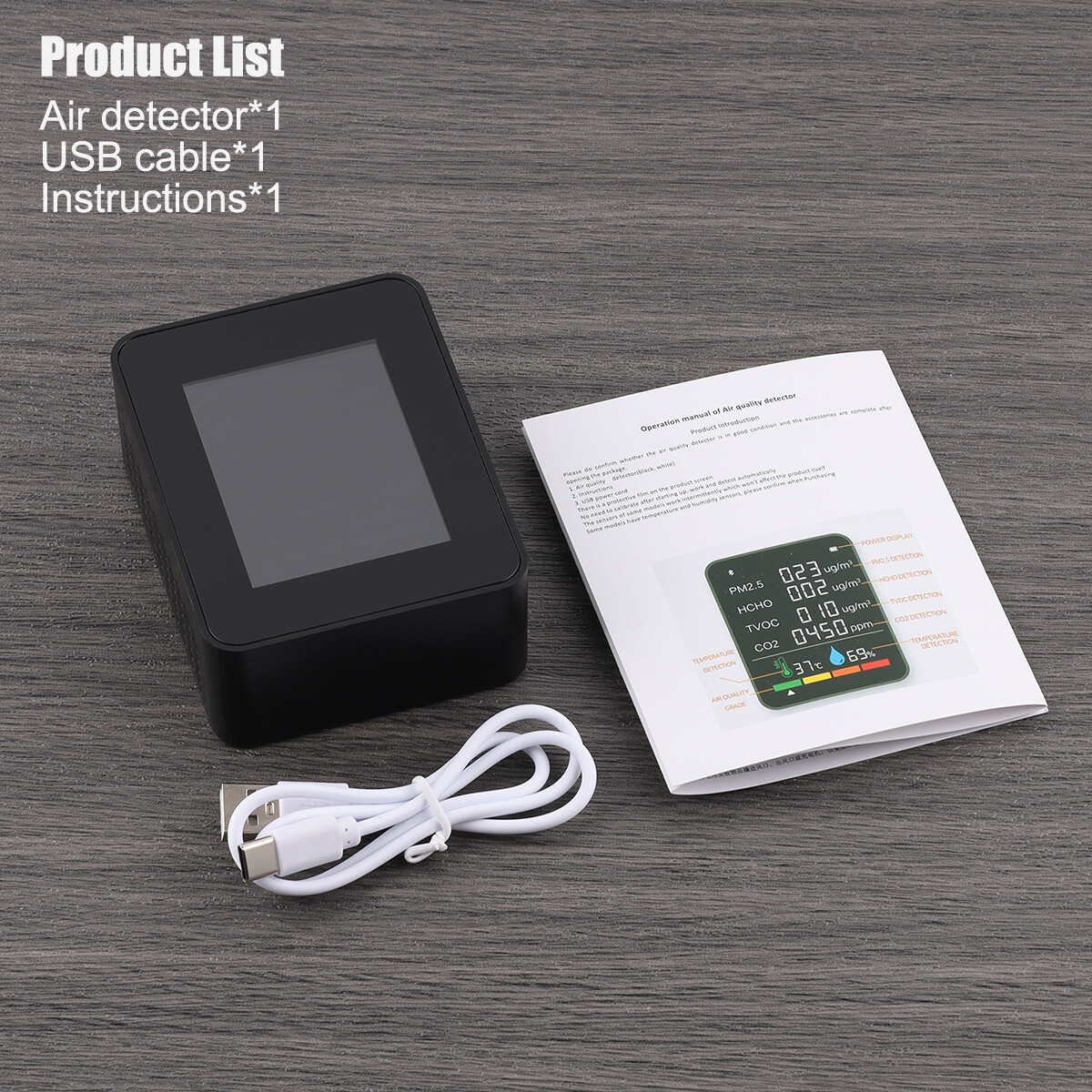
This is the broad-spectrum option. It detects PM2.5, PM10, plus the gases HCHO, TVOC, CO, and CO2 at the same time, which makes it easy to spot a problem without juggling multiple devices. The large display and four-color alarm let you notice changes from across the room, and the compact size fits a desk without taking over. It uses infrared detection for CO2 with a listed range of 400-5000ppm, which works for typical home and office spaces. A 1200mAh battery and Type-C 5V charging add to the portability. The limitation is that it is oriented toward real-time awareness rather than the long trend history the particle counter offers; the six-in-one's listed particle readings are PM2.5 and PM10, while the particle counter adds an even smaller particle size. For a quick, clear read of several air-quality factors, this is the simpler choice.
Final choice by use case
Choose the particle counter for allergen- or dust-focused monitoring, especially when you want to track trends over time. Choose the 6-in-1 when you want gas and particle coverage in a compact, easy-to-read screen. If mixed particles and gases are both on your radar, the 6-in-1 gives you the broadest starting point, while the particle counter gives you the deeper particle detail when you are ready to get specific.