Choosing between two inspection cameras is really choosing how you want to steer the probe. Inside walls, engine blocks, ductwork, and drain lines, there is no room for your head; only the camera on the end of a cable can get there. The Ralcam 4-Way 360° Articulating Borescope and the VEVOR 16.4 ft. 360° Borescope Inspection Camera tackle that problem differently, and their prices are $103 apart: USD 172.99 against USD 69.99.
Quick verdict
If your work demands deliberate steering and the ability to hold a view once you find it, the Ralcam is the more controllable choice. If you prefer rotating coverage, a larger screen, and a longer cable, the VEVOR is the more practical choice for long runs.
| Ralcam 4-Way 360° Articulating | VEVOR 16.4 ft. 360° Borescope SC8 | |
|---|---|---|
| Price | USD 172.99 | USD 69.99 |
| Price bar | ||
| Probe control | Four-way 360° articulating, locks at angle | 360° motorized rotating with dual front/side cameras |
| Camera head | 1080P, 6.2mm | 1080P, 0.32 in |
| Display | LCD display | 5 in IPS display with split-screen |
| Lights | 6 adjustable LEDs | 8 adjustable LEDs plus 1 auxiliary |
| Condition | New | New open-box |
Where the Ralcam wins
The Ralcam wins when your inspection demands precise aim. Instead of twisting a cable by hand, you can steer the tip, lock the angle, and hold a steady view. That is especially useful in close-clearance work where the position of the camera determines what you can see. It is the more deliberate tool for short, tight jobs.
Where the VEVOR wins
The VEVOR wins when you want to cover a long route with minimal cable wrangling. Rotating coverage lets you look around corners without re-aiming the whole probe, and the split-screen display helps you watch two angles at once. It is the better fit for sweeping inspections and for reaching farther into a line.
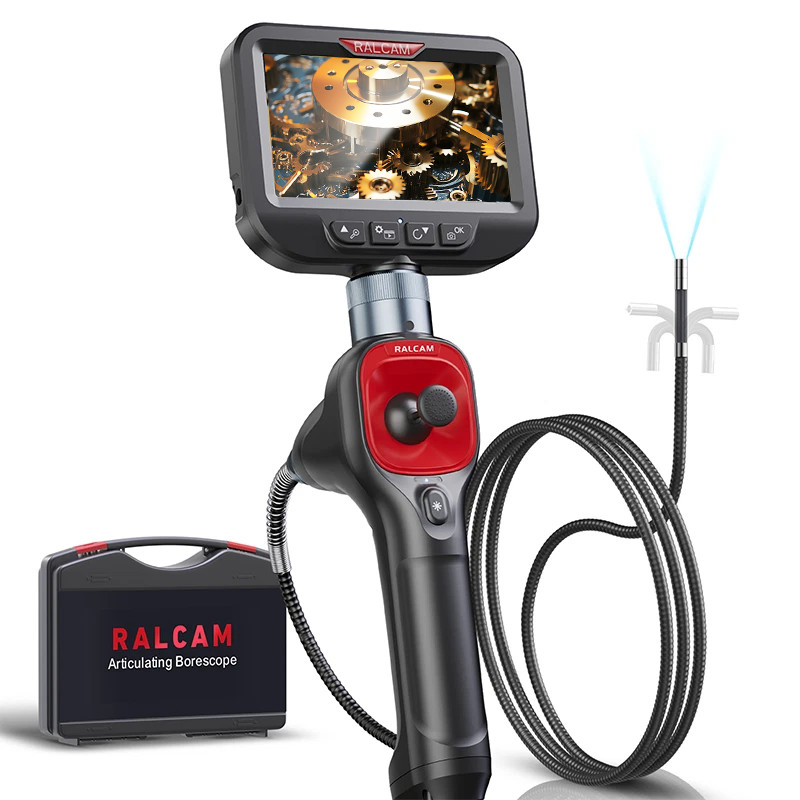
Ralcam 4-Way 360° Articulating Borescope Industrial Endoscope Inspection Camera
If your shop or field job involves looking into a valve, a stud bay, or a line that bends sharply, the Ralcam is the one to grab. The four-way articulating probe bends and rotates and can be locked at any angle, so you can hold a steady view instead of fighting a stiff cable. The 6.2mm head slips into openings that larger probes would miss, and the 1080P camera gives you crisp images when you arrive. Six adjustable LED lights help in dark cavities, and the 2600 mAh battery stretches out the work session. The main limitation is the price: you are paying noticeably more than the VEVOR for that articulation and lock-in control. If your days are filled with close, angled inspections, that extra cost buys real convenience. If your routes are long and straight, the VEVOR's rotating coverage is simpler.
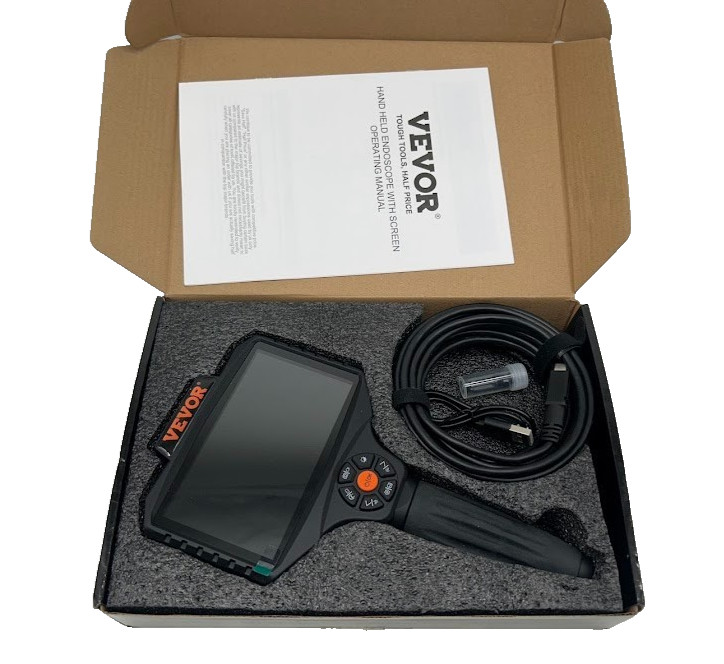
VEVOR 16.4 ft. 360° Borescope Inspection Camera with 1080P HD SC8
If your inspections run through drains, ductwork, or engine compartments where the probe has to go deeper, the VEVOR is the more forgiving tool. The motorized 360° rotating probe uses dual front and side cameras, so you can look around a bend by rotating, not by contorting your wrist. The 5-inch IPS display shows a bright, wide image and can split the screen to watch both cameras. Eight adjustable LED lights plus an auxiliary LED handle dark spaces, and the IP67 rating covers wet locations without extra shielding. The tradeoff is control: a rotating probe does not lock a bent tip the way the Ralcam can, and the slightly thicker head is less ideal for very tight clearances. For long, mostly straight runs with frequent view changes, this is the tool that gets the job done with less effort.
Final choice by use case
Choose the Ralcam when you need to aim the probe into a tight bend and lock the view there, especially in close-clearance work. Choose the VEVOR when you want longer reach, rotating coverage, and a screen that handles multiple viewing angles. For thermal borescope visual inspection that is mostly long, straight runs, the VEVOR is the straightforward pick; for fine, angled inspection, the Ralcam's steering is worth the price jump.