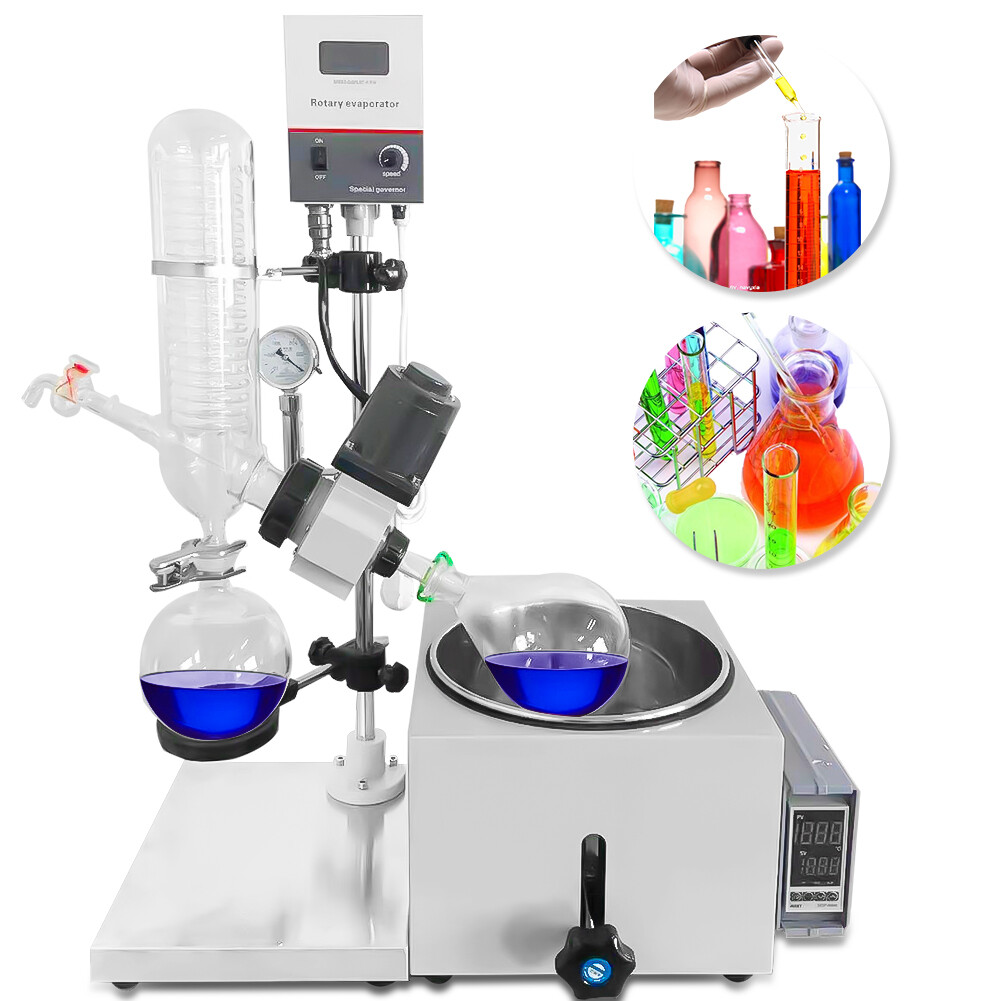
When you're outfitting a lab heating cooling vacuum setup, a rotary evaporator is a core piece for removing solvents. The Taishi 2L Rotary Evaporator, priced at USD 516.99, answers the batch-size and automation questions with a manual-lift design and glassware sized for small runs.
Quick verdict
If your evaporation work is small in scale, this Taishi model makes sense. It pairs a stainless steel bracket with high-temperature-resistant glass, so the core materials are in place for heated evaporation. This is not a motorized production rotovap, but a practical benchtop unit.
Who it suits
This rotary evaporator is a better fit for teaching labs, sample preparation areas, and small R&D groups than for high-throughput production. The included flasks hold enough for typical small-batch procedures, and the unit's footprint is manageable if you have a stable cart or bench.
What stands out from the listed details
The title explicitly mentions vacuum pump and chiller connection, which is an important detail for system planning. You know from the start that this rotovap is designed to run with those two pieces of lab equipment. It is a new unit from Taishi.
Meaningful trade-offs
The evaporation flask and collecting bottle are each 1L, which sets a clear per-batch limit. For larger volumes, you would need to run multiple cycles or look at a bigger rotovap. The manual lift method works fine but adds a physical step compared to motorized systems. The gross weight is 64.37 lbs, so plan for a surface that can handle the weight and the glassware once assembled.
Taishi 2L Rotary Evaporator with Vacuum Pump and Chiller Connection
At USD 516.99, this unit delivers a glass set with a 1L evaporation flask and a 1L collecting bottle. The high-temperature-resistant glass and stainless steel bracket are the main structural features, and the unit is meant to connect to a vacuum pump and chiller.
Bottom line
The Taishi 2L Rotary Evaporator is a straightforward option for labs that process small batches and don't need motorized automation. The small-batch glassware is the defining consideration, but the material choices and connection-ready design make it a reasonable starting point for a benchtop evaporation system.