When you're choosing between digital microscopes for coin and jewelry inspection, the big question is whether you want a stationary magnifier with a large screen or a portable one you can carry everywhere. The TOMLOV TriL110 and the TOMLOV P50 Handheld answer that question differently. This head-to-head spells out what each does best, so you can match the tool to your workflow.
Quick verdict
If you need a big-screen inspection setup with a multi-lens system that moves from an entire coin to fine surface details, go with the TOMLOV TriL110 at $149.00. If you want a pocket-sized digital scope with a built-in display and easy video capture for $42.03, the TOMLOV P50 Handheld is the simpler pick. The price gap is $106.97, which reflects a substantially larger screen and far wider zoom range in the TriL110.
| Product | Price | Key Specs | Price Indicator |
|---|---|---|---|
| TOMLOV TriL110 | $149.00 | 10.1-inch IPS, 14 LED, coin lens 2X-1000X, biological lens 2000X-2500X, 24MP | |
| TOMLOV P50 Handheld | $42.03 | 2.4-inch IPS, 6 LED, 3MP photo, 1080P video, battery powered |
Where the TOMLOV TriL110 wins
The rotating three-lens barrel sets it apart from single-lens handheld scopes. You can switch between a lower-power whole-coin view and a higher-power biological view without removing the sample or changing lenses. The HDMI output sends the image to a PC, laptop, or TV, which is useful when you need to show a detail to someone else or inspect for a long session without squinting at a tiny screen.
Where the TOMLOV P50 Handheld wins
The P50 is ready when you are. Because it runs on batteries and has its own built-in screen, it works at a flea market, in the garden, or on a repair bench without cables. The adjustable LED system helps manage glare on shiny items, and it can connect to a Windows or Mac computer when you want a larger view. Its strength is convenience and portability, not raw size.
Product notes
TOMLOV TriL110 Digital Microscope 2500X
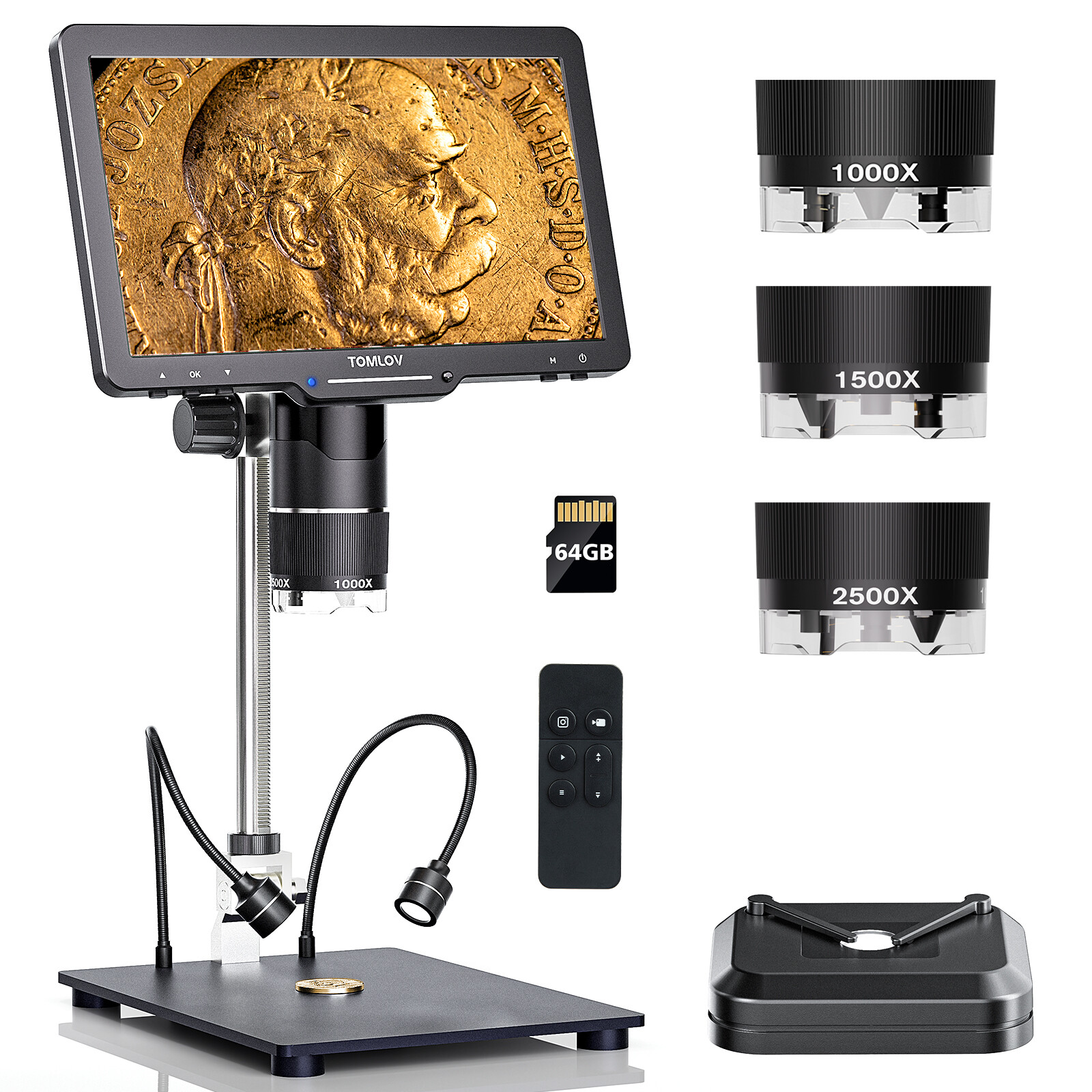
The TriL110 is for anyone who spends real time inspecting coins, circuit boards, or small samples. Its rotating lens barrel is the standout reason to choose it, because it replaces the usual lens-changing chore with a quick turn. You can start with the whole coin visible on the 10.1-inch IPS display and then shift to a close-up detail without disturbing the sample. The wireless remote makes it easier to capture a photo or adjust the view without knocking the scope, and the HDMI output gives you the option of a bigger external screen. The main limitation is mobility: with its large screen and lens assembly, the TriL110 is not a tool you slip into a bag. It belongs on a desk where it can stay connected and ready.
TOMLOV P50 Handheld Digital Microscope
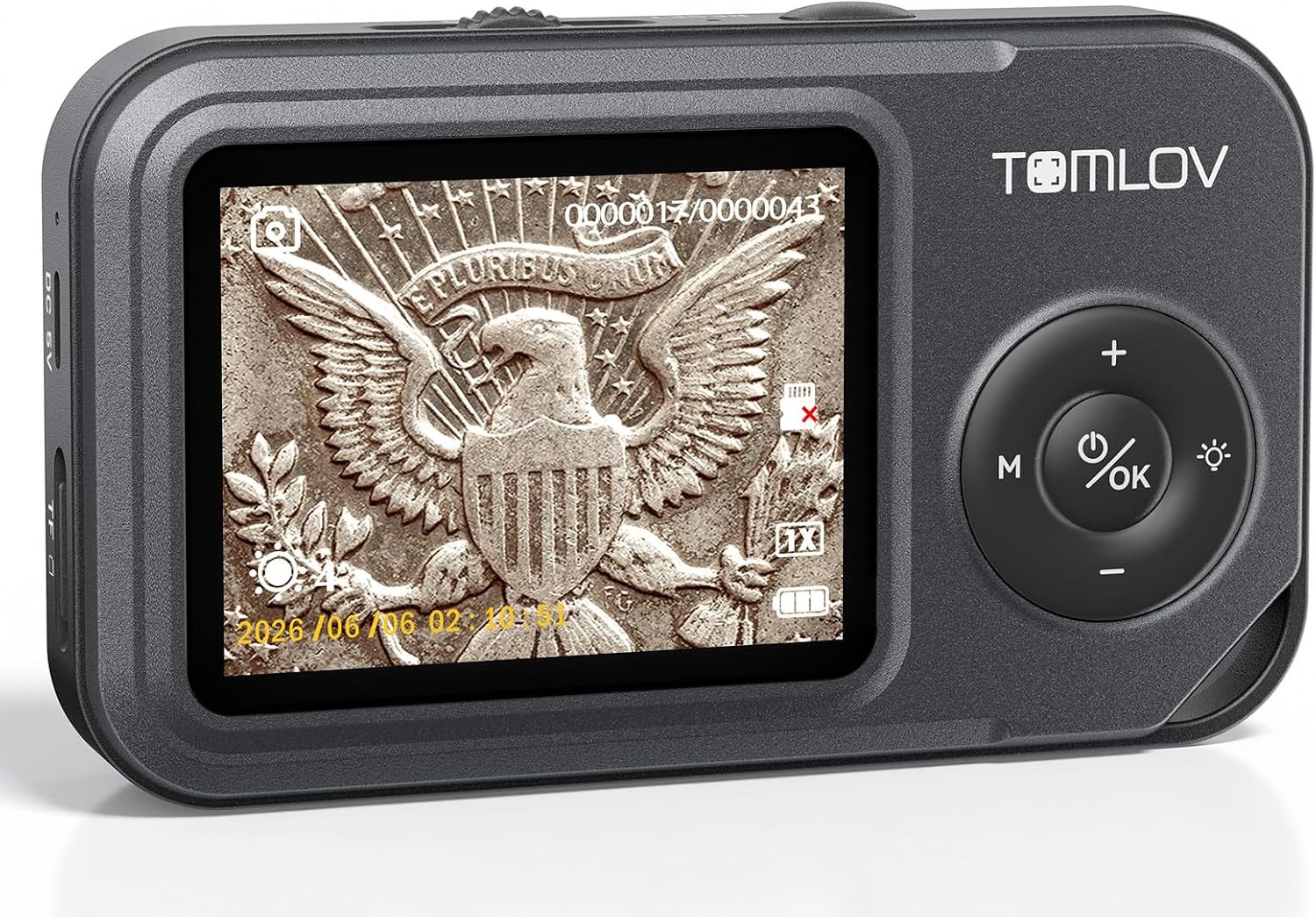
The P50 is the kind of magnifier you keep in a drawer and grab often. It has a 2.4-inch screen on the device itself, so you can inspect a coin, stamp, gem, or watch part with no setup. The built-in LEDs provide enough light for close-up work, and the four brightness levels help reduce harsh reflections on glossy surfaces. Because it captures both photos and video, you can document a find while you're still looking at it. The P50 also works with Windows and Mac when you need a bigger screen. Its limitation is the trade-off for being small: the display is compact, and the still image resolution is lower than the TriL110's, so it's better suited to quick checks than to fine analytical detail.
Final choice by use case
Choose the TOMLOV TriL110 if you want a fixed multi-lens microscope that can look at both an entire coin and tiny details at high magnification, and if you have a workspace where it can stay set up. Choose the TOMLOV P50 Handheld if you need a battery-powered, go-anywhere digital loupe for on-the-spot inspection, with photo and video recording and a much lower price.