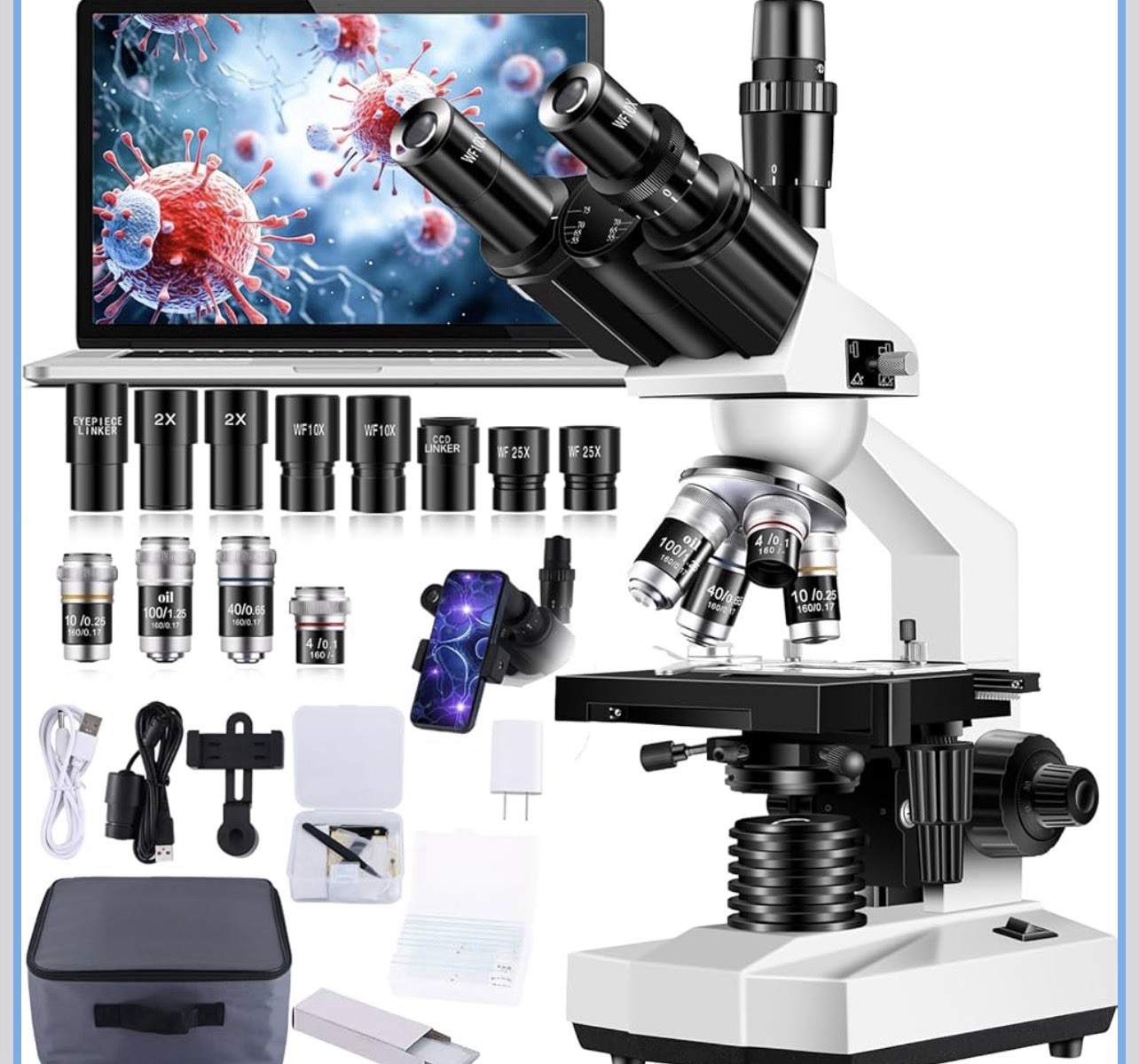
Choosing a microscope for lab imaging means balancing magnification reach, viewing comfort, and a head that can grow with you. You want to see clear images at both low and high powers, but you also do not want to be squinting through a single-viewer head after a long session. The Trinocular Microscope 40X-5000X Magnification Laboratory is an option that takes all three concerns seriously.
Quick verdict
This scope is a compelling middle-ground option at $269. It covers a broad magnification envelope and includes a three-tube viewer, which makes it easier to move from eyeballing slides to capturing what you see. The main caveat is that the top magnification relies on stacking auxiliary lenses, so you will give up field of view at the extreme high end.
Who it suits
This is a good fit for students, educators, and hobbyists who want a single microscope for prepared slides and biological observation. The included electronic eyepieces make it a sensible choice for labs or classrooms that want to image their observations. If you spend long sessions at the scope, the wide-angle eyepieces and adjustable isometric design should reduce fatigue.
What stands out
The standout is the comprehensive magnification setup. You get two WF10x and two WF25x eyepieces, plus two 2x magnifying lenses, allowing you to build many different magnifications from one kit. The 195 achromatic objective is described as reducing red, blue, and green fringing, and the infinity optical system is aimed at keeping images sharp. A built-in LED light source rounds out the package for biological work.
Meaningful trade-offs
The biggest trade-off is the nature of the top magnification. Reaching it requires adding auxiliary lenses to the high-power eyepieces, and at that level the working area is tiny. You will need a centered specimen and plenty of patience to get the image steady. Because this is a compound biological microscope, its strength is with thin, translucent samples rather than large, opaque materials. That distinction matters if you are trying to inspect surfaces or bulk objects.
Bottom line
At $269, this microscope gives you a lot of capability in one box. It is not the right tool for every kind of inspection, but for biological microscopy and lab imaging, it covers a broad span from low-power scanning to high-power detail work. If you want one microscope to handle both ends of that range, this is a practical candidate.
Trinocular Microscope 40X-5000X Magnification Laboratory
The strongest reason to choose this model is the included eyepiece set: two 10x, two 25x, and two 2x auxiliary lenses give you flexibility from wide scanning to close detail without buying additional components. The limitation shows up at the far end of that range: at maximum magnification, the field of view becomes very narrow, and any vibration or off-center slide will be easy to see.