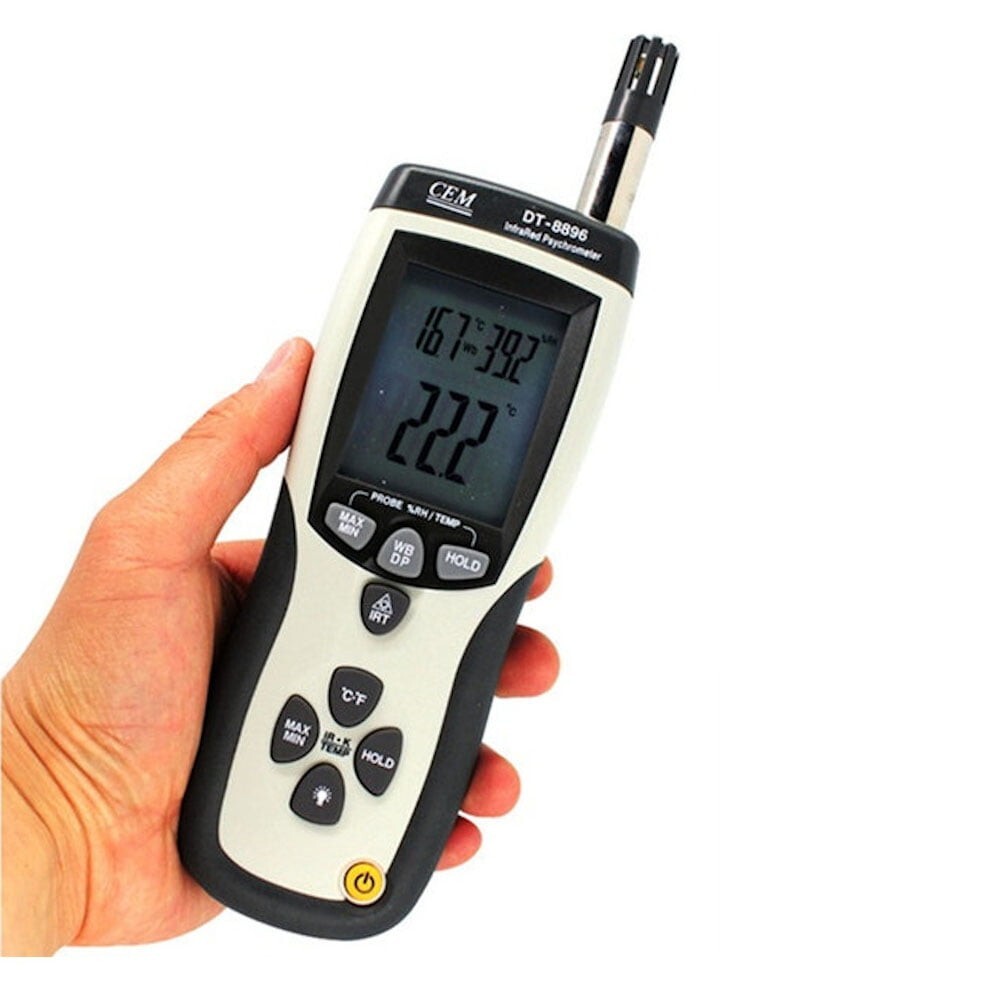

Photos from current listings. Actual item, color, and included accessories may vary.
CEM DT-8896 Buying Guide
The CEM DT-8896 is a handheld 4-in-1 environmental meter combining air temperature, humidity, dew point, and infrared (IR) surface temperature in one instrument. The key trade-off is sensor quality versus feature breadth: it uses a thermopile IR sensor and a capacitive humidity element rather than laboratory-grade chilled-mirror or platinum RTD references. Choose it for fast, portable spot checks across HVAC, building diagnostics, and indoor air quality triage; step up to dedicated hygrometers or IR thermometers only when you need documented calibration accuracy or continuous logging.
Key takeaways
- 4-in-1 architecture: air temperature via thermistor, relative humidity via capacitive sensor, calculated dew point, and non-contact IR surface temperature via thermopile — one tool for four measurements.
- IR thermometry uses a fixed emissivity assumption (typically 0.95) with a distance-to-spot ratio around 8:1, so accurate surface readings require holding the meter close to the target.
- Humidity accuracy is typically ±3% to ±5% RH across the mid-range, which is adequate for comfort and HVAC diagnostics but not for calibration labs or pharmaceutical monitoring.
At a glance
- Category
- Environmental & Indoor Air Measurement
- Status
- Listings available
- Last updated
- Nov 28, 2026
Current offers
Highlights
- 4-in-1 architecture: air temperature via thermistor, relative humidity via capacitive sensor, calculated dew point, and non-contact IR surface temperature via thermopile — one tool for four measurements.
- IR thermometry uses a fixed emissivity assumption (typically 0.95) with a distance-to-spot ratio around 8:1, so accurate surface readings require holding the meter close to the target.
- Humidity accuracy is typically ±3% to ±5% RH across the mid-range, which is adequate for comfort and HVAC diagnostics but not for calibration labs or pharmaceutical monitoring.
- Dew point is a computed value from temperature and RH, not a direct measurement — accuracy degrades in low-humidity or rapidly changing conditions compared with a chilled-mirror hygrometer.
Best use cases
- Best fit: HVAC technicians and home inspectors performing quick spot checks of room humidity, dew point, and supply/return vent or wall surface temperatures during a single walkthrough.
- Best fit: building diagnostics and mold-prevention triage — compare surface temperature against dew point to identify condensation risk on windows, walls, and ductwork.
- Wrong fit: continuous data logging, calibrated compliance reporting, or cleanroom monitoring — the DT-8896 is a spot-check tool without onboard logging or interchangeable calibrated probes.
- Wrong fit: measuring reflective or low-emissivity surfaces (bare metal, polished foil) with IR — emissivity mismatch causes large errors; use a contact probe or adjustable-emissivity meter instead.
Buying tips
- Confirm the meter ships with a calibrated certificate or at least a stated accuracy spec for humidity and IR; a 4-in-1 meter without documented tolerances is a toy, not an instrument.
- Check the IR distance-to-spot ratio (approximately 8:1) and match it to your targets — measuring a 2-inch pipe from 16 inches averages an 2-inch spot, so stay close.
- Verify the display resolution and units: 0.1°C/0.1% RH resolution is expected; a meter that only shows whole degrees is a lower-tier sensor.
- Prefer units with a replaceable or at least serviceable humidity sensor; capacitive elements drift over time and a sealed, unserviceable sensor shortens the tool's useful life.
Specs
| Measurement Types | Air temp, RH, dew point, IR surface |
|---|---|
| Humidity Accuracy | ±3% to ±5% RH typical |
| IR Distance-to-Spot | Approx. 8:1 |
| Dew Point Source | Calculated from temp + RH |
Alternatives to compare

Related searches
What to check before buying
- Confirm your measurement targets fall within the stated range: typical air temperature -20 to 60°C, RH 0-100%, and IR surface temperature up to several hundred degrees Celsius.
- Check that the IR emissivity assumption (typically fixed at 0.95) matches your surfaces; painted walls, wood, and most non-metals are fine, bare metals are not.
- Verify battery type and availability (typically 9V or AAA) plus auto power-off behavior, since a meter that drains batteries mid-inspection is a liability.
- Ensure the meter includes or accepts a wrist strap or holster and that the IR lens is protected — exposed thermopile optics are the most common failure point in field use.
FAQ
Data sources: eBay / Amazon listings and product attribute feeds. Updated Nov 28, 2026.
Some links on this page are affiliate links. If you buy after clicking one, we may earn a commission at no extra cost to you. This does not change which products appear here or their order. Affiliate disclosure.