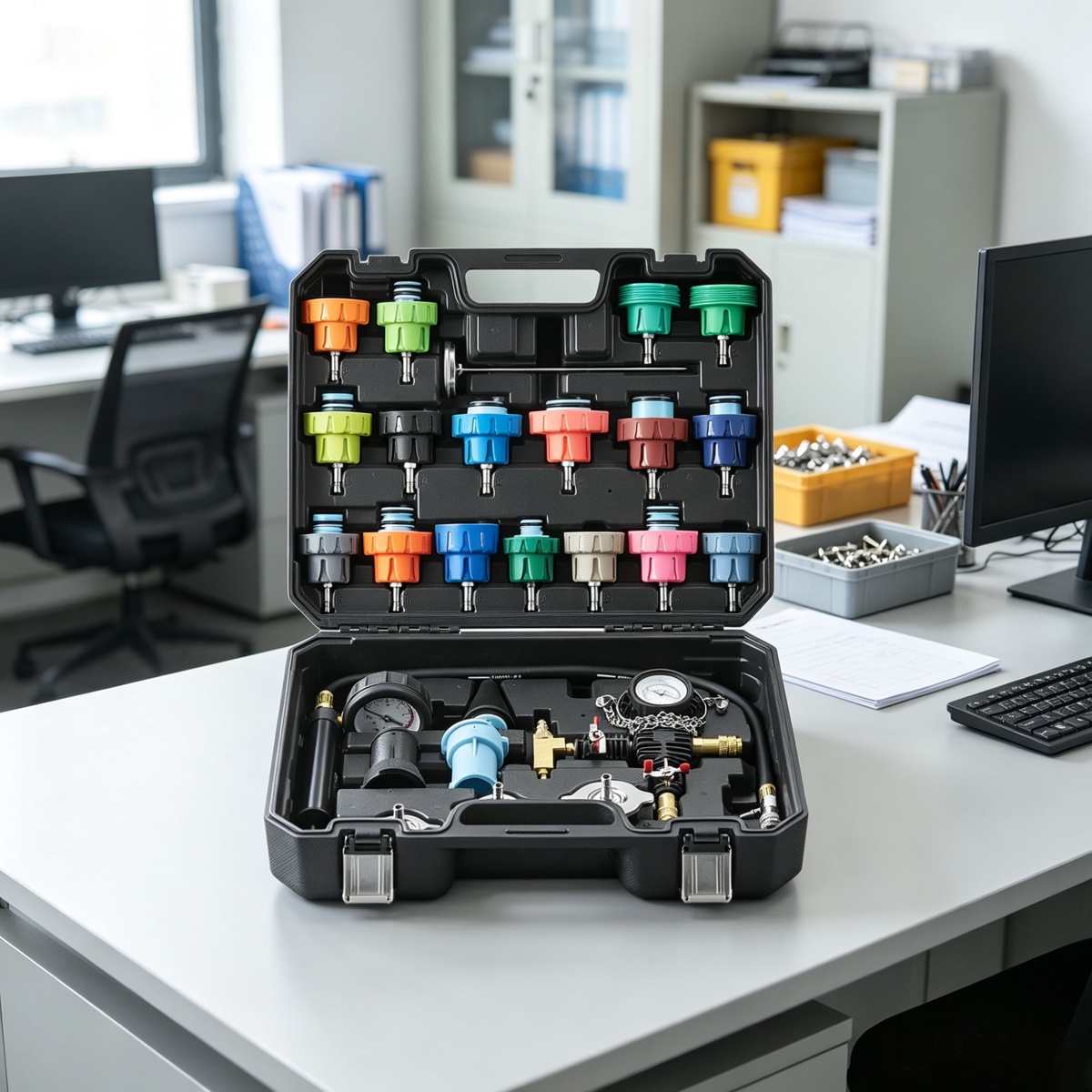

Photos from current listings. Actual item, color, and included accessories may vary.
Radiator Pressure Test Kit Buying Guide
A radiator pressure test kit is a hand-pump-and-gauge system that pressurizes a cooling system to locate leaks without running the engine. The core trade-off is between a universal cone-adapter kit that fits most radiator necks and a vehicle-specific cap-adapter kit that seals reliably on modern sealed systems. Buy the kit whose adapter range matches your cap standard and whose gauge reads at least 30 psi; anything less is a compromise for diagnostic work.
Key takeaways
- Universal kits use tapered rubber cones (typically 1.25–2.5 in) that expand into the filler neck; they seal on brass/copper radiators but slip on plastic-tank necks.
- Vehicle-specific kits use threaded or bayonet cap adapters matched to standards like ASTM D4682 or OEM bayonet sizes, giving a positive lock and repeatable seal.
- Gauge accuracy of ±2% full scale and a 0–30 psi (0–2 bar) range covers most automotive cooling systems; diesel and performance systems need 0–60 psi.
At a glance
- Category
- Pressure, Flow & Process Measurement
- Last updated
- Nov 28, 2026
Current offers
Highlights
- Universal kits use tapered rubber cones (typically 1.25–2.5 in) that expand into the filler neck; they seal on brass/copper radiators but slip on plastic-tank necks.
- Vehicle-specific kits use threaded or bayonet cap adapters matched to standards like ASTM D4682 or OEM bayonet sizes, giving a positive lock and repeatable seal.
- Gauge accuracy of ±2% full scale and a 0–30 psi (0–2 bar) range covers most automotive cooling systems; diesel and performance systems need 0–60 psi.
- A built-in pressure-relief valve and a 24–36 in hose with a quick-disconnect are the two features that separate a usable kit from a frustrating one.
Best use cases
- Best fit: DIY coolant-leak diagnosis on a copper/brass radiator with a 1.25–2.5 in filler neck — choose a universal cone-adapter kit with a 0–30 psi gauge.
- Best fit: European or Asian sealed systems with a threaded or bayonet cap — pick a kit with the exact cap adapters for your cap standard; universal cones will not seal.
- Wrong fit: testing a pressurized expansion tank or a system requiring more than 30 psi — skip automotive kits and use a 0–60 psi kit with the correct cap adapter.
- Wrong fit: using a cone kit on a plastic-tank radiator with a cracked neck — the cone cannot seal a damaged plastic neck; repair or replace the radiator first.
Buying tips
- Match the adapter to your cap: measure the filler-neck inner diameter; a cone kit needs at least 0.25 in of clean straight neck to seal.
- Choose a gauge range 10 psi above your system's rated cap pressure — a 15 psi cap needs a 0–30 psi gauge; a 30 psi cap needs 0–60 psi.
- Prefer a kit with a metal-bodied pump and a reinforced hose; plastic pump bodies crack at the threads and lose pressure during a 30-minute hold.
- Confirm the kit includes a temperature or pressure-hold valve; a kit without a relief valve can over-pressurize and damage heater cores and seals.
Specs
| Adapter Type | Universal cone vs cap-specific |
|---|---|
| Gauge Range | 0–30 psi (0–2 bar) standard |
| Pump Body | Metal vs plastic |
| Hose & Valve | Reinforced hose / relief valve |
Related searches
What to check before buying
- Measure your radiator filler-neck inner diameter and depth — cone adapters need a clean cylindrical neck, not a flared or damaged one.
- Identify your cap type: bayonet, threaded, or cam-lock — the kit must list that exact adapter, not a generic 'universal' claim.
- Check your system's rated cap pressure (typically 13–16 psi on cars, up to 30 psi on performance setups) and pick a gauge range above it.
- Confirm the hose length reaches from the filler neck to a visible gauge position and that the pump fits your hand clearance above the radiator.
FAQ
Data sources: eBay / Amazon listings and product attribute feeds. Updated Nov 28, 2026.
Some links on this page are affiliate links. If you buy after clicking one, we may earn a commission at no extra cost to you. This does not change which products appear here or their order. Affiliate disclosure.