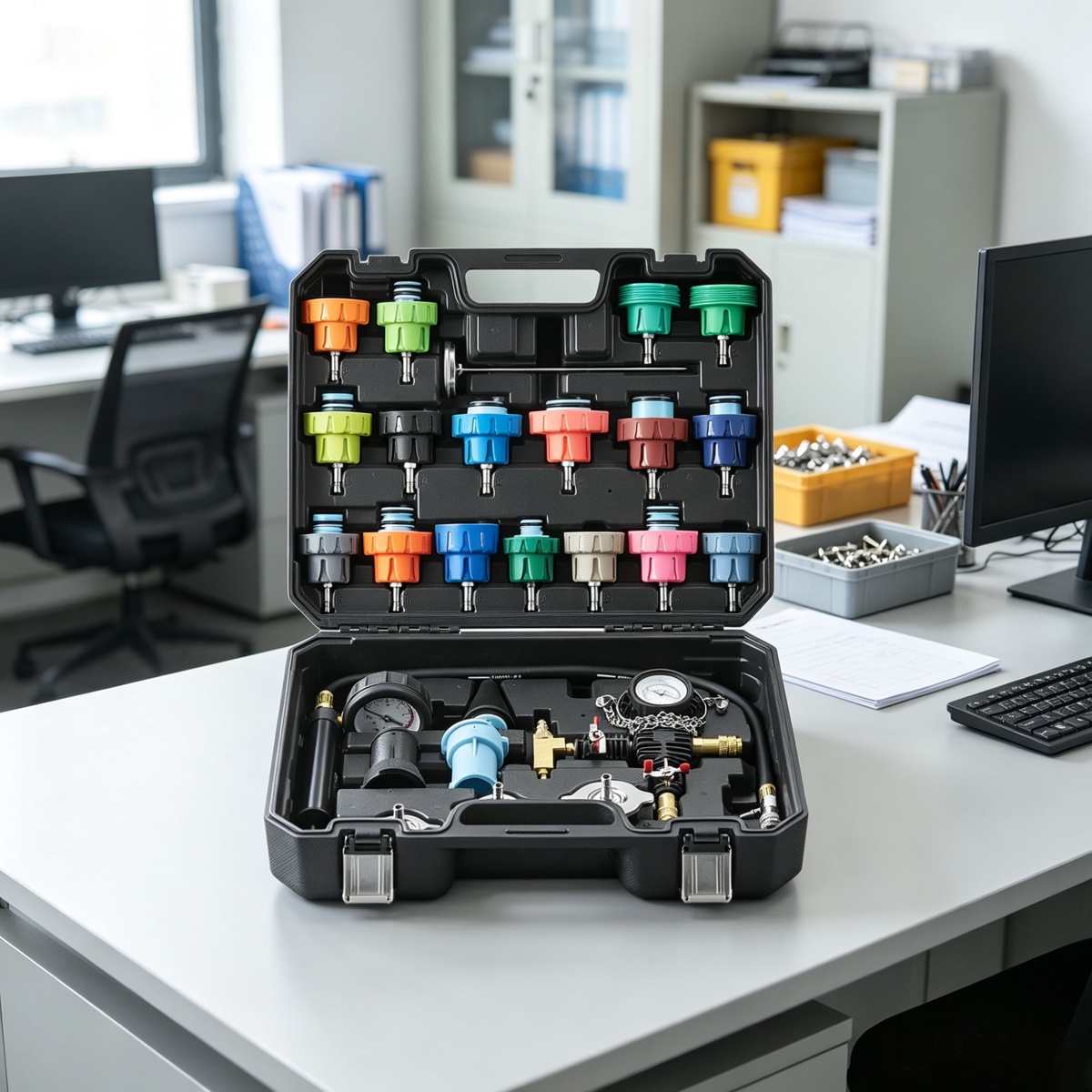

Photos from current listings. Actual item, color, and included accessories may vary.
Radiator Pressure Tester Buying Guide
A radiator pressure tester is a hand-pump and gauge kit that pressurizes a cooling system to reveal leaks without running the engine. The core trade-off is between a universal adapter set with a basic pump and a vehicle-specific cap adapter matched to your exact bayonet or thread standard. Buy a kit whose adapter matches your cap type and whose gauge holds pressure for 10+ minutes; skip generic cone adapters if you need a leak-proof seal on a plastic or threaded neck.
Key takeaways
- Pump type: hand-operated piston pumps reach 30 psi in 10-20 strokes; some kits include a 12V electric pump for one-person testing.
- Gauge accuracy: a 0-30 psi gauge with 1 psi increments and a hold valve is the practical standard; ±2% full-scale accuracy is typical for brass movements.
- Adapter connection: bayonet (Japanese/European), threaded (GM/Ford), and clamp-on cone styles are not interchangeable; a kit must list your cap standard.
At a glance
- Category
- Pressure, Flow & Process Measurement
- Last updated
- Nov 28, 2026
Current offers
Highlights
- Pump type: hand-operated piston pumps reach 30 psi in 10-20 strokes; some kits include a 12V electric pump for one-person testing.
- Gauge accuracy: a 0-30 psi gauge with 1 psi increments and a hold valve is the practical standard; ±2% full-scale accuracy is typical for brass movements.
- Adapter connection: bayonet (Japanese/European), threaded (GM/Ford), and clamp-on cone styles are not interchangeable; a kit must list your cap standard.
- Hose and seal material: EPDM or nitrile rubber seals resist glycol and 250°F coolant; vinyl or cheap rubber hardens and leaks within a season.
Best use cases
- Best fit: a universal kit with 5+ color-coded cap adapters for a home mechanic servicing multiple Asian, European, and domestic vehicles; skip single-adapter kits unless you own one model.
- Best fit: a vehicle-specific threaded adapter kit for a GM or Ford with a plastic surge tank; wrong fit is a cone-style universal adapter that cannot grip a recessed neck.
- Best fit: a kit with a 30 psi gauge and pressure-hold valve for diagnosing head gasket leaks; skip bicycle pumps or low-range 15 psi gauges that cannot reach test pressure.
- Wrong fit: using a radiator cap tester on a sealed expansion tank with no service cap; you need an adapter that connects to the hose or a dedicated cooling system test kit.
Buying tips
- Match the adapter to your cap: bayonet caps (Asian/European) need a twist-lock adapter; threaded caps (GM/Ford) need a screw-on adapter; cone adapters only seal on a smooth round neck.
- Choose a gauge range of 0-30 psi with 1 psi markings; a 0-15 psi gauge cannot test most systems that run 16-18 psi caps.
- Confirm the pump seals are EPDM or nitrile, not vinyl; EPDM resists coolant and heat and keeps a stable pressure reading for 10+ minutes.
- Prefer kits with a pressure-release valve and a flexible 24-inch hose; a stiff short hose makes it hard to read the gauge while pumping.
Specs
| Pump Type | Hand piston vs 12V electric |
|---|---|
| Gauge Range | 0-30 psi / 1 psi increments |
| Adapter Standard | Bayonet / threaded / cone |
| Seal Material | EPDM or nitrile rubber |
Related searches
What to check before buying
- Measure your radiator neck or expansion tank cap diameter and note the cap type (bayonet lugs vs threads) before ordering an adapter.
- Confirm your cooling system's rated cap pressure (usually 16-18 psi for modern cars, 13 psi for older models) and ensure the gauge range covers it.
- Check that the kit includes a cone adapter or a hose-clamp adapter if your vehicle has no service cap on the radiator.
- Verify the pump cylinder and seals are rated for glycol coolant and 250°F; cheap vinyl seals fail after a few uses.
FAQ
Data sources: eBay / Amazon listings and product attribute feeds. Updated Nov 28, 2026.
Some links on this page are affiliate links. If you buy after clicking one, we may earn a commission at no extra cost to you. This does not change which products appear here or their order. Affiliate disclosure.