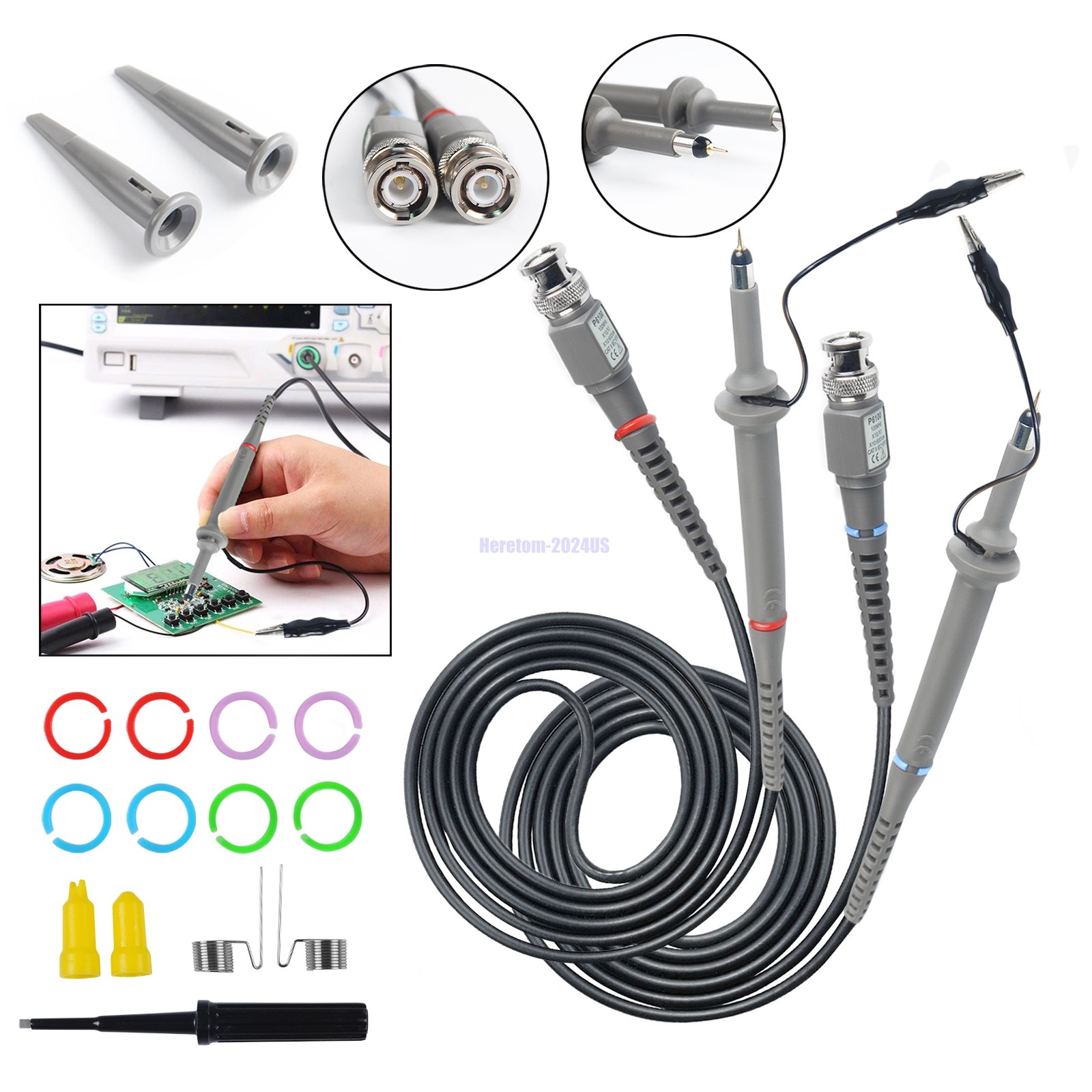

Photos from current listings. Actual item, color, and included accessories may vary.
10x Oscilloscope Probe Buying Guide
A 10x oscilloscope probe is a switchable or fixed 10:1 attenuation probe that divides the signal by ten to raise impedance and extend the measurable voltage range of a scope. The core trade-off is bandwidth versus input capacitance and compensation range: higher-bandwidth probes load the circuit more and demand matching compensation, while low-bandwidth probes are more forgiving but limit fidelity. The decision rule is to match probe bandwidth to at least the scope's analog bandwidth and ensure the compensation range covers the scope's input capacitance—anything less is a compromise.
Median $19.49
Key takeaways
- 10:1 attenuation raises input impedance to ~10 MΩ and multiplies voltage range by ten, but adds input capacitance that must be compensated.
- Bandwidth tier is set by the probe tip and compensation network: 100 MHz and 200 MHz probes are the common consumer tiers, with 200 MHz requiring tighter compensation.
- Switchable 1X/10X probes trade bandwidth for convenience—1X mode typically drops to a few MHz and is only for low-frequency, high-impedance nodes.
At a glance
- Category
- Test Leads, Probes, Fixtures & Accessories
- Last updated
- Nov 28, 2026
Current offers
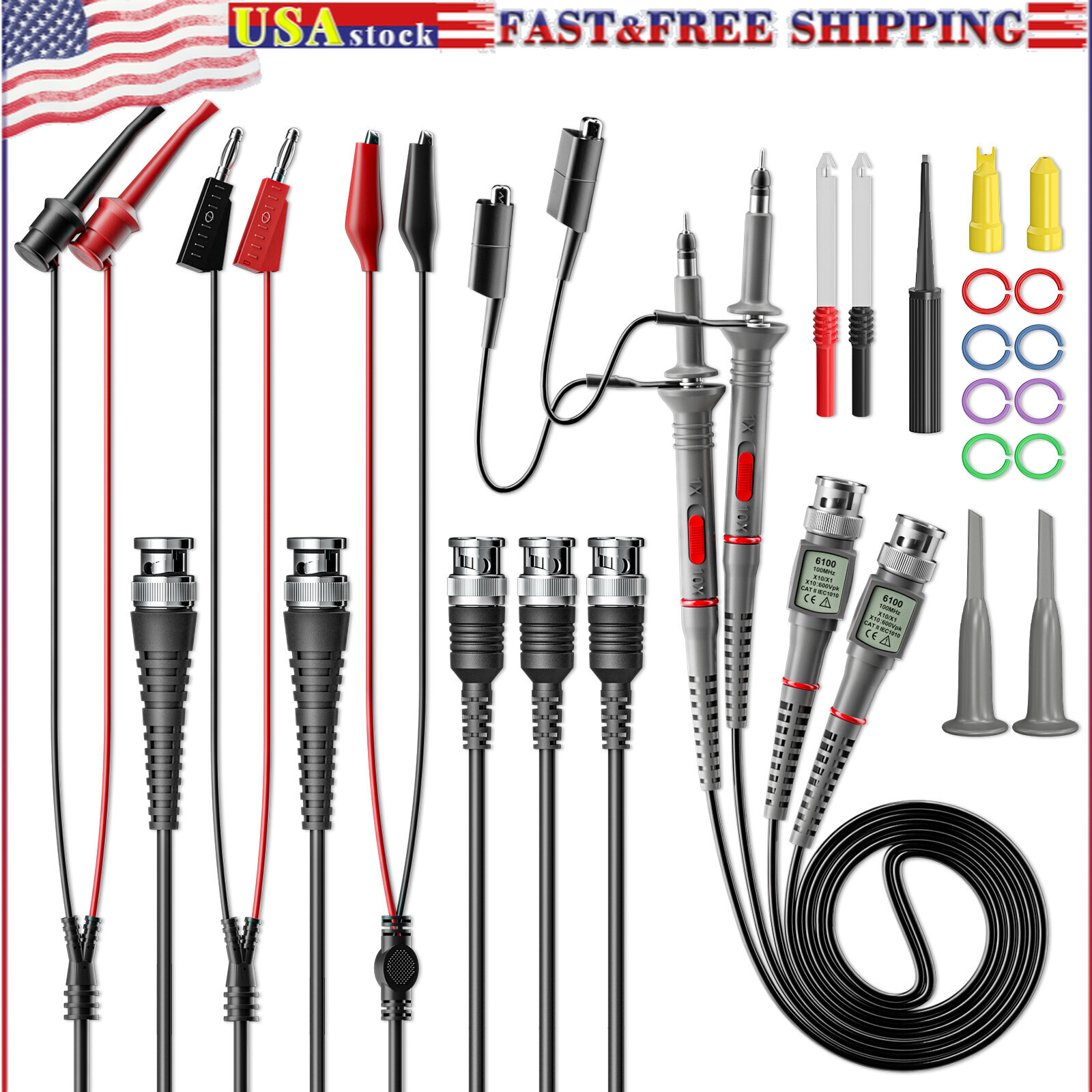
Highlights
- 10:1 attenuation raises input impedance to ~10 MΩ and multiplies voltage range by ten, but adds input capacitance that must be compensated.
- Bandwidth tier is set by the probe tip and compensation network: 100 MHz and 200 MHz probes are the common consumer tiers, with 200 MHz requiring tighter compensation.
- Switchable 1X/10X probes trade bandwidth for convenience—1X mode typically drops to a few MHz and is only for low-frequency, high-impedance nodes.
- Compensation range (e.g., 10–35 pF) must bracket the scope's input capacitance, or the probe cannot be properly matched, causing waveform distortion.
Best use cases
- Buy a matched 100 MHz 10X probe for a 100 MHz scope when probing audio, power-supply ripple, and low-speed digital—skip 200 MHz probes whose extra bandwidth the scope cannot use.
- Choose a 200 MHz 10X probe only when the scope's analog bandwidth is 200 MHz or higher; otherwise the probe's lower input capacitance still helps, but you pay for unused bandwidth.
- Pick fixed 10X probes for repetitive, calibrated measurements; choose switchable 1X/10X only for occasional low-frequency checks where 1X convenience outweighs reduced bandwidth.
- Skip 1X-only or low-bandwidth probes for switching converters and fast edges—they load the node and round off rise times beyond usable limits.
Buying tips
- Match probe bandwidth to scope bandwidth: a 100 MHz probe on a 200 MHz scope limits the system to 100 MHz; a 200 MHz probe on a 100 MHz scope is safe but unnecessary.
- Confirm the compensation range covers your scope's input capacitance (commonly 10–35 pF); outside that bracket the probe cannot be trimmed flat.
- Prefer probes with a 10 MΩ input impedance and a 1.5–2 m cable; longer cables add capacitance and reduce usable bandwidth.
- Check the voltage derating: 10X probes typically handle 300–600 V peak at DC, dropping with frequency—verify the derating curve for mains-adjacent work.
Specs
| Attenuation | 10:1 fixed or 1X/10X switchable |
|---|---|
| Bandwidth Tier | 100 MHz or 200 MHz (-3 dB) |
| Input Impedance | 10 MΩ at 10X |
| Compensation Range | 10–35 pF typical |
Related searches
What to check before buying
- Measure your scope's input capacitance and bandwidth from the datasheet or front panel—these two numbers determine the required probe compensation range and bandwidth tier.
- Confirm the probe's BNC connector matches your scope's input (standard 50 Ω BNC) and that the ground clip and tip accessories fit your probing points.
- Verify the probe's maximum voltage rating against the highest node voltage you will measure, including transients.
- Check that the compensation range brackets your scope's input capacitance; if it does not, the probe cannot be calibrated flat.
FAQ
Data sources: eBay / Amazon listings and product attribute feeds. Updated Nov 28, 2026.
Some links on this page are affiliate links. If you buy after clicking one, we may earn a commission at no extra cost to you. This does not change which products appear here or their order. Affiliate disclosure.