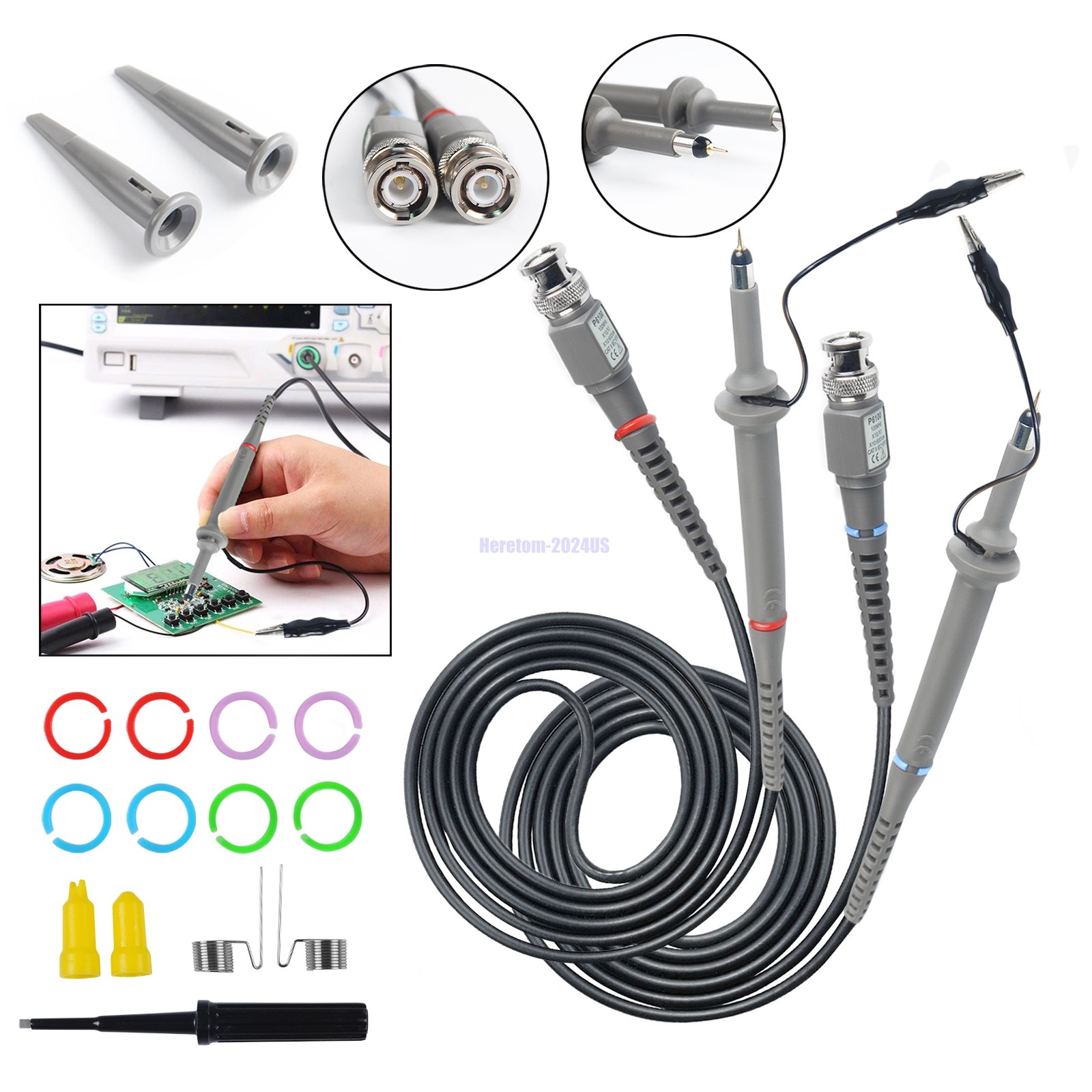

Photos from current listings. Actual item, color, and included accessories may vary.
10x Scope Probe Buying Guide
A 10x scope probe is a passive voltage divider that attenuates the signal by 10:1 before it reaches the oscilloscope, trading sensitivity for higher input impedance and wider bandwidth. The primary trade-off is between switchable 1x/10x convenience and fixed-10x durability and signal fidelity. Buy a fixed-10x probe rated at or above your scope's bandwidth for critical measurements; choose a switchable 1x/10x only for low-frequency, general-purpose troubleshooting.
Key takeaways
- Input impedance is 10 MΩ at 10x versus 1 MΩ at 1x; this higher impedance minimizes circuit loading for accurate high-impedance node measurements.
- Bandwidth at 10x is typically 5–10× the 1x bandwidth; a 100 MHz 10x probe only meets its rated bandwidth when the 10x setting is selected.
- Compensation capacitor adjusts probe capacitance (typically 10–20 pF) to match your scope's input capacitance, ensuring flat frequency response.
At a glance
- Category
- Test Leads, Probes, Fixtures & Accessories
- Last updated
- Nov 28, 2026
Current offers
Highlights
- Input impedance is 10 MΩ at 10x versus 1 MΩ at 1x; this higher impedance minimizes circuit loading for accurate high-impedance node measurements.
- Bandwidth at 10x is typically 5–10× the 1x bandwidth; a 100 MHz 10x probe only meets its rated bandwidth when the 10x setting is selected.
- Compensation capacitor adjusts probe capacitance (typically 10–20 pF) to match your scope's input capacitance, ensuring flat frequency response.
- Fixed-10x probes eliminate the fragile 1x/10x switch, offering better long-term reliability and consistent compensation stability.
Best use cases
- Best fit: High-frequency switching circuits, clocks, and digital buses above 20 MHz—select a fixed 10x probe with at least 100 MHz bandwidth and a compensation range covering your scope's input capacitance.
- Best fit: General bench troubleshooting where both low-voltage logic and higher-voltage rails are probed—choose a switchable 1x/10x probe rated 100 MHz on the 10x setting.
- Wrong fit: Measuring very small signals below 10 mV or low-impedance power rails—skip 10x and use a direct 1x probe or a dedicated low-noise differential probe.
- Wrong fit: Probing AC mains or high-voltage flyback nodes—skip standard 10x probes rated 600 V and select a properly safety-rated high-voltage differential probe.
Buying tips
- Match probe bandwidth to your scope: choose a probe rated at least equal to the scope's analog bandwidth to avoid limiting the measurement system.
- Check compensation range: the probe's adjustable capacitance must cover your scope's input capacitance (commonly 10–25 pF); a mismatch causes overshoot or rounding.
- Prefer 10x fixed attenuation for signals above 20 MHz; the 1x mode on switchable probes reduces bandwidth to 6–10 MHz and loads circuits heavily.
- Select readout-pin BNC probes only if your scope supports automatic attenuation sensing; otherwise standard BNC probes work universally.
Specs
| Attenuation | 10x fixed or 1x/10x switchable |
|---|---|
| Bandwidth (10x) | 100–500 MHz typical |
| Input Impedance | 10 MΩ at 10x |
| Compensation Range | 10–25 pF adjustable |
Related searches
What to check before buying
- Confirm your oscilloscope's input impedance (1 MΩ) and input capacitance (10–25 pF typical) from its datasheet before choosing a probe.
- Measure your scope's BNC input capacitance with a known square-wave source; the probe's compensation range must include this value.
- Verify the probe's maximum voltage rating (typically 600 V CAT I/II for standard 10x probes) against the circuit node you intend to probe.
- Check that the probe tip style (standard 2.5 mm or fine-pitch) matches your component lead spacing and that accessory tips are available.
FAQ
Data sources: eBay / Amazon listings and product attribute feeds. Updated Nov 28, 2026.
Some links on this page are affiliate links. If you buy after clicking one, we may earn a commission at no extra cost to you. This does not change which products appear here or their order. Affiliate disclosure.