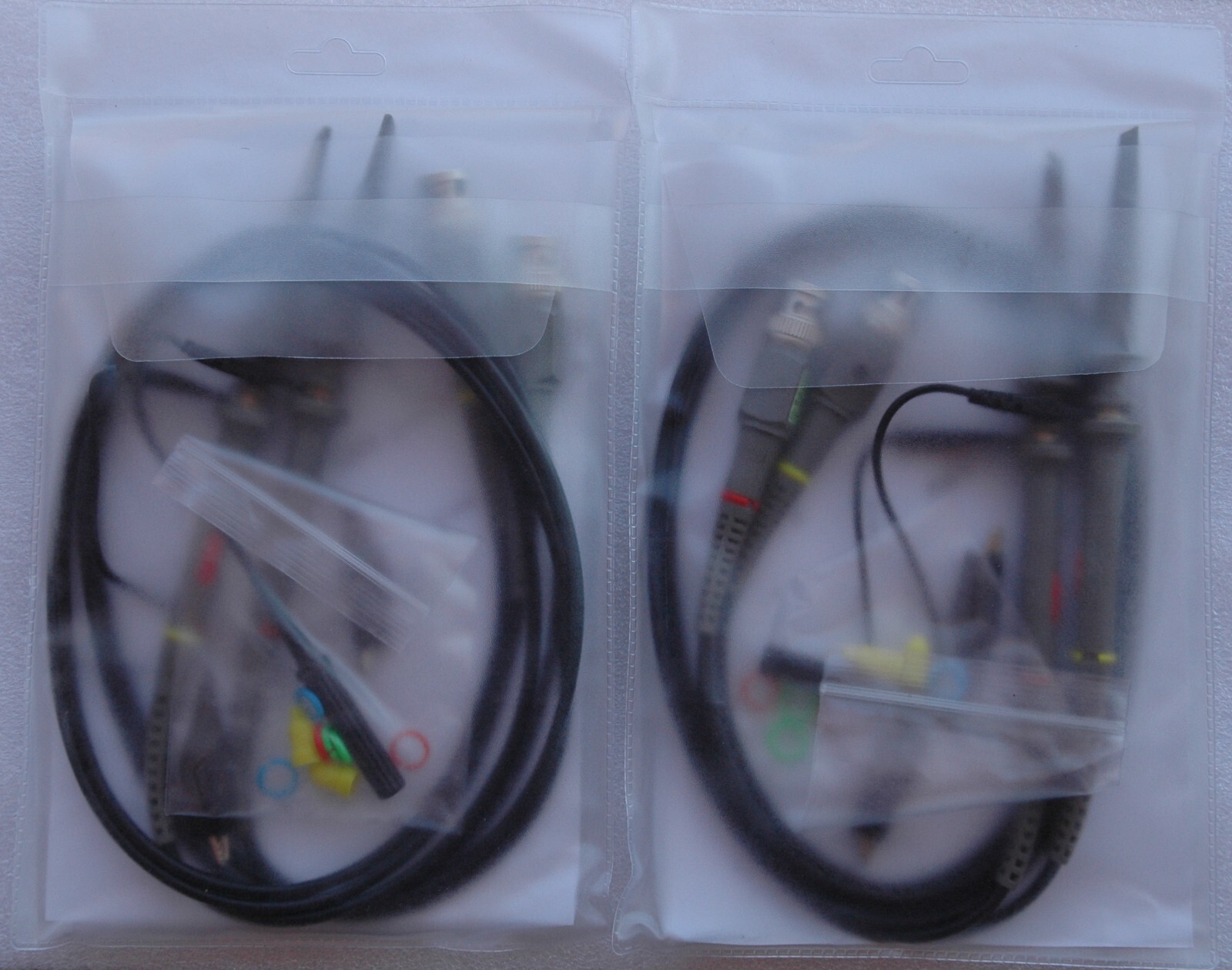

Photos from current listings. Actual item, color, and included accessories may vary.
Tektronix Oscilloscope Probe Buying Guide
Tektronix oscilloscope probes are the interface between your scope and the circuit under test, and their bandwidth, attenuation ratio, and compensation range determine whether your measurements are trustworthy. The core trade-off is genuine Tektronix passive probes with guaranteed compensation and safety ratings versus third-party clones that may claim 100–200 MHz but lack proper 10:1 compensation or CAT ratings. The decision rule: buy a probe whose bandwidth meets or exceeds your scope's analog bandwidth and whose compensation range covers your scope's input capacitance, or accept that your measurements are only as good as the probe.
Key takeaways
- Passive probe bandwidth must be at least equal to scope bandwidth; a 100 MHz probe on a 200 MHz scope limits the system to 100 MHz and degrades rise-time accuracy.
- 10:1 attenuation divides the signal by ten and multiplies input impedance, but only if the probe's compensation capacitor matches the scope's input capacitance (typically 10–20 pF for Tektronix).
- Safety ratings matter: genuine Tektronix probes carry CAT II or CAT III ratings and defined voltage derating curves, while generic clip probes often list only a bare maximum voltage with no category.
At a glance
- Category
- Test Leads, Probes, Fixtures & Accessories
- Last updated
- Nov 28, 2026
Current offers
Highlights
- Passive probe bandwidth must be at least equal to scope bandwidth; a 100 MHz probe on a 200 MHz scope limits the system to 100 MHz and degrades rise-time accuracy.
- 10:1 attenuation divides the signal by ten and multiplies input impedance, but only if the probe's compensation capacitor matches the scope's input capacitance (typically 10–20 pF for Tektronix).
- Safety ratings matter: genuine Tektronix probes carry CAT II or CAT III ratings and defined voltage derating curves, while generic clip probes often list only a bare maximum voltage with no category.
- Probe tip and ground-lead inductance limit high-frequency performance; short ground springs or bayonet tips are required for signals above roughly 20 MHz to avoid ringing.
Best use cases
- Best fit: general bench debugging of low-voltage digital and analog circuits up to 100 MHz — choose a 10:1 switchable passive probe rated for your scope's input capacitance and skip 1:1-only probes.
- Best fit: measuring power rails and audio signals where DC accuracy matters — pick a 10:1 probe with a compensation range spanning your scope's input capacitance and verify with the scope's calibrator.
- Wrong fit: probing mains-referenced or CAT III circuits with generic eBay clip probes — use a properly rated differential probe or a genuine Tektronix high-voltage probe instead.
- Wrong fit: chasing fast edges above 200 MHz — passive probes are inadequate; move to active or FET probes with low input capacitance rather than a higher-MHz passive clone.
Buying tips
- Match probe bandwidth to scope bandwidth: a 100 MHz probe on a 100 MHz scope is the minimum; for accurate rise time, choose probe bandwidth at least 3–5× the signal's highest frequency component.
- Check the compensation range: the probe's adjustable capacitor must cover your scope's input capacitance (commonly 10–20 pF for Tektronix), or the 10:1 square wave will show overshoot or rounding.
- Prefer switchable 1:1/10:1 probes for general work, but note that in 1:1 mode bandwidth drops sharply (often to 6–10 MHz) and input capacitance rises.
- Inspect the BNC connector and ground lead: genuine Tektronix probes use a standard 1 MΩ BNC interface, but clones often have looser tolerances that cause intermittent contact and noise.
Specs
| Bandwidth | 100 MHz / 200 MHz typical |
|---|---|
| Attenuation | 1:1 / 10:1 switchable |
| Input Capacitance | 10–20 pF (comp range) |
| Connector | BNC, 1 MΩ input |
Related searches
What to check before buying
- Confirm your oscilloscope's input impedance (1 MΩ) and input capacitance from its datasheet, then verify the probe's compensation range covers that capacitance.
- Measure your signal's maximum voltage and category: ensure the probe's voltage rating and CAT rating exceed the circuit's worst-case transient and working voltage.
- Check the probe tip style and accessories: standard 10:1 probes need a compatible tip, ground clip, and possibly a BNC adapter for your scope's front end.
- Verify probe bandwidth against the fastest edge you need to measure; if the probe is slower than the scope, the scope's rated bandwidth is not achievable.
FAQ
Data sources: eBay / Amazon listings and product attribute feeds. Updated Nov 28, 2026.
Some links on this page are affiliate links. If you buy after clicking one, we may earn a commission at no extra cost to you. This does not change which products appear here or their order. Affiliate disclosure.