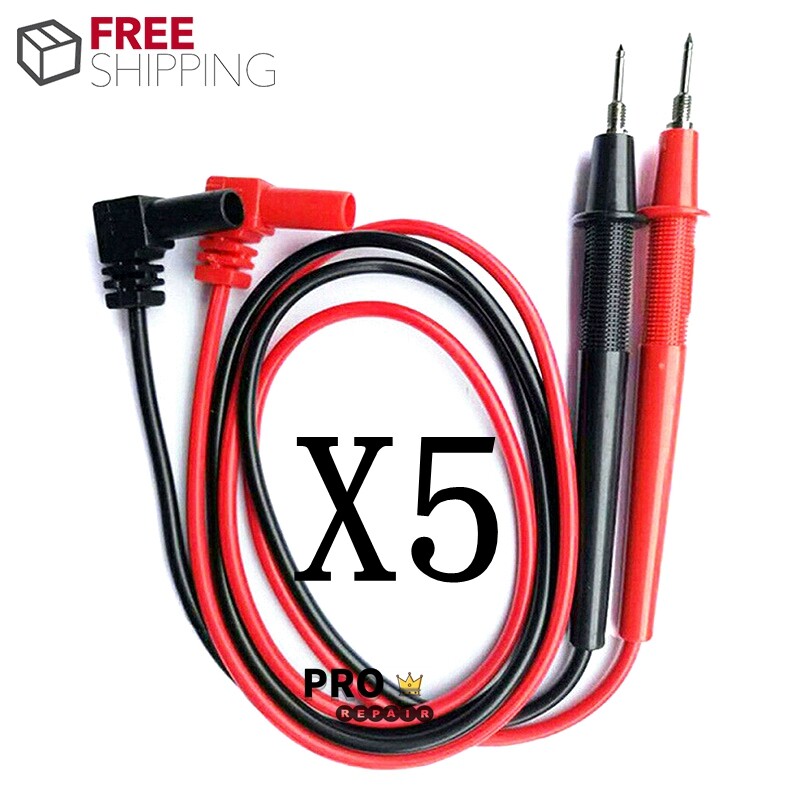

Photos from current listings. Actual item, color, and included accessories may vary.
Test Lead Wire Buying Guide
Test lead wire is the flexible, insulated conductor that carries signal or power between a meter, probe, and circuit under test. Buyers face a two-way trade-off: silicone insulation stays flexible and heat-resistant but costs more, while PVC insulation stiffens in cold and melts at lower temperatures, and conductor stranding determines both current capacity and flex life. Choose silicone-jacketed, multi-strand copper wire rated at least 1000V/10A for repeated bench work; treat thin PVC hookup wire as light-duty only.
Key takeaways
- Silicone insulation remains flexible from roughly -60°C to +200°C, while PVC stiffens below 0°C and softens near 80-105°C, so cold-bench or hot-air work favors silicone.
- Current capacity scales with conductor cross-section: 18 AWG handles about 10A, 16 AWG about 15A, and 14 AWG about 20A in short test-lead runs; thinner 22-24 AWG is signal-only.
- Fine-strand copper (high strand count, e.g. 0.1mm strands) delivers far longer flex life than coarse solid or 7-strand wire, which work-hardens and breaks at repeated bends.
At a glance
- Category
- Test Leads, Probes, Fixtures & Accessories
- Last updated
- Nov 28, 2026
Current offers
Highlights
- Silicone insulation remains flexible from roughly -60°C to +200°C, while PVC stiffens below 0°C and softens near 80-105°C, so cold-bench or hot-air work favors silicone.
- Current capacity scales with conductor cross-section: 18 AWG handles about 10A, 16 AWG about 15A, and 14 AWG about 20A in short test-lead runs; thinner 22-24 AWG is signal-only.
- Fine-strand copper (high strand count, e.g. 0.1mm strands) delivers far longer flex life than coarse solid or 7-strand wire, which work-hardens and breaks at repeated bends.
- Safety ratings differ: 1000V CAT III/IV leads suit panel and industrial measurement, while unrated 1500V/15A clip sets are bench jumper duty, not live distribution testing.
Best use cases
- Best fit: silicone 18 AWG (10A, 1000V) leads with shrouded banana plugs for daily multimeter bench and field work; skip thin PVC hookup wire if you bend leads constantly.
- Best fit: 16-14 AWG alligator-clip jumper sets (15-20A) for battery, automotive, and power-supply testing; skip them for CAT III/IV live panel measurement.
- Best fit: 22-24 AWG fine-strand wire for logic, sensor, and breadboard signal runs; skip it for any load above about 1A.
- Wrong fit: solid-core wire for test leads—it cracks at repeated flex; use it only for fixed proto-board jumpers, not handheld probes.
Buying tips
- Match AWG to load: 18 AWG for 10A, 16 AWG for 15A, 14 AWG for 20A; add margin if leads run bundled or in warm enclosures.
- Pick silicone jacket over PVC for flexibility below freezing and resistance to soldering-iron contact; PVC is acceptable for indoor room-temperature signal work.
- Choose fine-strand tinned copper over solid or 7-strand for flex life; tinning resists corrosion and improves solderability.
- Confirm connector standard: 4mm shrouded banana plugs mate with most multimeters; 2mm pins suit compact meters, and clip sets use screw or crimp terminations.
Specs
| Insulation | Silicone (-60 to +200°C) vs PVC |
|---|---|
| Conductor Gauge | 18 AWG 10A / 16 AWG 15A / 14 AWG 20A |
| Voltage Rating | 1000V CAT III/IV vs 1500V unrated |
| Connector Standard | 4mm shrouded banana / 2mm pin |
Related searches
What to check before buying
- Verify your meter's jack type and spacing: standard 4mm banana sockets vs 2mm pin jacks, and whether jacks are shrouded or exposed.
- Check the voltage/current you will measure against lead rating (CAT III/IV and 1000V vs 1500V clip sets) before connecting to any live circuit.
- Confirm wire length and gauge suit reach and load: longer runs add resistance, so step up one AWG size for runs beyond about a meter at full current.
- Check tip and clip compatibility: probe tip diameter (2mm vs 4mm) and alligator jaw opening must grip your test points or terminals.
FAQ
Data sources: eBay / Amazon listings and product attribute feeds. Updated Nov 28, 2026.
Some links on this page are affiliate links. If you buy after clicking one, we may earn a commission at no extra cost to you. This does not change which products appear here or their order. Affiliate disclosure.