Setting up a lab bay for heating, cooling, and vacuum work usually raises the same question: do you start with a rotary evaporator or a recirculating chiller? The two are often used together, but if you're buying one instrument at a time, the choice comes down to the job you need to unlock first. The rotary evaporator is listed at USD 516.99, and the lab chiller circulator is listed at USD 740.34. This head-to-head compares them on price, core role, and practical fit for your bench.
Quick verdict
If your immediate work is solvent removal, concentration, or drying samples under reduced pressure, the rotary evaporator is the direct tool for the job. If your immediate work is maintaining precise temperatures for reactions, samples, or lab instruments, the chiller circulator is the more flexible choice. Neither tool replaces the other; the right first purchase is the one that matches your daily workflow.
Comparison at a glance
| Comparison | 2L Rotary Evaporator | 6L Lab Recirculating Chiller |
|---|---|---|
| Listed price | USD 516.99 | USD 740.34 |
| Primary job | Solvent removal under vacuum with a 1L evaporation flask and 1L collecting bottle | Temperature-controlled circulation from 23°F to 212°F (-5°C to 100°C) |
| Standout specs | Manual lifting, high-temperature-resistant glass | 0.01°C adjustment, external circulation mode |
Where each product wins
Rotary evaporator. The rotary evaporator is the right first tool when solvent removal is the bottleneck in your workflow. It gives you a dedicated path to concentrate or dry samples under reduced pressure. Paired with a pump and a chiller, it becomes the centerpiece of a complete evaporation setup.
Chiller circulator. The chiller circulator wins when temperature control is the shared requirement across many experiments. It brings active temperature control to whatever equipment you connect it to. If you need stable temperatures for samples or reactions, this is the tool that covers those needs.
Product notes
2L Rotary Evaporator
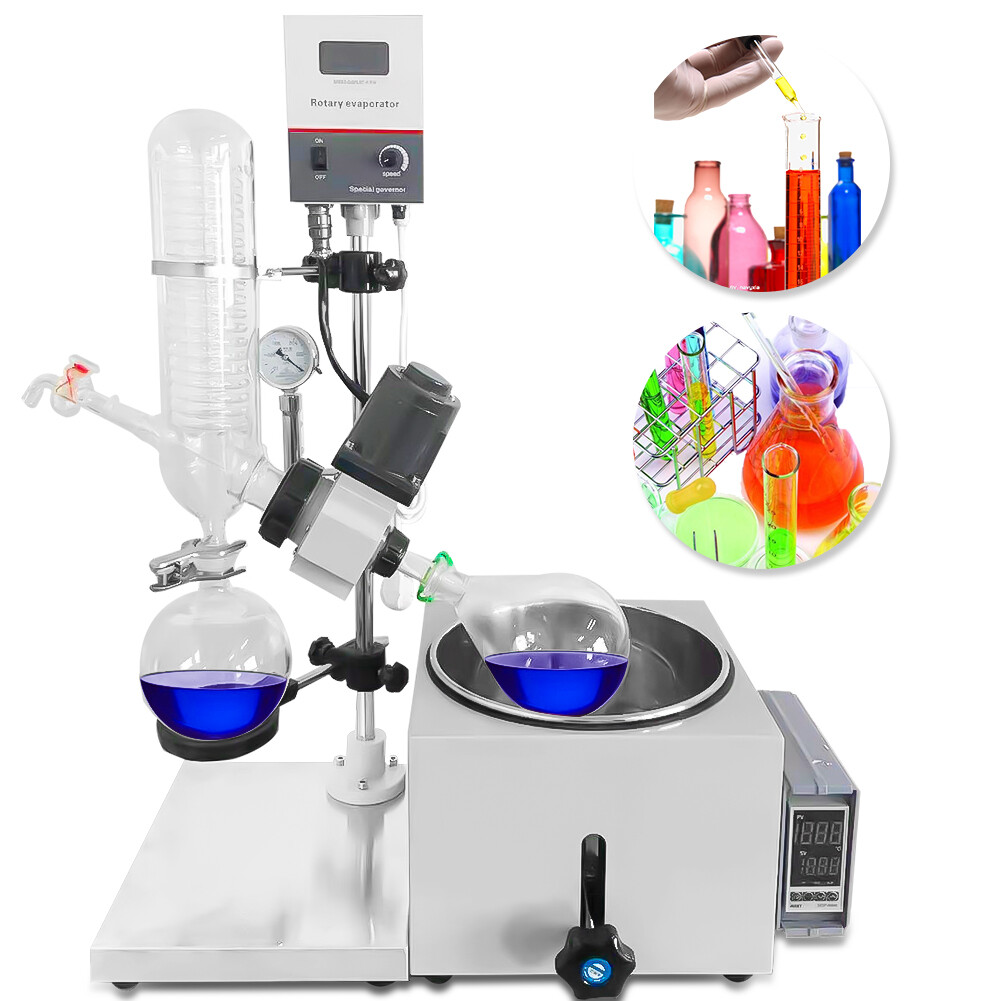
This rotary evaporator is the practical starting point for labs that routinely remove solvent from samples. It comes with a 1L evaporation flask and a 1L collecting bottle, both made from high-temperature-resistant glass, and the stainless steel bracket gives the setup a sturdy foundation. The manual lifting control is straightforward: you raise and lower the flask yourself, which keeps the mechanism simple and gives you direct feedback during a run. Because it's designed to connect to a vacuum pump and chiller, it fits neatly into an existing lab heating-and-cooling rig. The trade-off is that this is a manual-lift unit, so it lacks the convenience of motorized raising for large or frequent batches. Also, if your lab's primary need is temperature control for reactions, this will still need a chiller to run properly.
6L Lab Recirculating Chiller
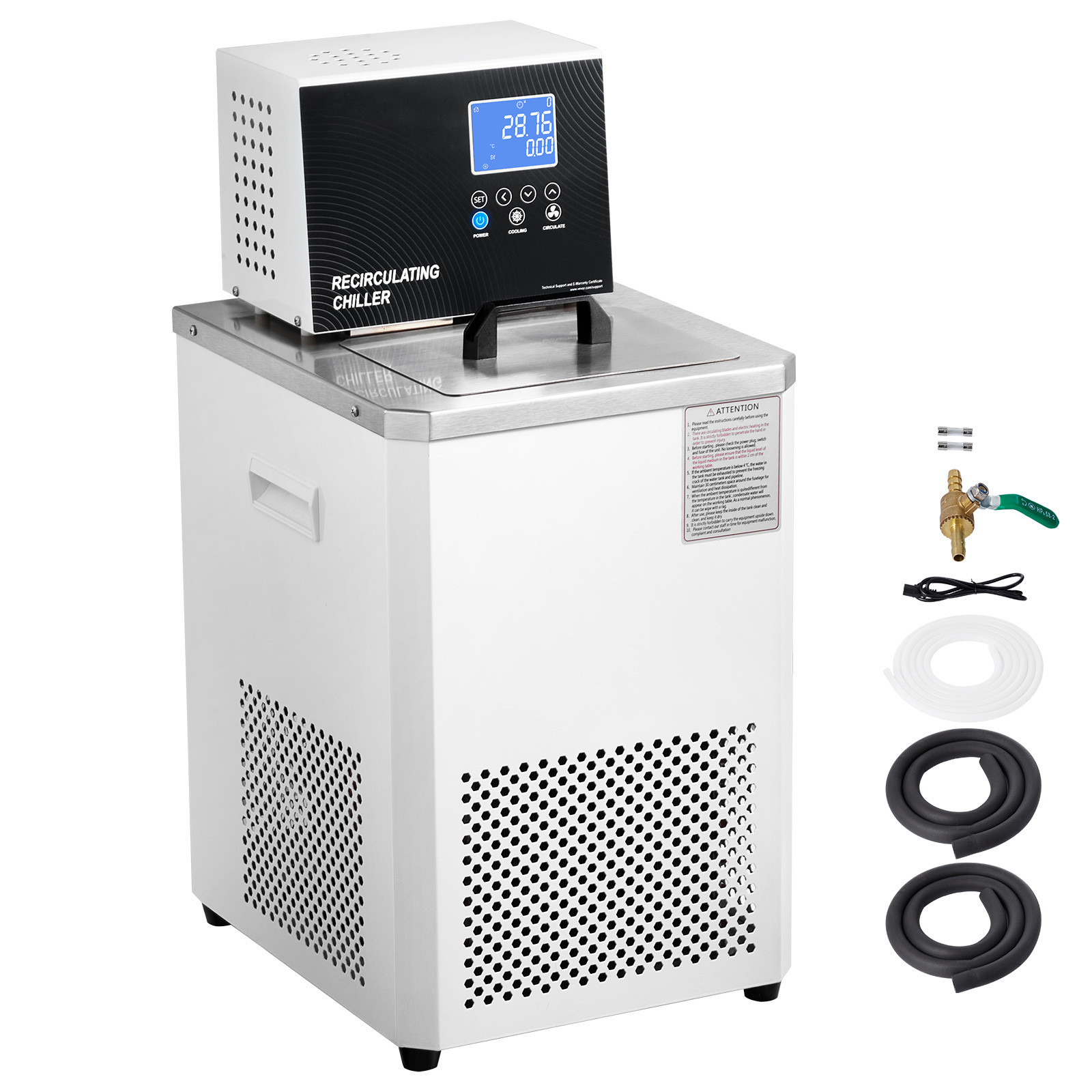
If precise temperature control is your starting point, this chiller circulator is the more flexible piece of equipment. Its dual circulation system lets you operate in internal mode for uniform temperatures in small-scale experiments and sample preservation, then switch to external mode to pump temperature-controlled fluid through a reactor, condenser, or other external equipment. The setpoint range spans 23°F to 212°F (-5°C to 100°C), so it can handle both cold biological-sample storage and hot chemical synthesis. The countertop tank is made of 304 stainless steel, and the temperature display reads in 0.01°C increments, making fine adjustments easier. The main limitation is that it doesn't provide vacuum function-you'll still need a pump for evaporation work.
Final choice by use case
- Choose the rotary evaporator if your primary protocol is solvent removal, sample concentration, or drying under reduced pressure. Start with the rotary evaporator and add a chiller later for a full rotovap setup.
- Choose the chiller circulator if your primary protocol is temperature-sensitive reactions or sample storage. It gives you the most flexibility from the start.
- If you truly need both, buy the rotary evaporator first and add the chiller when your protocol demands it.