When you start comparing oscilloscopes signal spectrum analyzers, the first thing you'll see is the massive price spread. Two used Agilent instruments at opposite ends of that range show how different the tools can be. The Agilent N9320B is a straightforward RF spectrum analyzer priced at the low end of the market, while the Agilent Keysight E5052B is a signal source and phase noise analyzer aimed at advanced RF characterization. This head-to-head will help you figure out which one deserves a spot on your bench.
Quick Verdict
The N9320B is the sensible choice for general RF measurements, education, and troubleshooting where a 3 GHz analyzer and a modest budget are enough. The E5052B is the tool for engineers who need phase noise, VCO, and clock jitter analysis up to 7 GHz and can justify the cost. In short: if you are measuring signals, pick the N9320B. If you are analyzing the sources themselves, choose the E5052B.
Side-by-Side Comparison
| Feature | Agilent N9320B | Agilent Keysight E5052B |
| Price | $1,200 | $36,500 |
| Frequency range | 9 kHz - 3 GHz | 10 MHz - 7 GHz |
| Primary function | RF spectrum analyzer | Signal source / phase noise analyzer |
| Notable spec | Displayed average noise level -130 dBm, resolution bandwidth 10 Hz to 1 MHz | Designed for VCO and clock jitter characterization |
| Condition | Used; sold as-is, out of calibration | Used |
Where Each Product Wins
The N9320B wins for anyone who needs a working spectrum analyzer without spending a fortune. Its frequency coverage of 9 kHz to 3 GHz handles most RF interference checks, beacon testing, and equipment verification. The E5052B wins for advanced signal source characterization. Its phase noise analysis and jitter measurement features, combined with the 7 GHz top end, put it in a different league. If your work rarely goes beyond measuring the frequency and amplitude of a signal, the N9320B gives you the essential tools at a fraction of the cost. If you need to understand a signal source's stability, spectral purity, or jitter, the E5052B is the analyzer designed for that depth.
Product Notes
Agilent N9320B 9 kHz - 3 GHz RF Spectrum Analyzer
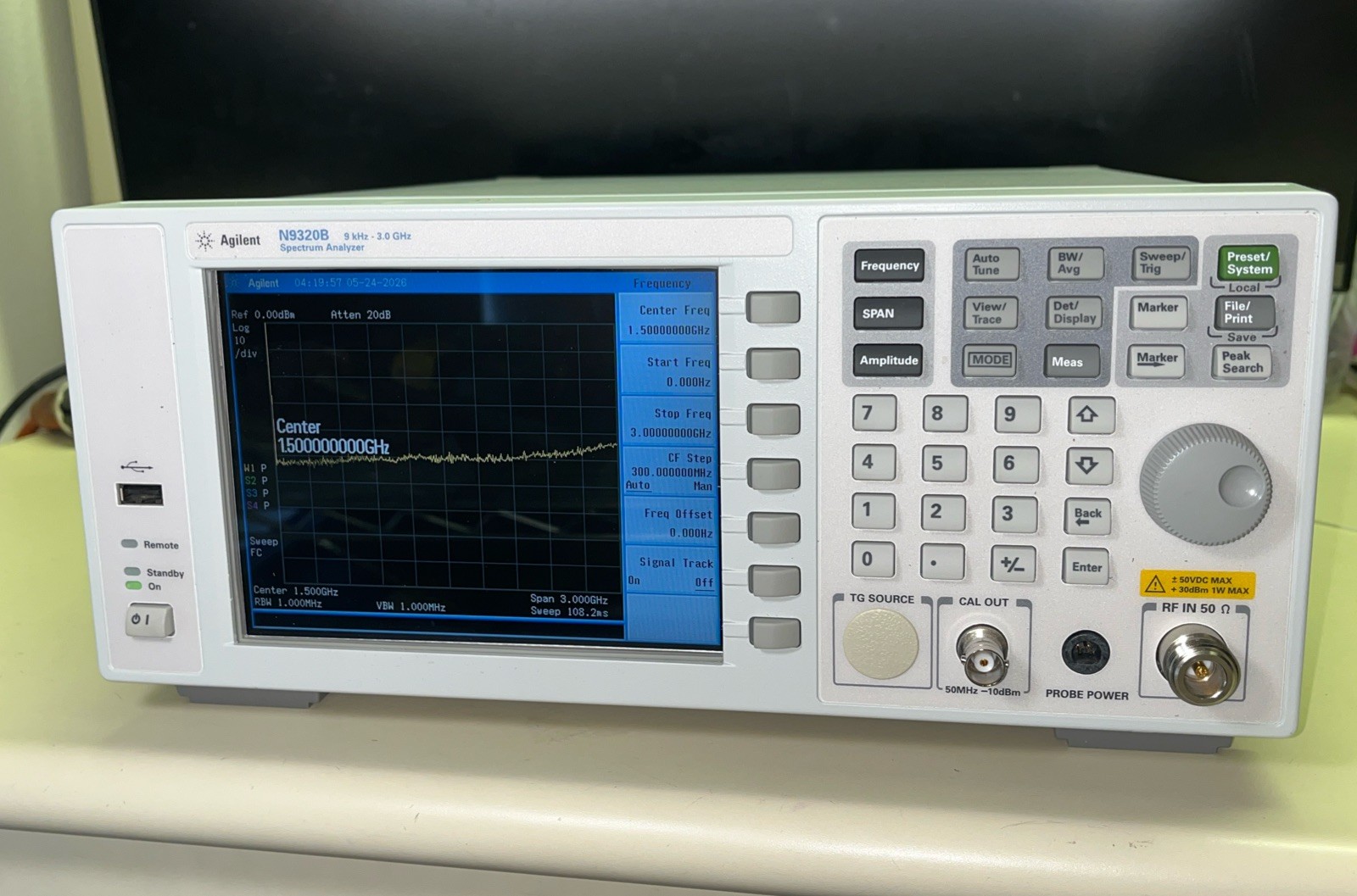
The N9320B covers a wide practical range with a displayed average noise level of -130 dBm and resolution bandwidth from 10 Hz to 1 MHz, giving you a serviceable view of RF signals in the field or classroom. If it fits your needs, the included spec is strong for the money. The big limitation is that this unit is sold as-is and out of calibration, and it arrives without accessories or a power cable. You will need to arrange calibration and bring your own cables before you can trust its measurements. For a technician's bench or a learning lab, that trade-off can be worth it.
Agilent Keysight E5052B Signal Source/Phase Noise Analyzer 10MHz-7GHz
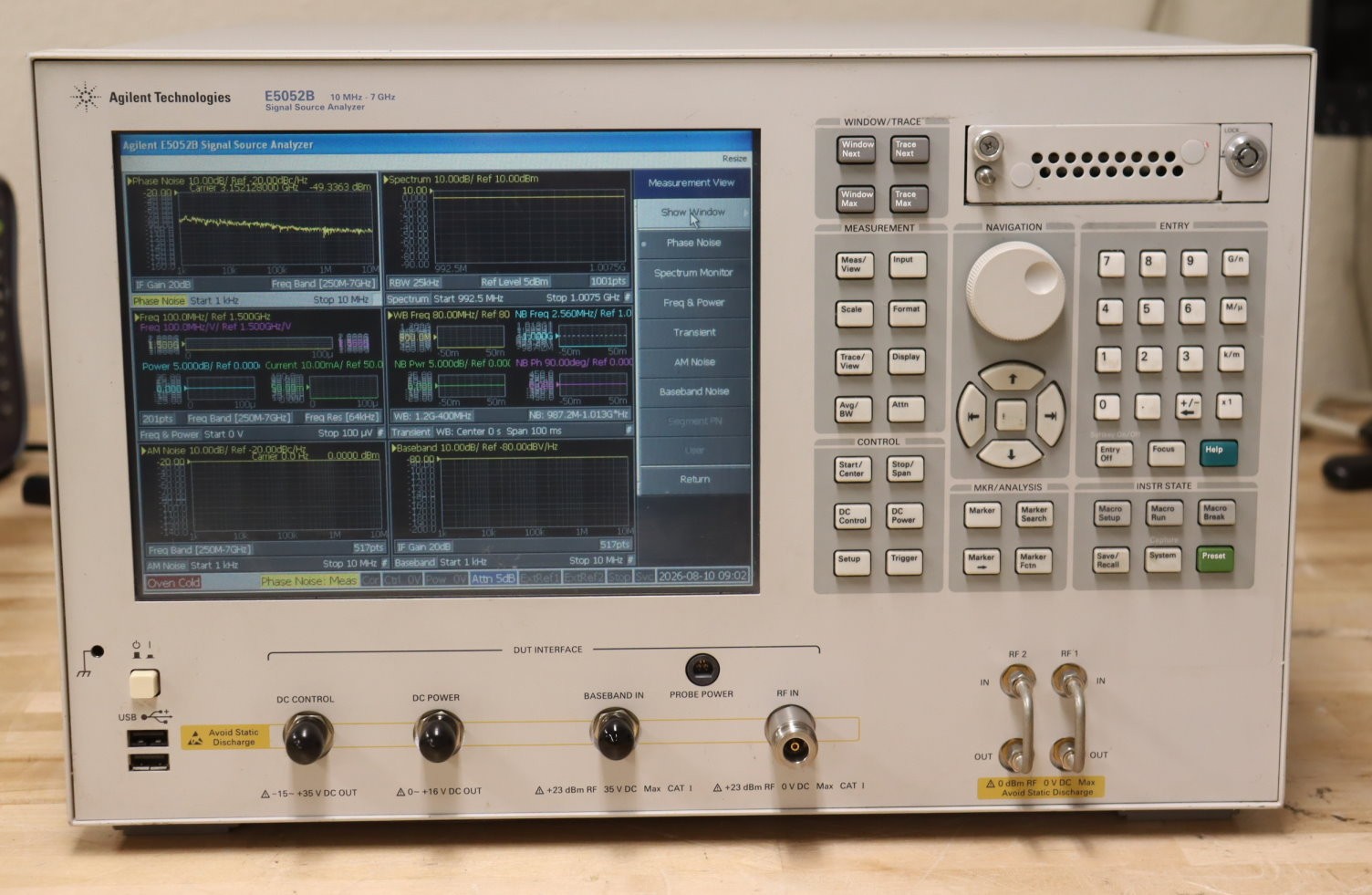
The E5052B is built for one thing: deep analysis of signal sources. Its 10 MHz to 7 GHz range and phase noise measurement capability are designed for evaluating VCOs, system reference clocks, and high-speed data communication circuitry. That makes it the pick when you need to see how a signal source behaves under demanding conditions. The limitation is its starting frequency: 10 MHz means you can't use it for low-frequency audio or IF work. And given its price tier, you are paying for high-end features rather than basic spectrum analysis. If your projects revolve around oscillator design or jitter evaluation, this is the analyzer that will earn its place.
Final Choice by Use Case
Choose the Agilent N9320B at $1,200 when your work is standard RF frequency measurements, interference hunting, or teaching spectrum analysis. Choose the Agilent Keysight E5052B at $36,500 when phase noise, VCO characterization, and clock jitter evaluation are a core part of your engineering routine. There is no single "best" here; the right instrument depends entirely on the measurements you need to make.