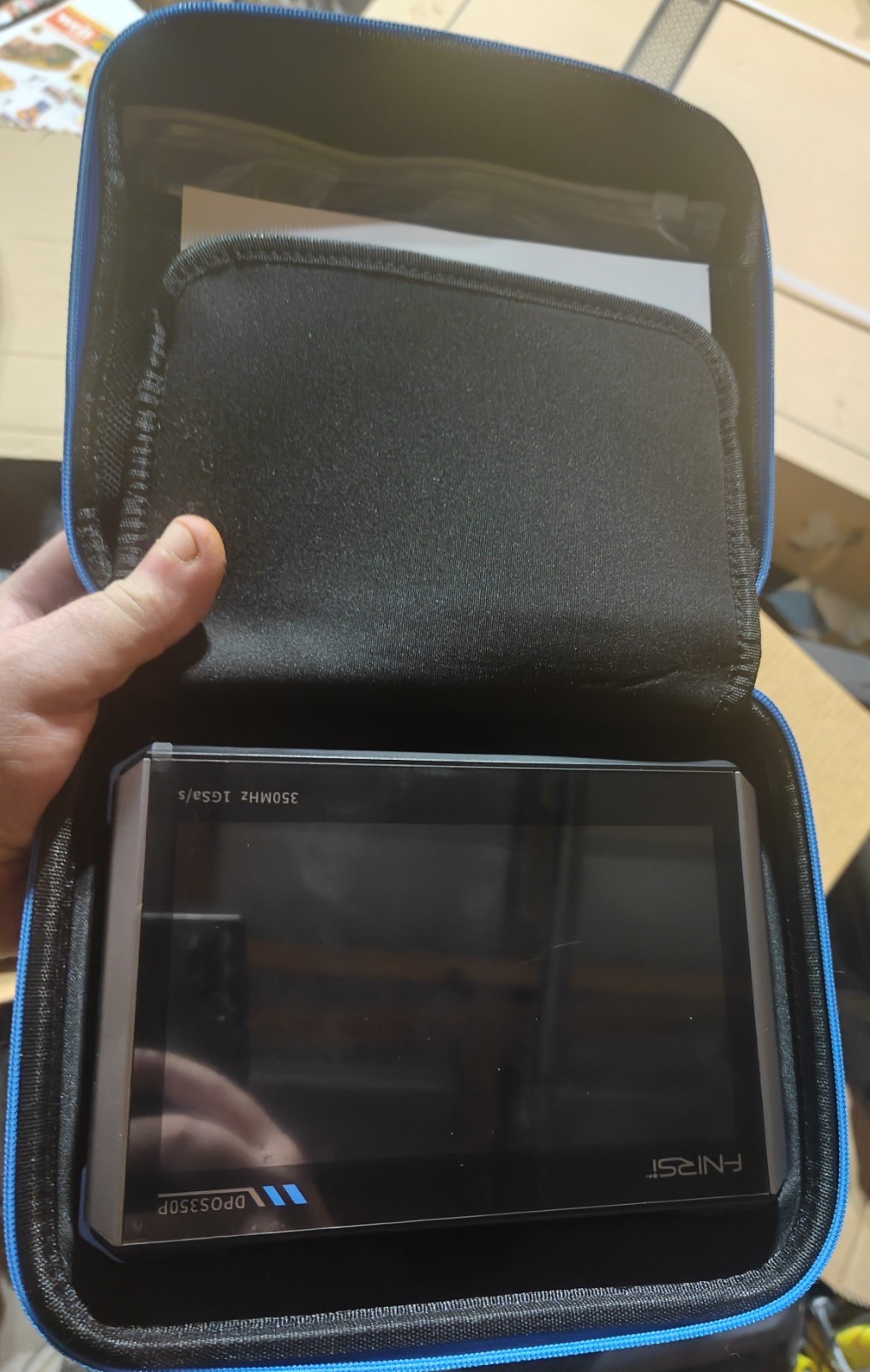
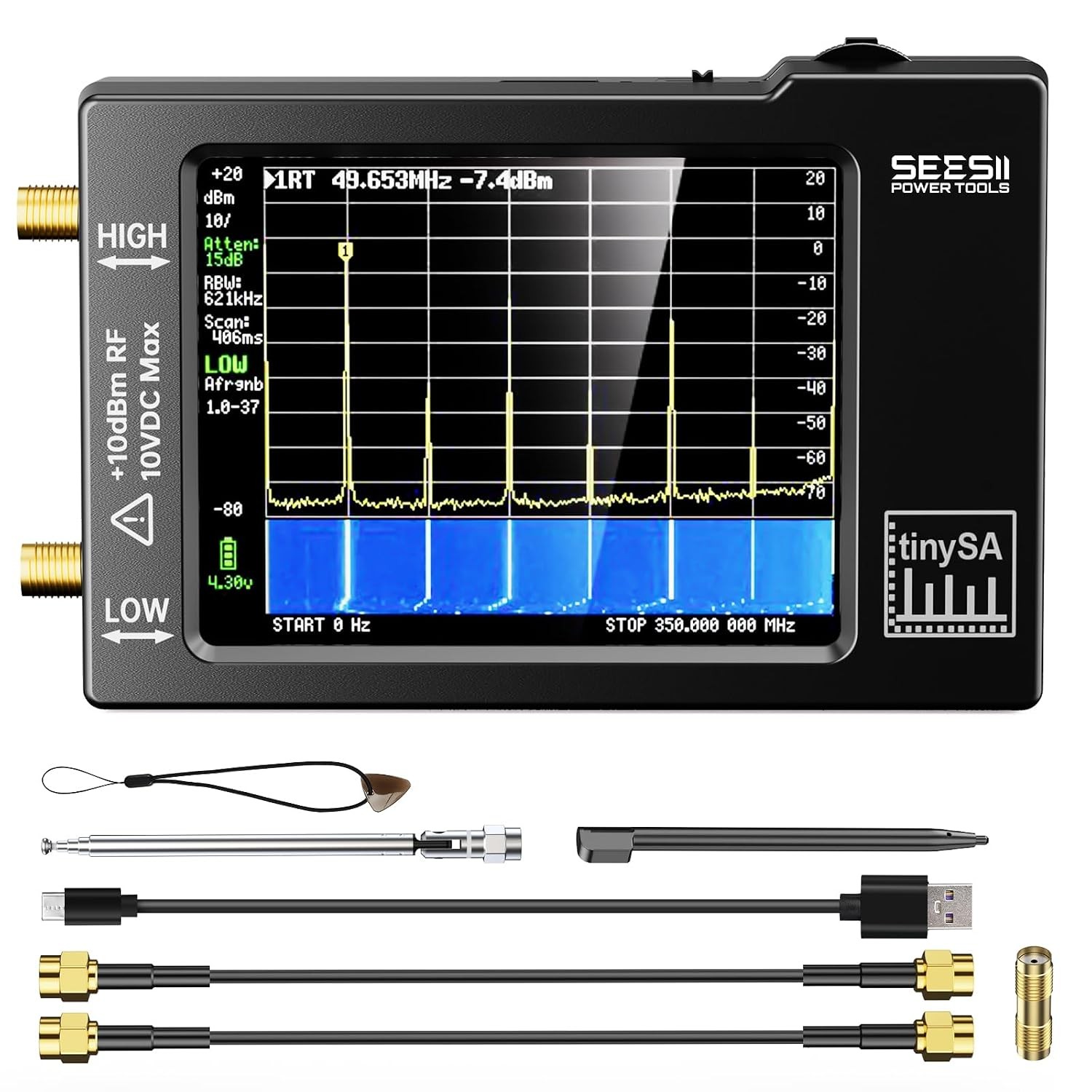
If you are choosing between signal analysis instruments for your bench, the first question is whether you need to see waveforms or just watch frequencies. The DPOS350P answers with an oscilloscope; the TinySA answers with a dedicated frequency analyzer that covers the low-frequency through UHF range. They sit at opposite ends of a $39.98-to-$225 range, so the real choice is about what kind of work your instrument will do.
Quick verdict
Buy the DPOS350P when your projects involve waveform detail: capturing a fast edge or measuring parameters across two channels. Buy the TinySA when your main task is frequency sweeping in the MF/HF/VHF range, with UHF coverage as a useful extra, and you want a focused frequency tool rather than a full oscilloscope. In short, the DPOS350P is the more complete instrument; the TinySA is the more focused frequency tool.
At a glance
| Instrument | Listed price | Price bar | Core specs | Best suited to |
|---|---|---|---|---|
| DPOS350P 4-in-1 Digital Oscilloscope | USD 225.00 | 350MHz bandwidth, 2 channels, 1GSa/s sampling, 7-inch 1024x600 display, signal generator and spectrum analyzer | Bench work needing time-domain detail plus frequency checks | |
| TinySA Spectrum Analyzer | USD 39.98 | 100kHz to 960MHz sweeps, two inputs, switchable resolution filters, calibration signal generator | Frequency tracing, band hunting, and signal source output |
Where each product wins
- The DPOS350P wins when the job is time-domain work: a scope with fast sampling and a large, readable display.
- The TinySA wins when the job is frequency-domain work: wide sweep coverage with adjustable resolution filters.
DPOS350P 4-in-1 Digital Oscilloscope
The DPOS350P gives you a real oscilloscope at the center of the kit. The 2 digital channels, 350MHz bandwidth, and 1GSa/s real-time sampling are enough for high-speed logic and analog signals, and the 5ns-to-50s time base spans very fast edges to slow sweeps. The 1024x600 display on a 7-inch screen shows waveform detail clearly, while the 12 parameter measurements and ±400V overvoltage protection make bench work easier. The trade-offs are the open-box condition and the broader all-in-one design: if your only job is frequency sweeping, you are paying for oscilloscope capability you may not use.
TinySA Spectrum Analyzer
The TinySA packs a lot of analysis into one tool. It covers 100kHz to 960MHz through two inputs: a high-quality MF/HF/VHF input for 0.1MHz to 350MHz, and a secondary UHF input for 240MHz to 960MHz. Switchable resolution bandpass filters between 2.6kHz and 640kHz let you choose between finer detail and faster sweeps, and the color display shows 290 scan points at a time. The main limitations are its used condition and the description of the UHF input as lesser quality, so treat UHF readings as a helpful check rather than a precision reference.
Final choice by use case
Choose the DPOS350P if you regularly troubleshoot or measure waveforms and want one instrument for waveform viewing, signal generation, and frequency checks. Choose the TinySA if your work is centered on frequency coverage and cost, and you can live with a used unit and a secondary UHF input. The deciding factor is whether an oscilloscope belongs on your bench. Once you know whether you are chasing time-domain details or frequency-domain patterns, the better buy becomes obvious.