Choosing an oscilloscope or signal spectrum analyzer for repair work often comes down to a practical trade-off: do you want a small, straightforward instrument for learning and basic troubleshooting, or more headroom for demanding measurements? The DSO153 Handheld Digital Oscilloscope Portable Mini DSO for Beginner Repair Teaching is aimed at the first use case. Its portable format and beginner-focused title make its intended role clear, while its bandwidth and compact screen define where it fits.
Quick verdict
At USD 26.99, this handheld digital oscilloscope is a focused pick for someone who wants a portable scope for beginner repair, teaching, or simple signal checks. The key question is whether its two channels, 1 MHz bandwidth, and 5 MS/s maximum real-time sampling rate align with the signals you plan to view. Those specifications point to a compact learning and repair tool rather than a choice for work that requires greater measurement headroom.
Who it suits
This DSO153 makes the most sense for a beginner working through basic electronics repair or teaching oscilloscope fundamentals. The product title directly identifies those uses, and the two-channel configuration gives users the ability to view two signals together. It also combines oscilloscope and multimeter functionality, which may appeal to shoppers who want both functions in one handheld device.
It is less suitable when a larger display or broader signal range is the main priority. The product is best matched with tasks that stay within its stated specifications and with users who value a portable format over a more expansive viewing area.
Handheld Digital Oscilloscope Portable Mini DSO for Beginner Repair Teaching
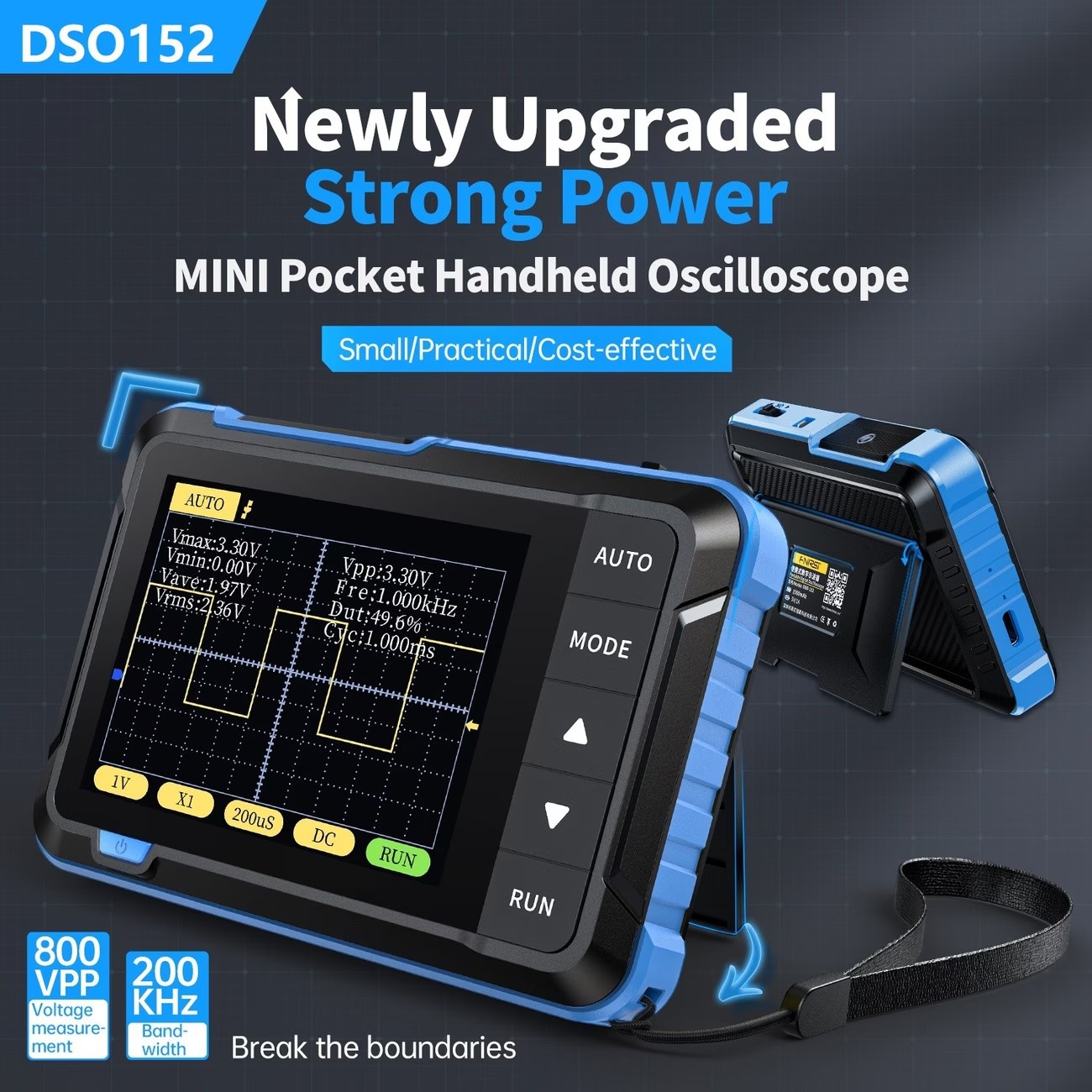
The strongest reason to choose this DSO153 is the combination of a mini handheld design and two channels in a single portable instrument. That matches the repair-and-teaching focus in its name and provides a straightforward starting point for basic waveform work.
The clearest limitation is the 2.8-inch LCD with 320 x 240 resolution. That compact display keeps the unit small, but it can make detailed waveform viewing less comfortable than on a larger-screen instrument. This is the concrete trade-off to weigh before choosing it.
What stands out
Beyond the core scope function, the device includes AUTO, Normal, and Single operating modes. The Type-C interface supports data transfer and charging, while direct firmware updates are supported. A built-in 1000mAh lithium battery is also part of the design, reinforcing the handheld approach.
The combination of a digital oscilloscope and multimeter function adds practical flexibility for beginner repair work. Rather than focusing on one listed feature alone, the appeal is the way the operating modes, two-channel setup, and portable design fit the product's stated teaching and repair purpose.
Meaningful trade-offs
The main trade-off is measurement headroom. A 1 MHz bandwidth and 5 MS/s sampling rate create a narrower fit for shoppers whose work calls for faster sampling or a wider frequency range. The compact screen is a second consideration: users who prefer more room for waveform viewing may find the 2.8-inch format restrictive.
Those limits do not conflict with the product's intended beginner repair and teaching role. They simply make it important to match the DSO153 with straightforward tasks rather than expecting a broader-purpose measurement setup.
Bottom line
For a shopper seeking a compact oscilloscope for beginner repair or teaching, the DSO153 offers a direct feature-to-use-case match: two channels, multimeter functionality, Type-C connectivity, and portable operation. It is a focused choice when those functions matter more than a larger display or greater measurement headroom.