When you're shopping for oscilloscopes for signal analysis, the first tension is usually bandwidth versus price. You want enough sample rate to see fast edges, enough memory to zoom into long captures, and ideally a signal generator so you can test circuits without a second instrument. The Hantek Digital DSO2000 Series Oscilloscope tries to answer all of that in one package.
Quick verdict
At $199.97, the Hantek DSO2000 is a digital oscilloscope with a 2-channel front end, 1 GSa/s sampling, and 8M memory depth. It covers the essentials for everyday signal work, and the DSO2D10 model is the variant at the heart of that package.
Who it suits
This scope suits anyone debugging microcontrollers, power supplies, or audio and sensor circuits. The series spans 100 MHz and 150 MHz analog bandwidth options, so it covers many common signal speeds. If you expect to zoom into long captures, the deep memory is a plus.
What stands out
The 32 kinds of auto measurements with statistics, protocol decode for RS232/UART, I2C, SPI, CAN, and LIN, a 3-digit digital voltage meter, and a 6-digit hardware frequency indicator make this more than a bare waveform viewer. You can also save settings, waveforms, reference waveforms, CSV, and pictures for documentation.
Meaningful trade-offs
The biggest trade-off is channel count. This is a 2-channel scope, and the extra channel on the DSO2D10 is the built-in waveform generator, not a third analog input. If you need to monitor three or more analog signals, this won't cover you.
Bottom line
For $199.97, the Hantek DSO2000 is a practical digital oscilloscope for signal analysis. If you need a single instrument for common debugging tasks and don't require three or more analog inputs, it's a straightforward choice.
Hantek Digital DSO2000 Series Oscilloscope (DSO2D10)
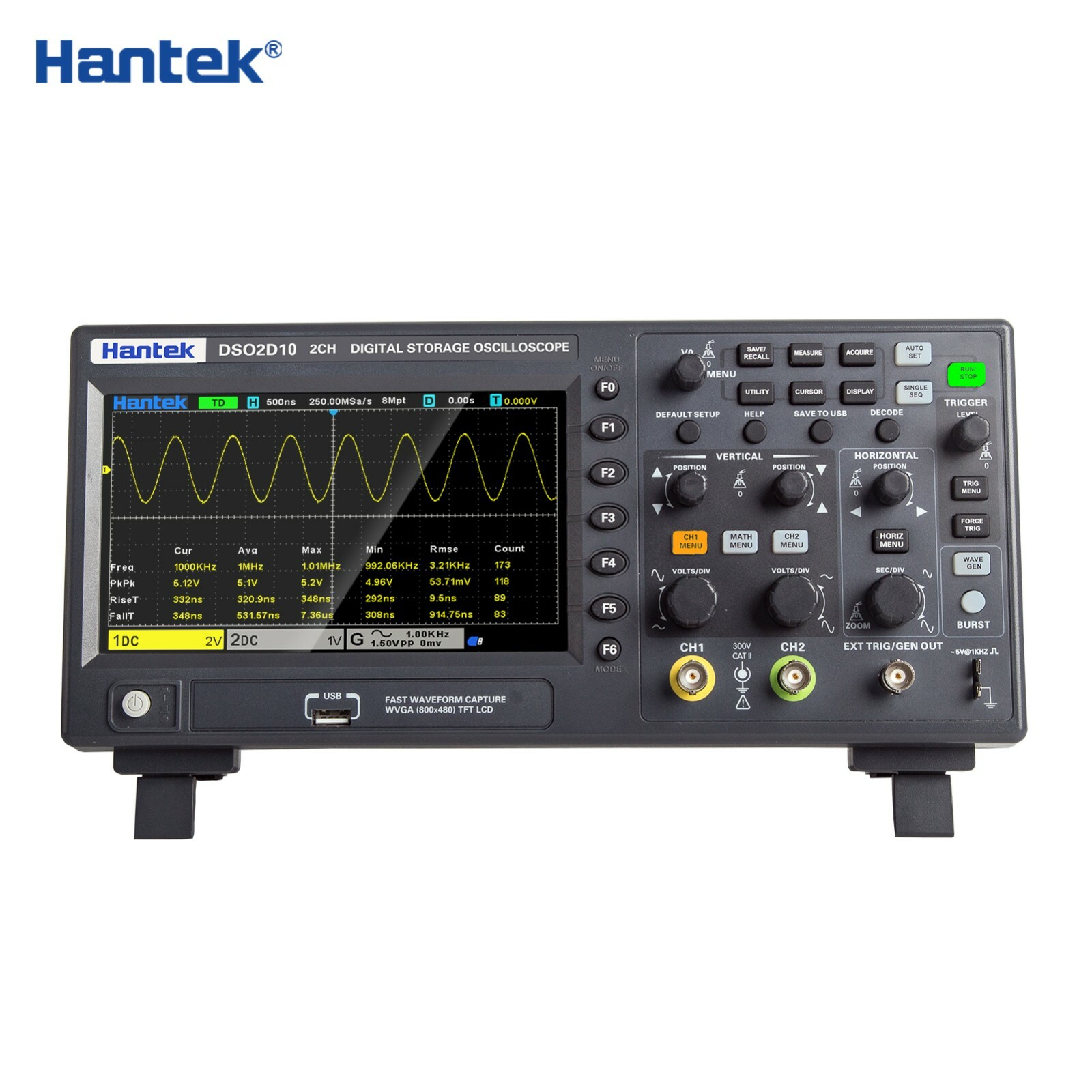
The DSO2D10 is the model that includes the 1-channel 25 MHz waveform generator alongside the standard scope functions. Choose it when you want measurement and stimulus generation in one box. The limitation to keep in mind is the 8-bit vertical resolution, which is better suited to general-purpose signal viewing than high-precision low-amplitude measurements.