When it comes to environmental indoor air measurement, the first question isn't just "is this room clean?" It's "what do I actually want to measure?" One monitor in this head-to-head is a specialized particle counter that tracks three specific particle sizes and records a history. The other is a multi-function detector that aims for a broad overview. Here's how to decide.
Quick verdict
If you need to know specific particle-size counts, the Air Quality Monitor with Dust Particle Counter is the one. If you want a simple, portable detector for a general sense of your indoor air, the LifeBasis Air Quality Detector is the easier pick. The $120 gap between them makes the choice about how much detail you need.
Comparison table
| Product | Price | What it does | Standout feature |
|---|---|---|---|
| Air Quality Monitor (PM0.3/2.5/10 Dust Particle Counter) | $159.99 | Measures PM0.3, PM2.5, and PM10 with laser scattering, plus temperature and humidity | Stores 999 timestamped readings and shows a trend chart |
| LifeBasis 11-in-1 Air Quality Detector with Stand | $39.99 | 11-in-1 detector for indoor air quality | Runs on battery and includes a stand |
Where each product wins
The particle counter wins when you need to know specific particle size levels. It's built for detailed, real-time tracking, and that focused capability is what sets it apart. If you're comparing air quality before and after a change, this is the tool that gives you the numbers.
The LifeBasis wins when you want a broad, easy-to-use detector. Its approach is about giving you an overall look at indoor air rather than a deep dive into a single metric. For everyday awareness, it's the simpler companion.
Product notes
Air Quality Monitor (PM0.3/2.5/10 Dust Particle Counter)
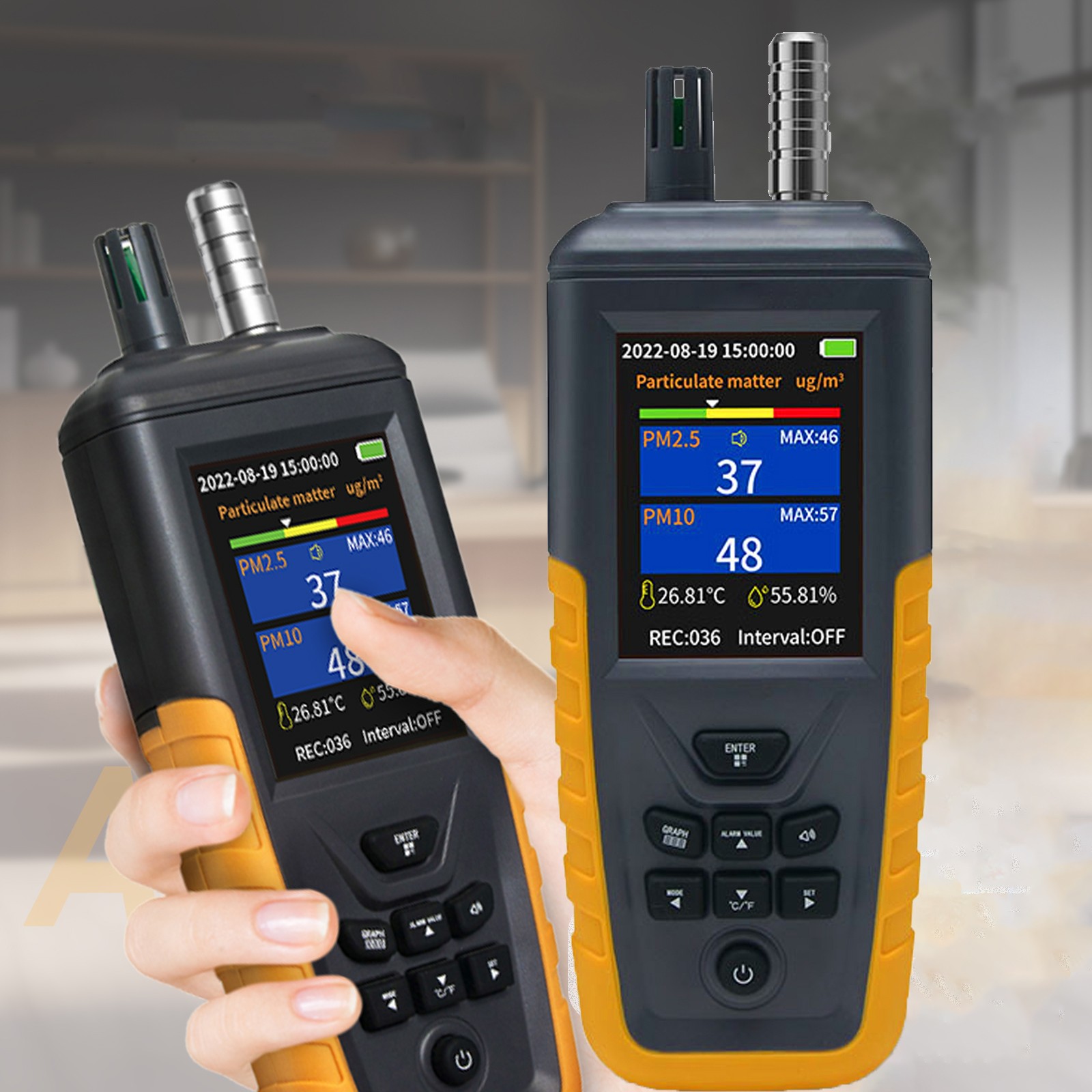
This monitor uses laser scattering to measure PM0.3, PM2.5, and PM10 with an accuracy of ±12μg/m³. It also tracks temperature and humidity, and stores up to 999 timestamped measurements with a trend chart, so you can spot patterns over a day or week. An adjustable audible alarm lets you set your own threshold, and the CE certification adds to its reliability. Choose this one if you want a detailed record of how particle levels change over time. The limitation is that its focused design is more than a casual user needs just to get a sense of whether the air is fine. If you're the kind of person who likes data, this monitor delivers it; if you just want a nod of approval, it's more instrument than you may require.
LifeBasis 11-in-1 Air Quality Detector
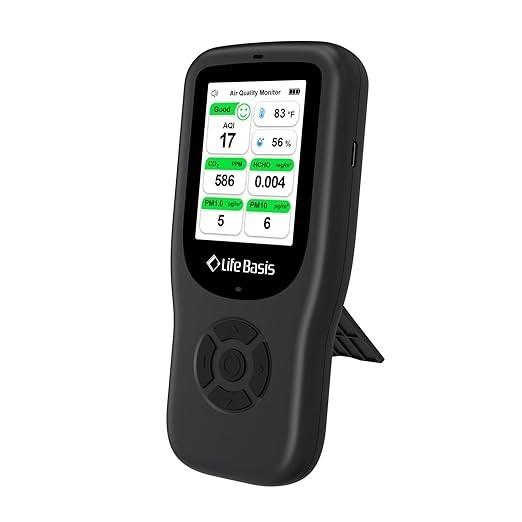
The LifeBasis detector runs on battery power and includes a stand, so you can place it just about anywhere without hunting for an outlet. It's positioned as a multi-function detector, meaning it's looking at indoor air quality from multiple angles rather than focusing on one number. The real-time readings are easy to use, and the device stays out of the way. If you want a detector that's simple to move and simple to understand, this is it. The limitation is that breadth is the goal here; anyone needing deep particle-size data will want the dedicated counter. For everyday reassurance, though, the LifeBasis offers a convenient way to keep an eye on your home's air.
Final choice by use case
If your planning depends on specific particle size readings, the Air Quality Monitor (PM0.3/2.5/10 Dust Particle Counter) is the right pick. It's the one that will tell you when a particular size fraction climbs.
If you just want a practical detector for daily awareness, the LifeBasis Air Quality Detector is the easier choice. It gives you a broad read on your indoor air without making you learn a single metric.