For anyone shopping in the oscilloscopes and signal spectrum analyzers space, the decision often comes down to whether a high-end analyzer can match the demands of your bench. That's the situation with the Agilent Keysight E5052B Signal Source/Phase Noise Analyzer, a 10 MHz to 7 GHz base model with a focus on measurement throughput for VCO, reference clock, and clock jitter applications.
Quick Verdict
The E5052B is a compelling choice if your work regularly involves VCOs, system reference clocks, LAN modules, or high-speed data communication links where clock jitter is a critical spec. With coverage from 10 MHz to 7 GHz, it handles a wide swath of oscillator characterization tasks without forcing you to move between multiple instruments. Priced at US$36,500, it's a significant commitment, and it's worth that investment only if your workloads genuinely need the throughput and phase noise capabilities this analyzer brings.
Who It Suits
This analyzer is built for engineering teams and labs that characterize high-frequency signal sources day in and day out. If you're working on RF, microwave, or millimeter-wave oscillators, or on timing-critical circuits like LAN modules, the E5052B speaks directly to those applications. It also fits high-speed data communication systems where clock jitter evaluation is essential. You'll want to be comfortable working within the base frequency coverage, because the instrument's range is what defines its usefulness.
What Stands Out from the Listed Details
The E5052B is specifically positioned around the needs of VCO and signal source characterization. Its measurement throughput is a key highlight; in a busy lab, that means less time staring at sweeps and more time interpreting results. The same strengths carry over to clock jitter evaluation, which is a growing concern as data rates climb. The unit is identified as the E5052B model, so you know exactly which instrument you're evaluating.
Agilent Keysight E5052B Signal Source/Phase Noise Analyzer
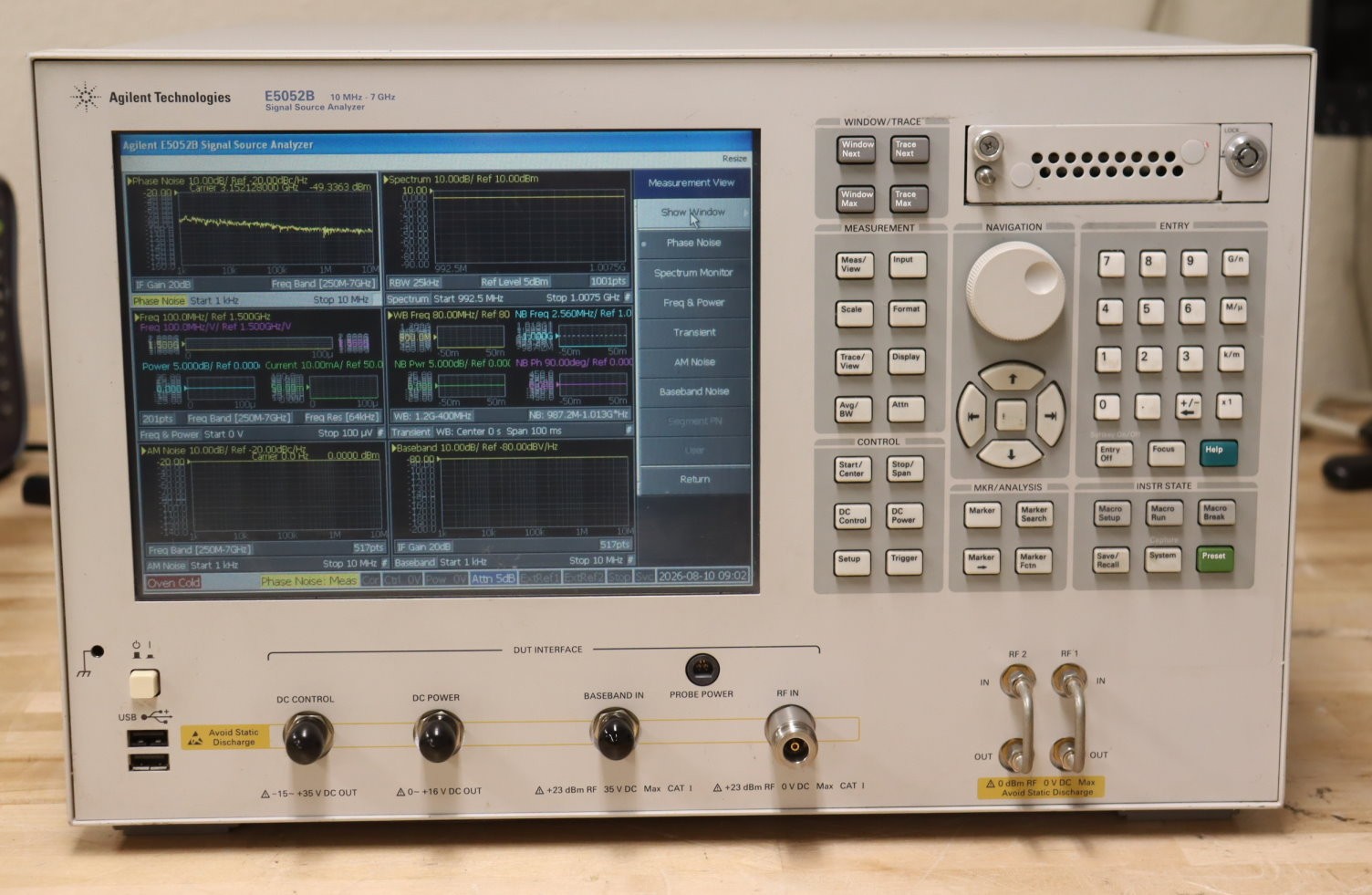
If you're serious about phase noise and clock jitter, this E5052B gives you a base frequency window that covers most VCO and reference clock work, plus the throughput needed to keep a busy lab moving. The limitation is that it's a used instrument, so you need to be sure the specific unit's performance matches your expectations before committing. If you ever need to move beyond the base range, additional hardware is required.
Meaningful Trade-Offs
The most meaningful trade-off is the investment. At this level of pricing, you're paying for a high-performance test instrument, not a budget accessory. You need to be honest about whether your projects require the E5052B's throughput and phase noise strengths or whether a simpler tool would do. Frequency range is the other structural limit. The base unit covers a solid portion of VCO and reference clock work, but if your roadmap includes signals above that ceiling, you'll need to factor in the E5053A to push to 26.5 GHz and the 11970 series mixers to reach 110 GHz. That additional hardware transforms the E5052B into a bigger system, so planning for it matters.
Bottom Line
If your bench lives and breathes oscillator and signal source measurements within the E5052B's frequency window, this used unit deserves a hard look. It combines the base capability with the measurement throughput that makes VCO, reference clock, and clock jitter work practical in a production or engineering setting. The US$36,500 price is substantial, and the used condition means you should confirm the unit's performance aligns with your expectations. For the right lab, the E5052B can justify its cost by turning complex source characterization into a routine task.