When you're comparing oscilloscopes for signal and spectrum analysis, the hardest part is deciding whether to optimize for fast signal capture or for a software-driven workflow you can take to the workbench. The Tektronix TDS 380 and the Digilent Analog Discovery 2 take opposite paths, with $45 separating their listed prices. This head-to-head helps you choose based on the signals you actually measure.
Quick verdict
Choose the Tektronix TDS 380 when fast, high-frequency signals are your main workload. Choose the Digilent Analog Discovery 2 when you want a lower-priced scope with fine signal detail and software-driven controls. The Tektronix keeps the traditional bench experience; the Digilent brings the instrument to your laptop.
Comparison at a glance
| Consideration | Tektronix TDS 380 | Digilent Analog Discovery 2 |
|---|---|---|
| Listed price | USD 195.00 | USD 150.00 |
| Maximum bandwidth | 400 MHz | 30 MHz |
| Max real-time sampling | 2 GS/s | 100 MSa/s |
| Digital resolution | 8-bit | 14-bit |
| Channels | 2 | 2 |
The right pick depends on where the signal sits and how you like to work. If most of your measurements stay at moderate frequencies, the Digilent's focused design may cover everything you need. If you're chasing fast edges on digital buses or high-frequency analog waveforms, the Tektronix's broader measurement envelope becomes more valuable.
Where each product wins
The Tektronix TDS 380 is the stronger match for conventional benchtop use. Its autoset, measure menu, math functions, hardcopy support, and rear-panel connectivity give it the feel of a self-contained instrument. The Digilent Analog Discovery 2 is the stronger match for software-first testing, bringing a USB/WaveForms workflow to your laptop.
Tektronix TDS 380 400MHz 2GS/s 2 Channel Digital Real-Time Oscilloscope Tested
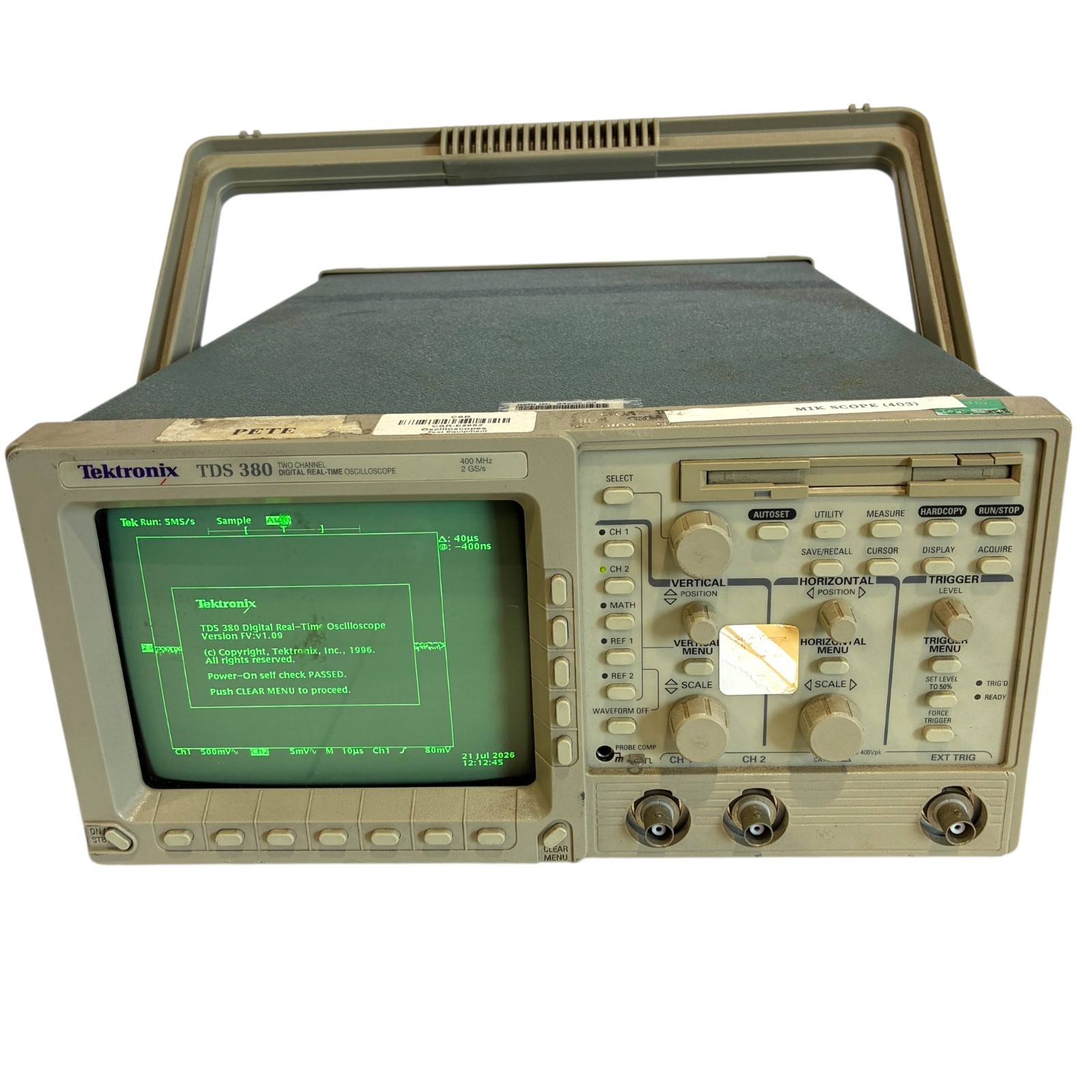
If your work involves fast digital logic or high-frequency analog signals, the Tektronix TDS 380 is a strong match. The front-panel autoset, measure menu, math functions, and hardcopy support form a complete benchtop workflow, while RS-232, GPIB, Centronics, and video-out ports make it easy to connect external equipment. Autoset helps you get a usable trace fast, and the measure menu handles routine voltage and timing readings without extra software. The two channels let you compare an input and output side by side. The limiting factors are the 8-bit resolution and the used condition: it is a tested unit rather than a new-in-box product, and the display is the older CRT style. For a traditional bench instrument with clear high-frequency focus, this is the one.
Digilent Analog Discovery 2 USB Digital Oscilloscope 30MHz 2CH 100MSa/s 14-bit
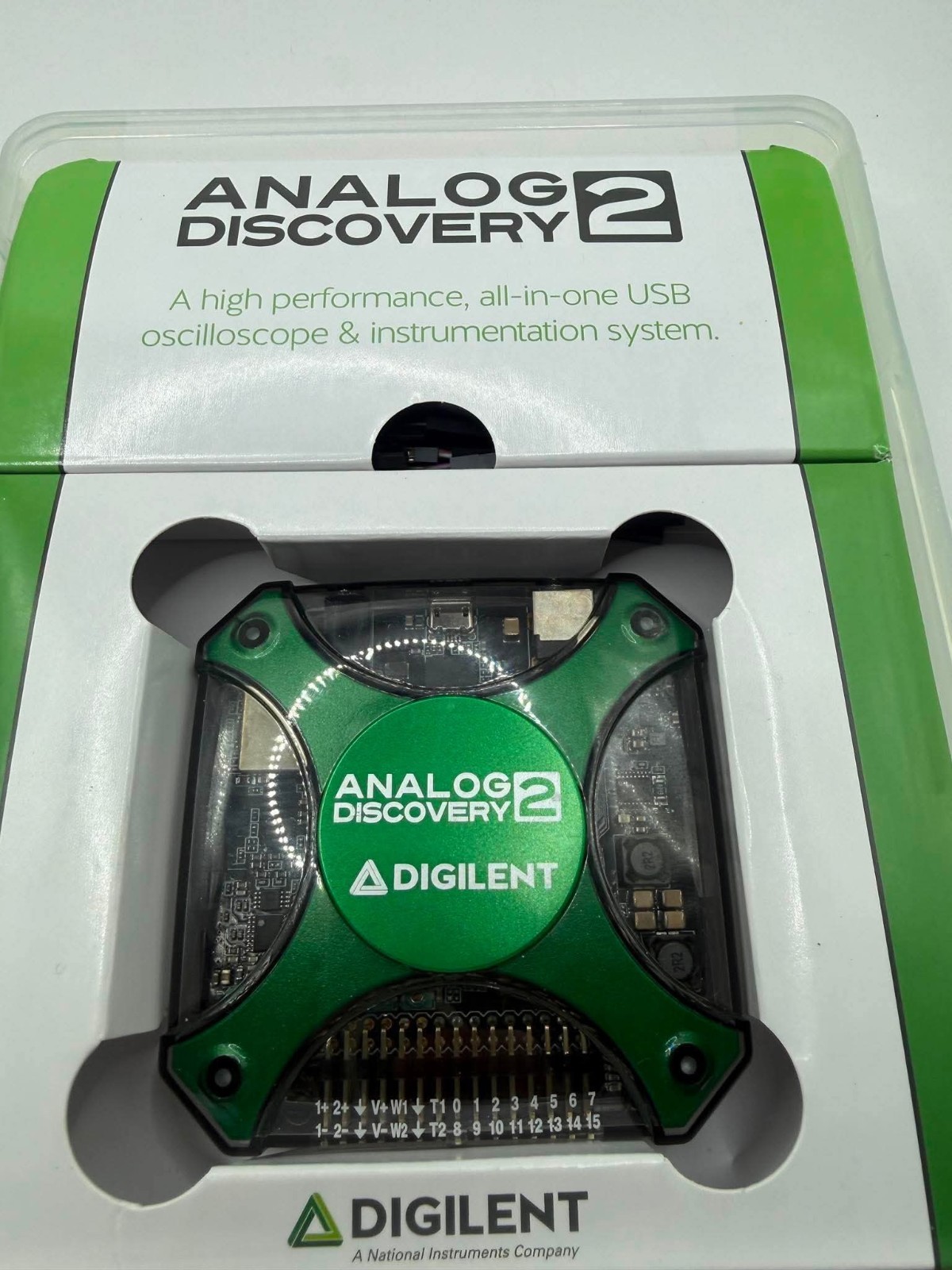
The Digilent Analog Discovery 2 takes a software-first approach. Plug it into USB and use the installed WaveForms 2015 application for capture and analysis, so most of your control happens on screen rather than through a dedicated panel. The 14-bit resolution helps when you need to see small amplitude differences, and the open-box listing means you get a new-condition unit with opened packaging. That makes it a practical choice for learning environments or quick checks at a desk. The two-channel input gives you room to compare signals without switching probes. The main tradeoff is the 30 MHz bandwidth ceiling, which will miss very fast edges or high-frequency carriers. For a compact, laptop-driven two-channel scope, it's the more convenient pick.
Final choice by use case
If your signals routinely live at higher frequencies than a compact general-purpose scope can handle, the Tektronix TDS 380 is the right fit. If you want a software-driven instrument with fine signal detail, the Digilent Analog Discovery 2 makes more sense. For a student, hobbyist, or anyone measuring lower-frequency signals, the Digilent's finer signal detail makes it a strong choice. For serious lab work, the Tektronix is the one to put on your bench.