Choosing between two similar handheld spectrum analyzers usually comes down to one question: how high do your signals actually go? The TinySA Ultra+ ZS406 and ZS407 look nearly identical on paper, but their listed frequency ranges split them apart.
Quick verdict
If your measurements stay within the ZS406's range, the touchscreen and 50W attenuator make it a straightforward choice. If you need more headroom for modern RF bands, the ZS407's broader coverage is the deciding factor.
At a glance
| Feature | ZS406 | ZS407 |
|---|---|---|
| Listed price | USD 179.00 | USD 229.00 |
| Price bar | ||
| Listed frequency range | 100kHz-5.4GHz | 100kHz-7.3GHz |
| Display | 4-inch TFT LCD (480×320) | 4-inch LCD |
| Battery | 5000mAh | Built-in 5000mAh |
| Storage | 32GB micro SD card | +32GB |
| Signal generator | 2-in-1, 100kHz-900MHz | 2-in-1, 100kHz-900MHz |
| Hardware version | V0.4.6 | V0.5.4 |
| Standout extras | Touchscreen | ESD protection |
Where the ZS406 wins
The ZS406's case rests on the 50W attenuator and the concrete sensitivity specs. The included attenuator is rated to 50 watts from DC to 3GHz with N-type connectors, and the listed DANL figures - -153dBm/Hz at 100MHz with the LNA off and -169dBm/Hz with the LNA on - give you a clear picture of its sensitivity for bench work.
Where the ZS407 wins
The ZS407's headline is its broader listed coverage, which makes it relevant for 5G NR and Wi-Fi 6E work. It runs the V0.5.4 hardware system, includes ESD protection, and offers RBW from 200Hz to 850kHz for measurements like SSB two-tone intermodulation testing. The 5000mAh battery keeps it portable alongside the ZS406.
TinySA Ultra+ ZS406 (100kHz-5.4GHz)
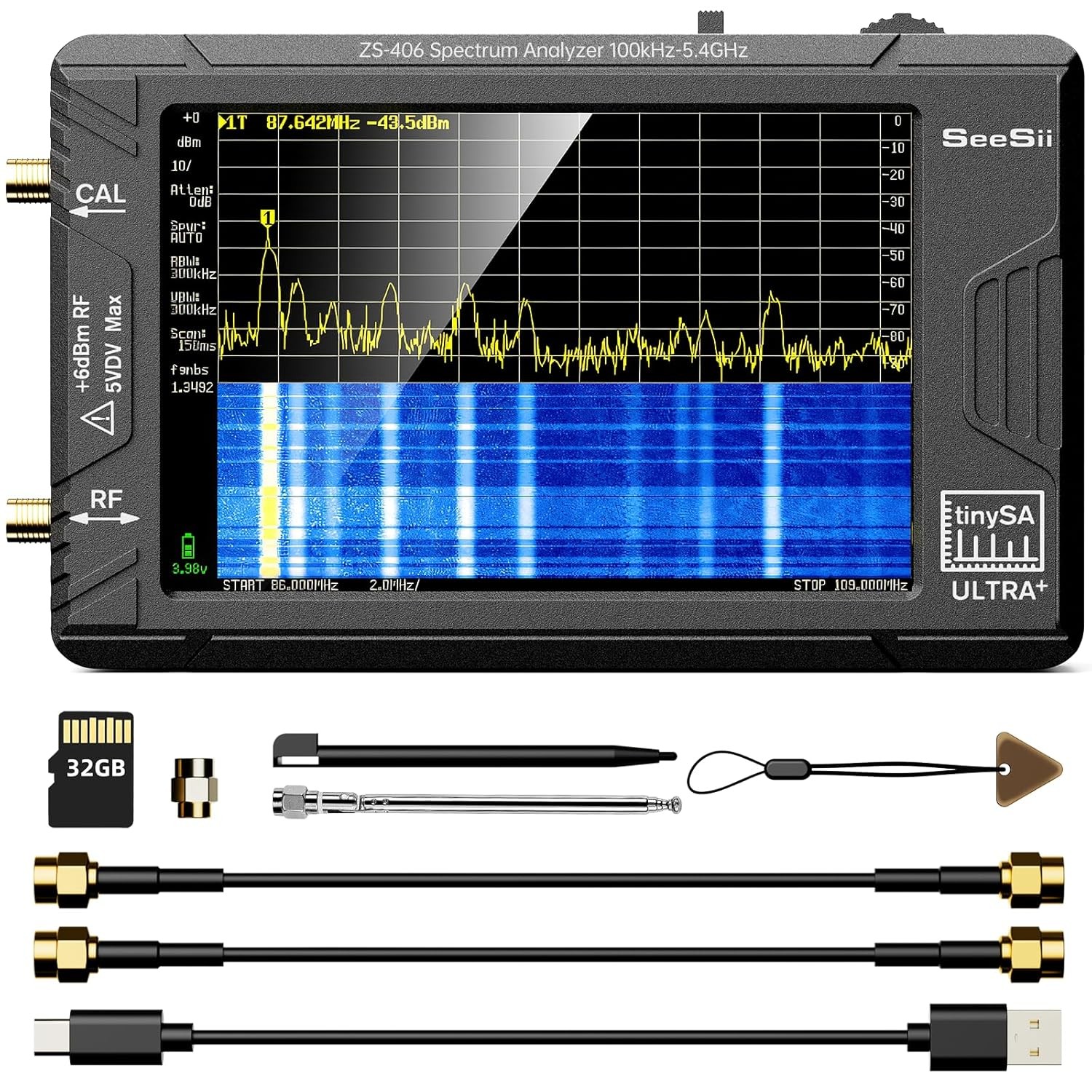
The ZS406 is the pick when you don't expect to chase signals above 5.4GHz. Its 4-inch TFT touchscreen at 480×320 resolution makes navigating the menus easier, and the included 50W attenuator - rated to 50 watts from DC to 3GHz with N-type connectors - handles higher-power checks. The listed DANL figures of -153dBm/Hz at 100MHz with the LNA off and -169dBm/Hz with the LNA on give you a clear picture of its sensitivity. The limitation is the 5.4GHz ceiling: in ultra mode, sensitivity degrades above 2.5GHz and more sharply above 5.3GHz, so the top of the range comes with reduced dynamic range.
TinySA Ultra+ ZS407 (100kHz-7.3GHz)
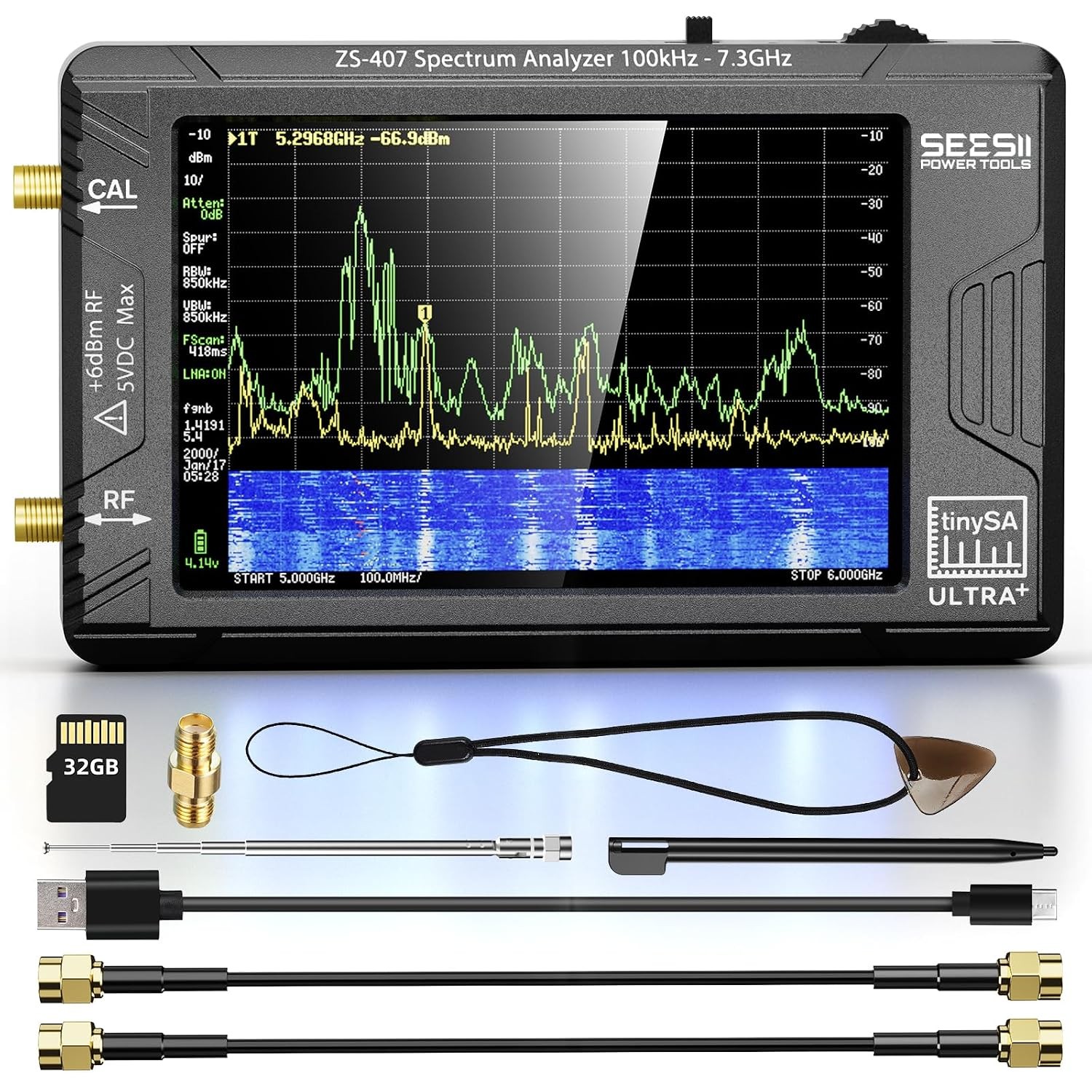
If your signals climb past the ZS406's ceiling, the ZS407 is the one to reach for. Its listed range reaches 7.3GHz, which covers 5G NR and Wi-Fi 6E bands that the ZS406 cannot claim. The V0.5.4 hardware system, ESD protection, and 200Hz-850kHz RBW support high-precision tasks like SSB two-tone intermodulation testing. The trade-off is the higher listed price: USD 229.00 versus USD 179.00 for the ZS406. If you rarely work with signals above the lower model's ceiling, that extra frequency coverage may not justify the cost difference for your workflow.
Final choice by use case
For general bench work in the lower spectrum - checking filters, verifying oscillators, sweeping HF/VHF/UHF - the ZS406's touchscreen and 50W attenuator make it the pragmatic pick. For RF work that reaches into modern high-frequency bands, the ZS407's wider range is the deciding factor. If you aren't sure which category you fall into, ask whether any signal in your pipeline exceeds the ZS406's ceiling; that single question settles it.