Choosing a signal spectrum analyzer starts with a simple but important decision: how much tool do you actually need before the price stops making sense? In this head-to-head, one analyzer is a feature-rich model, while the other is a compact instrument priced to get you started quickly. Both can help you look at RF signals, but they're built for different buying moments.
Quick verdict
If you want a broader, ready-for-the-bench RF tool and are comfortable paying for that convenience, the TinySA Ultra+ ZS407 is the one to choose. If you want the smallest reasonable investment for basic spectrum checks, the TinySA 100kHz-960MHz is the practical pick.
Side-by-side comparison
| Product | Price | Price bar | Condition |
| TinySA Ultra+ ZS407 | USD 199.00 | | New |
| TinySA 100kHz-960MHz | USD 39.98 | | Used |
The price bars show how far apart these two are in cost. The Ultra+ asks for roughly USD 159 more than the TinySA.
Where each product wins
TinySA Ultra+ ZS407: The Ultra+ has the larger 4-inch touchscreen, a 5000mAh rechargeable battery, a built-in low-noise amplifier and attenuator, and an RF signal generator in its name. That combination makes it feel like a small RF workbench rather than a single-purpose meter. The touchscreen alone changes how quickly you can navigate frequency spans, and the battery makes it easy to move between the shack and the field.
TinySA 100kHz-960MHz: The original TinySA keeps the essentials cheap. It has a color display with 290 scan points, separate MF/HF/VHF and UHF inputs, a built-in calibration signal generator, and switchable resolution bandpass filters. It is a very capable little analyzer for lower-frequency work, and it fits in a drawer when you aren't using it.
Product notes
TinySA Ultra+ ZS407
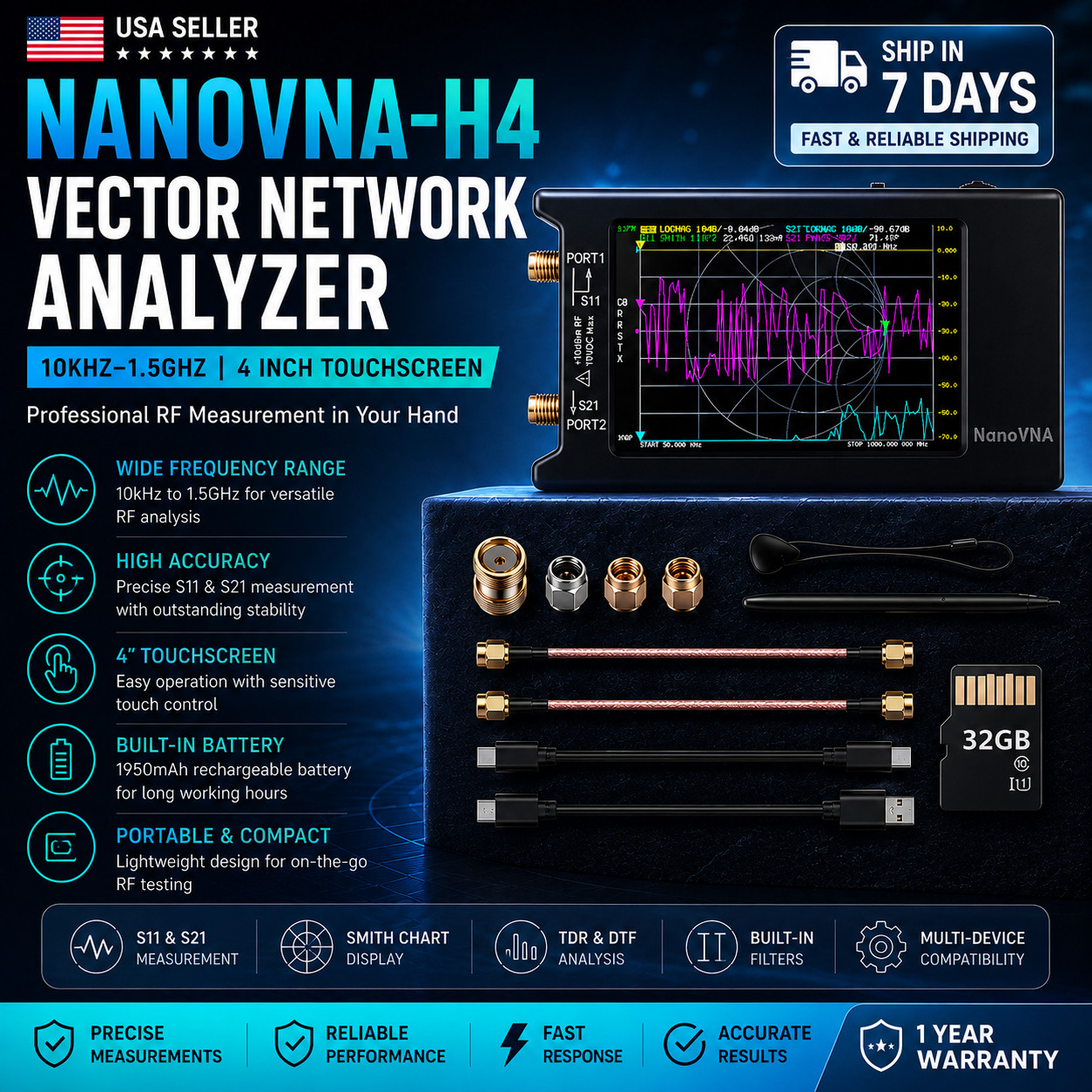
The Ultra+ ZS407 is a straightforward choice if you want a new instrument that feels like a complete testing station. Beyond the display and battery, it also has USB connectivity, which makes it easy to connect to a computer for logging or more detailed analysis. The built-in low-noise front end helps when you're hunting for weak signals, and the name says it includes an RF signal generator as well. The limitation to weigh is the cost: at USD 199, it sits at the top of this price range, and for occasional checks the extra capability may not be worth the outlay. If you plan to spend real time troubleshooting antennas and filters, that higher price buys a much smoother workflow.
TinySA 100kHz-960MHz
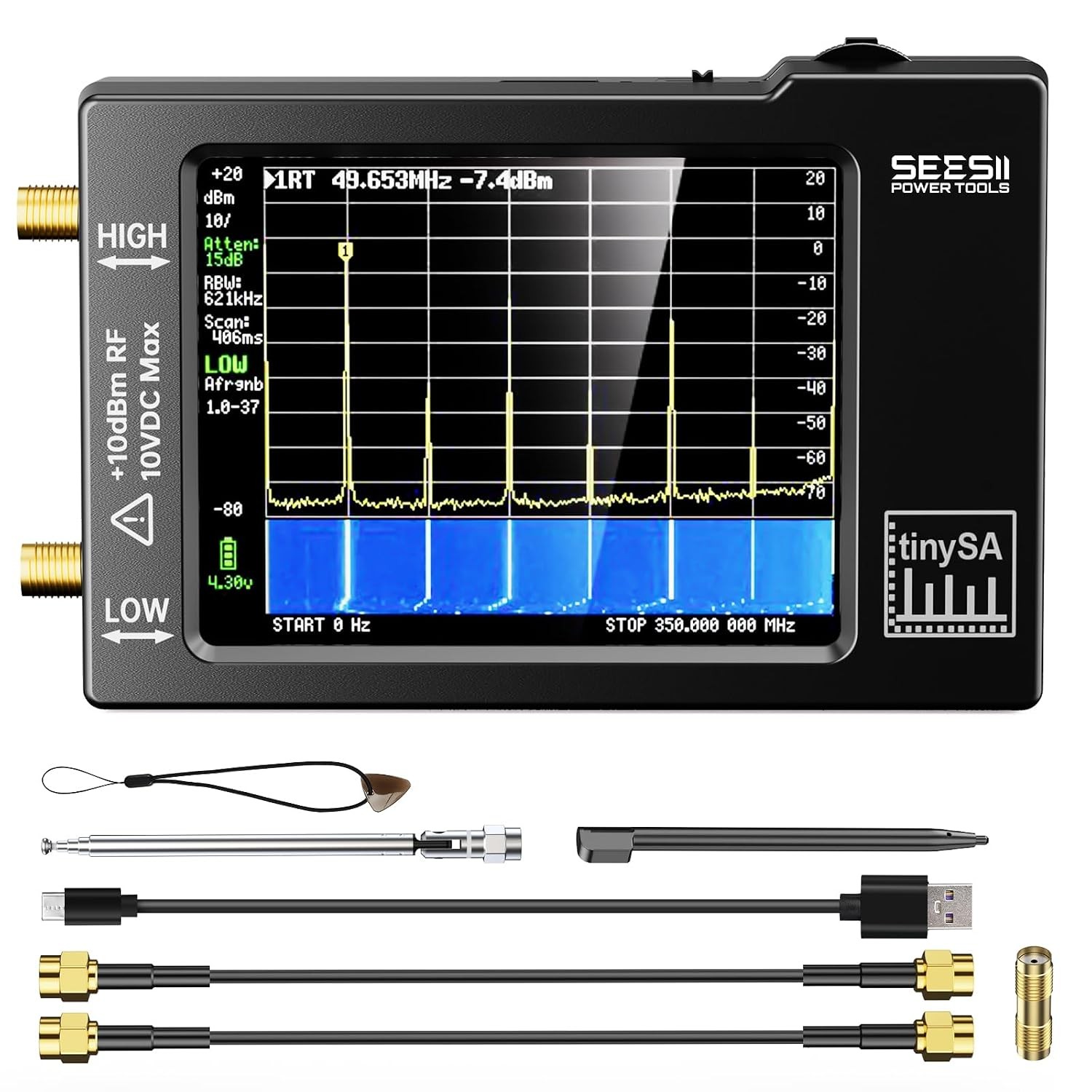
For the money, the TinySA gives you a lot of basic measurement ability. The built-in calibration signal generator supports automatic self-test and low-input calibration, which is a nice feature at this price level. The dual inputs are useful if you work across the MF/HF/VHF range and also poke around UHF, because you can use the higher-quality input for lower bands and the secondary input for UHF. The main limitation is the used condition: you are buying a unit that has had prior use. For a first analyzer or a spare unit on a budget, that trade-off is easy to accept.
Final choice by use case
Go with the TinySA Ultra+ ZS407 if you want a feature-dense analyzer for regular RF work and don't want to feel limited. Choose the TinySA 100kHz-960MHz if you need a lower-cost way into spectrum analysis, want a spare unit, or only do occasional HF/VHF/UHF checks.