When you need to check whether a wire is live or why a car circuit isn't working, the tool choice matters. In the multimeters electrical testers aisle, two options take different approaches: a pen that senses voltage near a conductor, and an automotive probe that connects to a DC circuit for a clear readout.
The Voltage Electric Tester Volt Detector Test Pen AC DC Non-Contact Sensor 12-1000V is the better choice for general live-wire checks and fault tracing. The 5-90V DC Digital Circuit Tester Automotive Test Light Car Electrical Probe Tool is the better choice for vehicle wiring diagnosis.
Quick Verdict
If you want a quick way to detect live wires and trace faults, the Voltage Tester Pen set is the more direct pick. If you're diagnosing vehicle wiring, the Automotive Circuit Tester is the more specialized tool.
Side-by-Side Comparison
| Product | Listed Price | Key Strengths |
|---|---|---|
| Voltage Tester Pen Set | USD 6.59 [##########] | AC/DC detection, two pens, digital display |
| Automotive Circuit Tester | USD 4.90 [#######---] | DC circuit diagnosis, red/green polarity, 0.1V precise reading |
Where Each Product Wins
The Voltage Tester Pen set wins when you need to confirm a conductor is live without touching it, distinguish null lines, or find broken points. Its pen-style form makes it easy to sweep along wiring and get a quick answer.
The Automotive Circuit Tester wins when you're working on cars, trucks, SUVs, or boats and need to trace a circuit quickly. The included extra probe and large clamp are practical touches for tight spaces.
Product Notes
Voltage Electric Tester Volt Detector Test Pen AC DC Non-Contact Sensor 12-1000V

If your main job is confirming whether a wire is live before you work on it, this pen-style tester is the straightforward tool. It senses voltage with a pen-style probe, and the two-piece set gives you a backup unit. The Blu-ray digital display is designed to stay readable in darker spaces, and the insulating ABS shell adds sturdy, impact-resistant protection. The built-in self-check function is a useful safety touch. Choose it when you want quick presence checks, null-line identification, or broken-point tracing on alternating and direct current circuits. The trade-off is that its listed features focus on detection and fault-finding, so if you need a precise decimal voltage reading for component-level diagnosis, you'll want a dedicated digital circuit tester instead.
5-90V DC Digital Circuit Tester Automotive Test Light Car Electrical Probe Tool
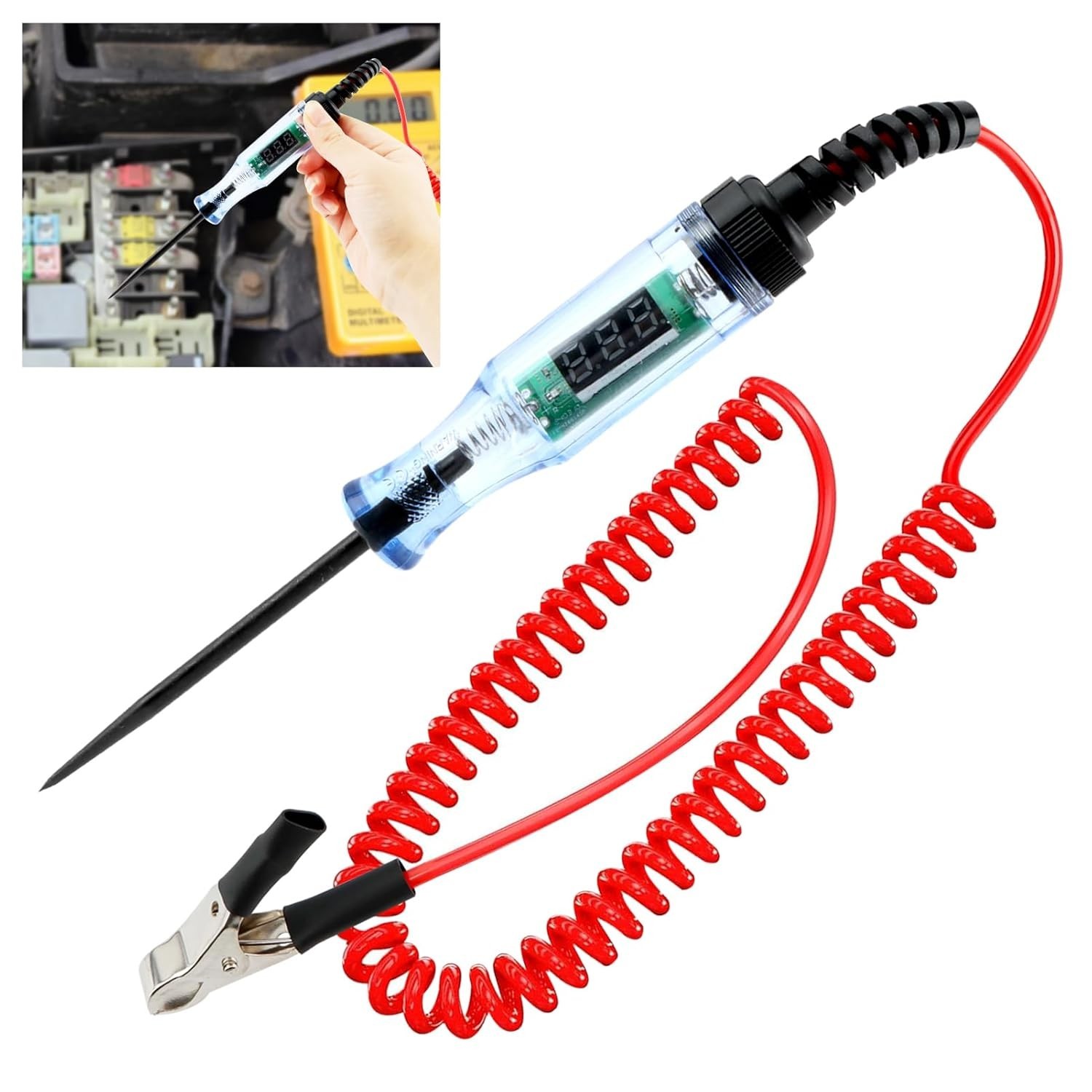
This one is built for vehicle electrical work. It uses a bright LED display with red/positive and green/negative indicators, and it includes an extra probe and large clamp to fit tight spaces. It's designed to diagnose dead batteries, alternator output, and faulty wiring in cars, trucks, SUVs, and boats. The 0.1V precise reading is a strong reason to pick it when you need exact numbers rather than just a "power/no power" check. The clear limitation is that it's DC-focused, so it won't replace an AC non-contact voltage pen for live-wire detection. If your work is mostly automotive electrical troubleshooting, this is the more practical buy.
Final Choice by Use Case
For general electrical work in the workshop, the Voltage Tester Pen set offers more flexibility because it handles both AC and DC detection without touching a conductor. For automotive electrical work, especially when you need to see polarity at a glance, the Automotive Circuit Tester is the tool to grab. The right pick depends on whether your priority is broad voltage detection or focused vehicle diagnosis.