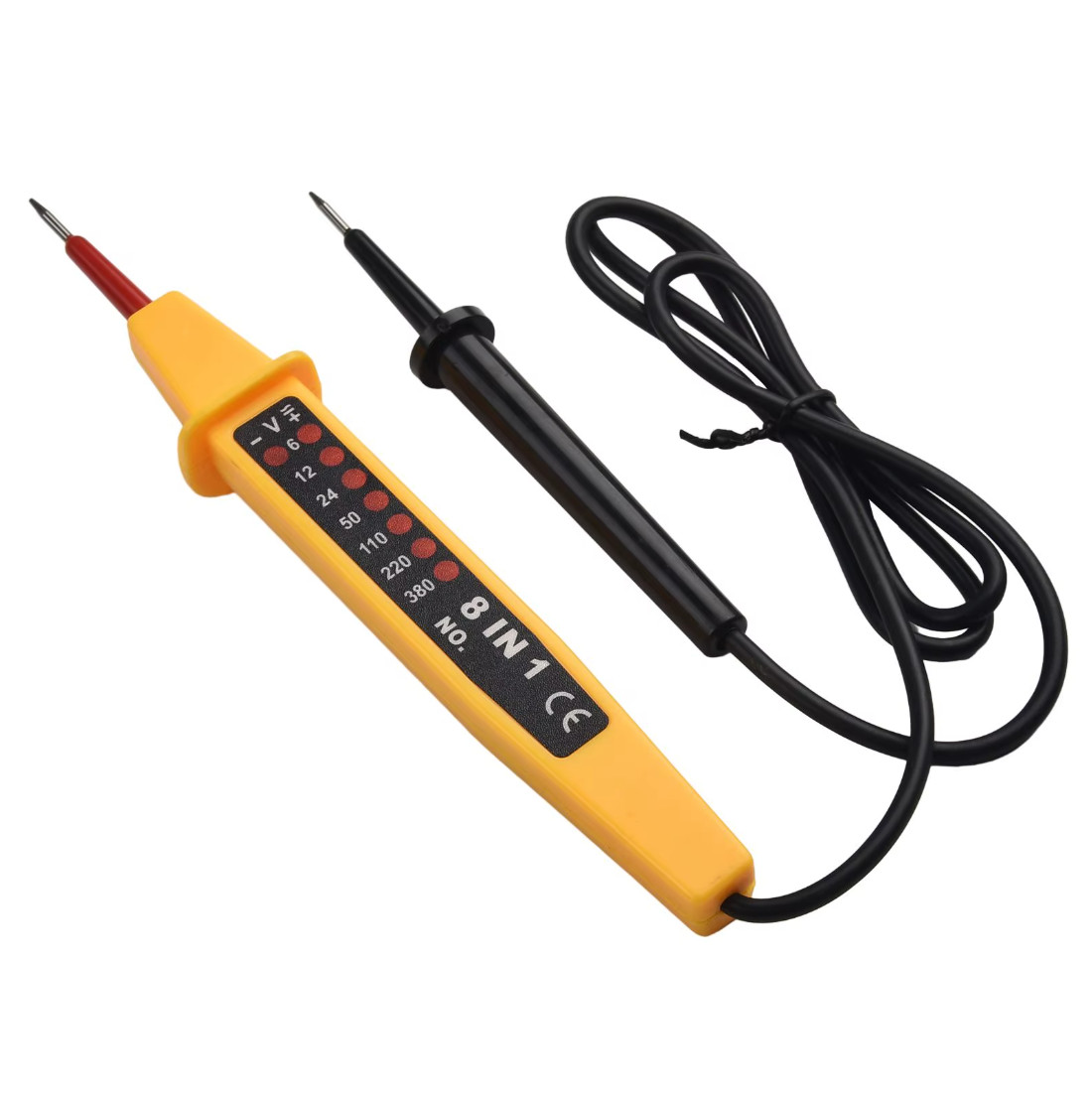

Photos from current listings. Actual item, color, and included accessories may vary.
Auto Electrical Tester Buying Guide
An auto electrical tester is a handheld diagnostic tool for checking voltage, continuity, polarity, and circuit integrity on 12V/24V vehicle systems; the core trade-off is between a simple non-contact voltage pen and a full digital multimeter with load-testing capability. Durable options use fused inputs, CAT III safety ratings, and true-RMS sensing, while compromises omit fusing and rely on non-contact-only detection that cannot measure actual voltage or current.
Key takeaways
- Non-contact voltage pens detect AC fields only through insulation and cannot measure DC voltage, resistance, or current on vehicle circuits.
- Digital multimeters with 10 MΩ input impedance and CAT III 600V rating are the minimum safe standard for automotive 12V/24V diagnostics.
- Continuity mode with audible beep and diode test separates open circuits from shorted components; pens lack both functions entirely.
At a glance
- Category
- Multimeters & Electrical Testers
- Last updated
- Nov 28, 2026
Current offers
Highlights
- Non-contact voltage pens detect AC fields only through insulation and cannot measure DC voltage, resistance, or current on vehicle circuits.
- Digital multimeters with 10 MΩ input impedance and CAT III 600V rating are the minimum safe standard for automotive 12V/24V diagnostics.
- Continuity mode with audible beep and diode test separates open circuits from shorted components; pens lack both functions entirely.
- Fused mA/10A inputs protect the meter and vehicle wiring during current draw tests; unfused cheap meters risk arc faults.
Best use cases
- Best fit: a CAT III 600V digital multimeter with 10A fused current input for parasitic draw tests, alternator output checks, and voltage-drop diagnostics on 12V/24V systems.
- Wrong fit: a non-contact voltage pen for any measurement requiring actual voltage readout, resistance, or current—it only indicates presence of AC field and is useless for DC vehicle diagnostics.
- Best fit: a pen-style tester for quick presence/absence checks on trailer lights, fuse slots, and socket polarity when no numerical measurement is needed.
- Skip: any tester without a CAT safety rating or fused inputs for under-hood work near high-current starters and alternators.
Buying tips
- Match the meter's DC voltage range to the system: 12V auto systems need at least 0-20V DC resolution to 0.01V; 24V truck systems need 0-200V DC range.
- Choose a meter with a 10A fused current input for parasitic draw testing; 200mA-only meters blow fuses on starter or alternator current.
- Verify true-RMS sensing for reliable AC readings on alternator ripple and inverter outputs; averaging meters misread distorted waveforms.
- Select silicone test leads rated 1000V CAT III with 4mm banana plugs; PVC leads stiffen in cold weather and lack double insulation.
Specs
| Tester Type | Digital multimeter vs non-contact pen |
|---|---|
| Safety Rating | CAT III 600V minimum for auto |
| DC Voltage Range | 0-20V (12V) / 0-200V (24V) |
| Current Input | 10A fused + mA range |
Related searches
What to check before buying
- Confirm the vehicle system voltage (12V car, 24V truck) and that the tester's DC range covers 0-20V or 0-200V with 0.01V resolution.
- Check that test lead probes fit your fuse tap and connector sizes—standard 4mm banana to 2mm probe tips cover most automotive terminals.
- Verify the meter carries a CAT III 600V or higher safety rating for under-hood use near high-energy circuits.
- Ensure the tester includes a continuity beep mode and diode test for checking relays, fuses, and wiring integrity.
FAQ
Data sources: eBay / Amazon listings and product attribute feeds. Updated Nov 28, 2026.
Some links on this page are affiliate links. If you buy after clicking one, we may earn a commission at no extra cost to you. This does not change which products appear here or their order. Affiliate disclosure.