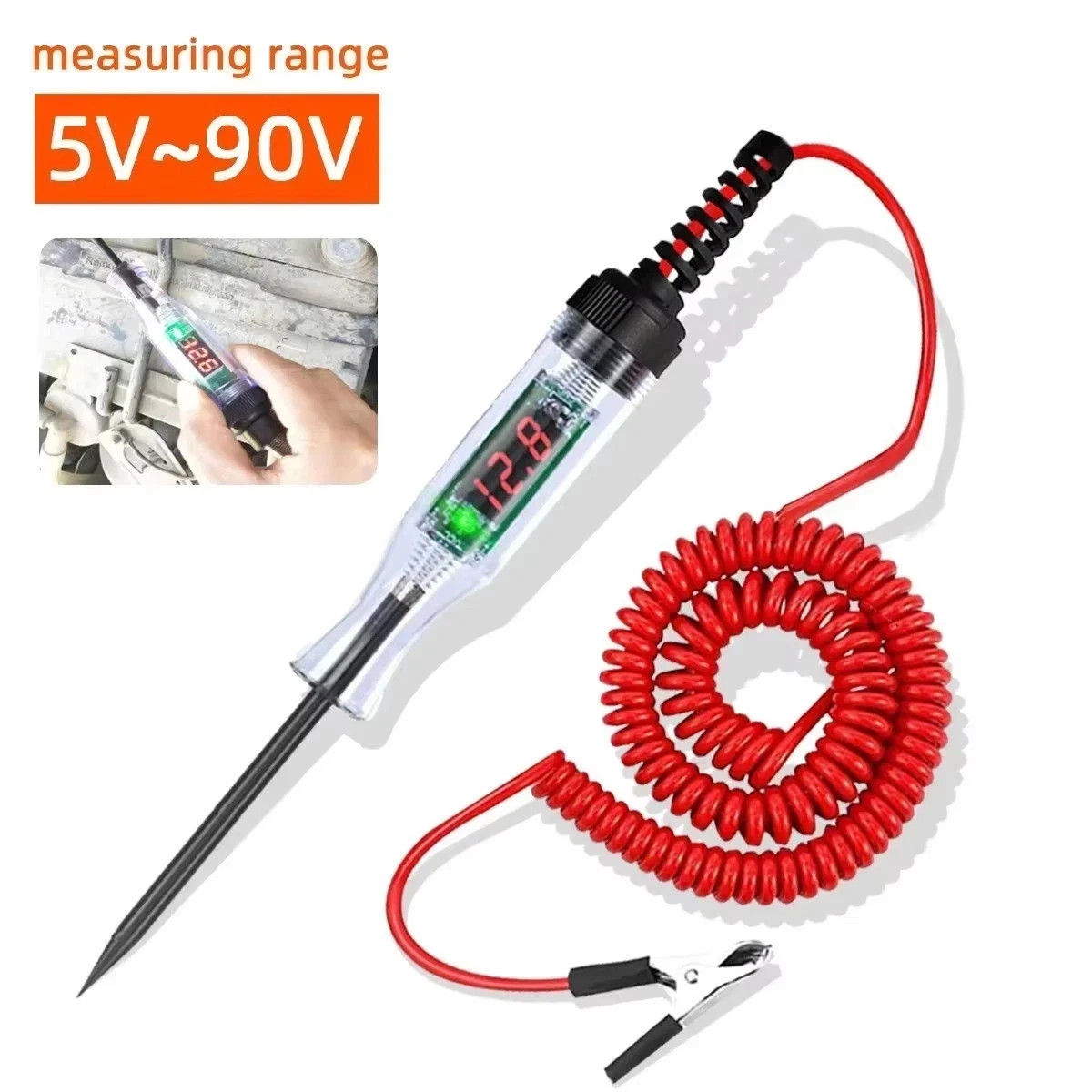

Photos from current listings. Actual item, color, and included accessories may vary.
Electric Circuit Tester Buying Guide
An electric circuit tester is a handheld diagnostic tool that verifies voltage presence, continuity, and breaker/outlet wiring, ranging from simple non-contact voltage pens to automotive test lights and dedicated breaker finders. The core trade-off is between a single-function tester with a fixed voltage range and a multi-function unit with auto-ranging or selectable ranges that covers both household and automotive circuits. Buy a tester rated explicitly for the voltage and system you work on; skip universal-looking pens that lack category ratings or a defined voltage ceiling.
Key takeaways
- Automotive test lights are typically rated 6V/12V/24V DC with a clip-to-ground lead and a probe; household testers are rated 90-250V AC and are not interchangeable with DC vehicle circuits.
- Circuit breaker finders use a plug-in transmitter at the outlet plus a receiver at the panel; they identify the correct breaker only when the transmitter and receiver are paired and the circuit is energized.
- Non-contact voltage pens detect the electric field around a live conductor and indicate presence, not exact voltage; solenoid (contact) testers give a rough voltage tier but load the circuit.
At a glance
- Category
- Multimeters & Electrical Testers
- Last updated
- Nov 28, 2026
Current offers
Highlights
- Automotive test lights are typically rated 6V/12V/24V DC with a clip-to-ground lead and a probe; household testers are rated 90-250V AC and are not interchangeable with DC vehicle circuits.
- Circuit breaker finders use a plug-in transmitter at the outlet plus a receiver at the panel; they identify the correct breaker only when the transmitter and receiver are paired and the circuit is energized.
- Non-contact voltage pens detect the electric field around a live conductor and indicate presence, not exact voltage; solenoid (contact) testers give a rough voltage tier but load the circuit.
- GFCI outlet testers inject a small leakage current to trip the device; a tester without a GFCI test button cannot verify ground-fault protection, only wiring polarity.
Best use cases
- Home electrical troubleshooting (outlets, switches, breakers): choose a 90-250V AC non-contact pen plus a GFCI-capable outlet tester or a dedicated breaker finder kit; skip automotive test lights.
- Automotive 6V/12V/24V diagnostics (fuses, relays, trailer wiring): choose a DC test light with a ground clip and 6-24V rating; skip AC-only pens and household outlet testers.
- Panel labeling and breaker mapping: choose a transmitter/receiver breaker finder rated for the panel voltage and frequency; skip basic voltage pens, which cannot identify a specific breaker.
- Continuity and component checks: choose a digital multimeter with a continuity buzzer and diode test; skip single-function pens and test lights, which cannot measure resistance.
Buying tips
- Match the voltage rating to the system: household AC testers should be CAT III 600V or better; automotive testers must state 6V, 12V, and 24V DC compatibility.
- For breaker finding, confirm the transmitter plugs into the outlet type you have (standard 120V or GFCI) and the receiver is paired to that transmitter model; mismatched pairs fail to identify breakers.
- Choose a tester with a defined display or LED tier rather than an unlabeled glow: a 12V/24V/120V/240V labeled scale prevents misreading a live circuit.
- Prefer units with replaceable leads or fuses; a blown internal fuse in a cheap tester often makes it read dead on a live circuit, which is a safety failure.
Specs
| Tester Type | Voltage pen / Test light / Breaker finder |
|---|---|
| Voltage Rating | 6-24V DC or 90-250V AC |
| Safety Category | CAT II / CAT III 600V |
| GFCI Test Function | Trip button vs none |
Related searches
What to check before buying
- Confirm the outlet or circuit voltage and type (120V AC household, 12V/24V DC vehicle, 240V appliance) before selecting a tester tier.
- For breaker finders, verify the panel is energized and the transmitter outlet is on the same circuit you are mapping; dead circuits cannot be traced.
- Check that the tester's probe and lead length reach your work area and that the ground clip is insulated for automotive use.
- Verify the tester carries a CAT safety rating appropriate to the panel or circuit you will probe; CAT II for outlets, CAT III for distribution panels.
FAQ
Data sources: eBay / Amazon listings and product attribute feeds. Updated Nov 28, 2026.
Some links on this page are affiliate links. If you buy after clicking one, we may earn a commission at no extra cost to you. This does not change which products appear here or their order. Affiliate disclosure.