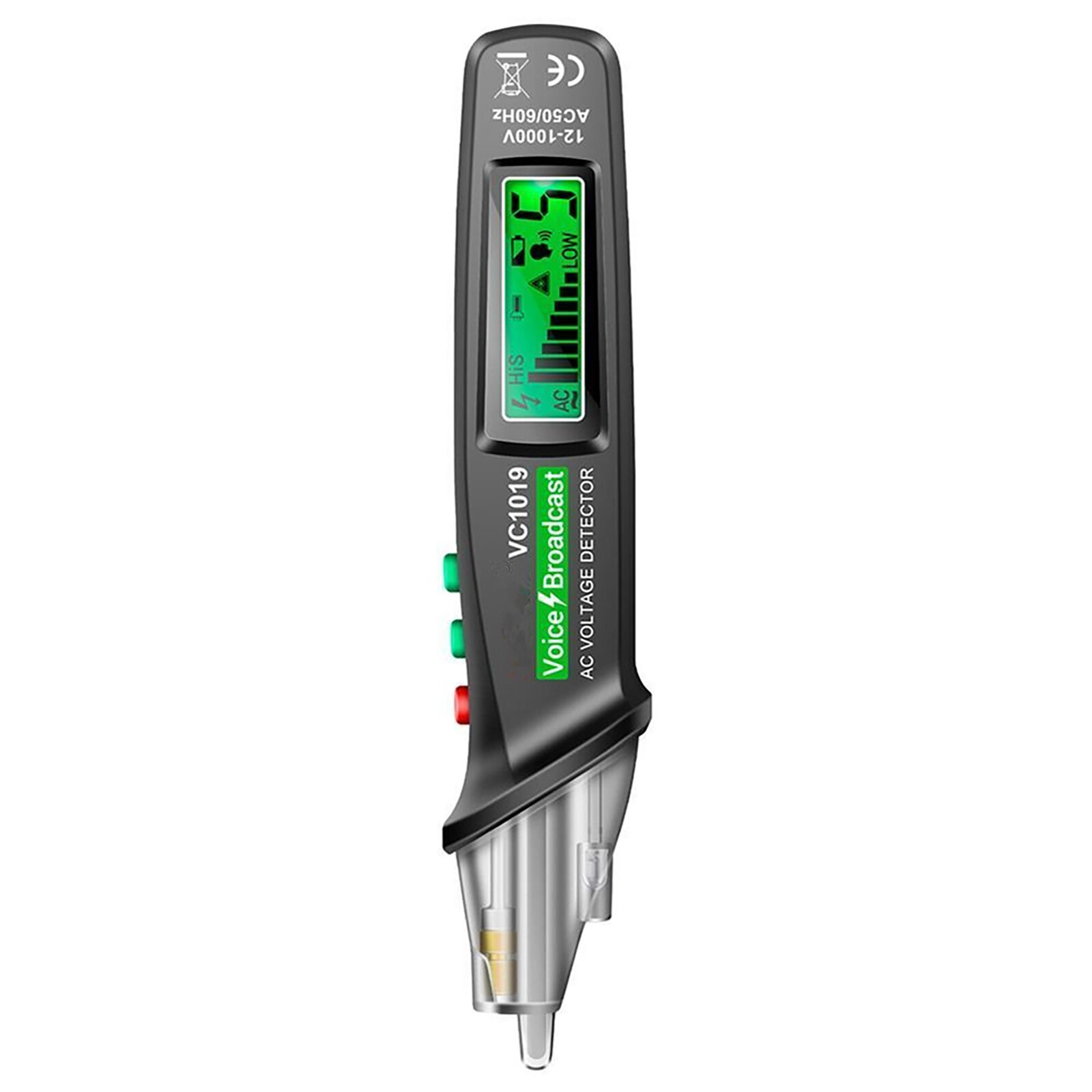

Photos from current listings. Actual item, color, and included accessories may vary.
Electric Wire Tester Buying Guide
An electric wire tester covers two distinct tools: non-contact voltage pens that detect live AC wiring through insulation, and continuity/toner testers that trace and verify dead circuits. The core trade-off is safety-rated CAT voltage protection versus convenience—pens must meet CAT III/IV standards for panel work, while simple continuity testers are for de-energized circuits only. The decision rule: buy a properly rated non-contact pen for live-wire safety checks, and a separate multimeter or toner for dead-circuit tracing and continuity.
Key takeaways
- Non-contact voltage pens detect 12V–1000V AC via capacitive sensing; they do not measure voltage numerically or work on DC or shielded cables.
- CAT III 1000V / CAT IV 600V ratings are the safety threshold for panel and service-entrance work; unrated pens are for receptacle-level checks only.
- Continuity testers and wire toners require a de-energized circuit and a complete loop; they cannot trace live AC wiring safely.
At a glance
- Category
- Multimeters & Electrical Testers
- Last updated
- Nov 28, 2026
Current offers
Highlights
- Non-contact voltage pens detect 12V–1000V AC via capacitive sensing; they do not measure voltage numerically or work on DC or shielded cables.
- CAT III 1000V / CAT IV 600V ratings are the safety threshold for panel and service-entrance work; unrated pens are for receptacle-level checks only.
- Continuity testers and wire toners require a de-energized circuit and a complete loop; they cannot trace live AC wiring safely.
- Adjustable-sensitivity pens distinguish phantom voltage from true live wires; fixed-sensitivity budget pens often false-trigger on bundled cables.
Best use cases
- Best fit: a CAT III 1000V non-contact pen for quickly identifying live versus dead receptacles, switches, and breakers before maintenance—skip unrated pens for panel work.
- Best fit: a continuity tester or tone generator for identifying which breaker feeds an outlet or tracing dead runs—never use on energized circuits.
- Wrong fit: using a non-contact pen to confirm a circuit is de-energized for safe work; always verify with a properly rated multimeter or two-pole tester.
- Wrong fit: expecting a voltage pen to read exact voltage or test DC automotive wiring; choose a digital multimeter or dedicated DC tester instead.
Buying tips
- Match the CAT rating to the panel: CAT III 1000V minimum for distribution boards, CAT IV 600V for service entrances; CAT II is receptacle-level only.
- Choose adjustable sensitivity so the pen can narrow detection in crowded boxes and avoid false positives from adjacent circuits.
- For tracing dead wires, pick a toner with selectable tone and a receiver with adjustable gain; basic continuity testers need a complete loop.
- Verify the voltage range covers your work: 12V–1000V AC pens handle residential and light commercial; DC testing requires a multimeter or dedicated DC tester.
Specs
| Detection Type | Non-contact AC / Contact continuity |
|---|---|
| Voltage Range | 12V–1000V AC (pens) |
| Safety Rating | CAT III 1000V / CAT IV 600V |
| Circuit State | Live AC vs De-energized only |
Related searches
What to check before buying
- Confirm your panel voltage and category: residential 120/240V split-phase needs CAT III 1000V for panel work; CAT II suffices for outlet checks.
- Check whether you need live-wire detection (non-contact pen) or dead-circuit tracing (toner/continuity)—these are separate tools with different safety rules.
- Inspect test leads and pen tips for double insulation and finger guards; exposed metal near the tip reduces safety margin.
- Verify battery type and included accessories (case, spare tips); button-cell pens are compact but require frequent replacement.
FAQ
Data sources: eBay / Amazon listings and product attribute feeds. Updated Nov 28, 2026.
Some links on this page are affiliate links. If you buy after clicking one, we may earn a commission at no extra cost to you. This does not change which products appear here or their order. Affiliate disclosure.