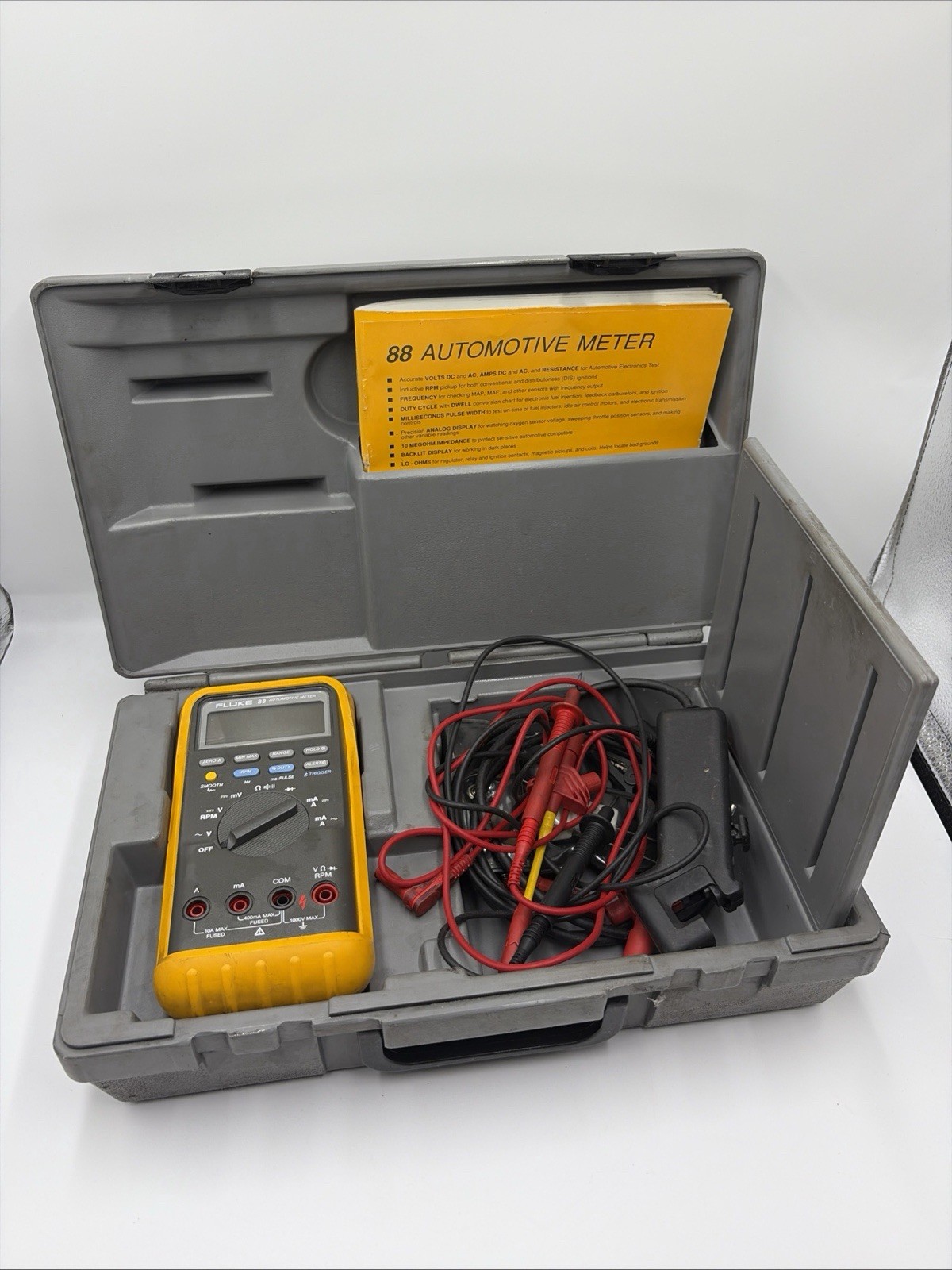

Photos from current listings. Actual item, color, and included accessories may vary.
Fluke Automotive Multimeter Buying Guide
A Fluke automotive multimeter is a handheld digital multimeter (DMM) built for vehicle diagnostics, adding functions like duty cycle, RPM, millivolt DC, and pulse width beyond basic voltage/resistance. The core trade-off is between a rugged true-RMS safety-rated meter with automotive-specific modes and a cheaper basic DMM that lacks low-voltage resolution and protected inputs. Choose a true-RMS, CAT III 600 V rated meter with dedicated automotive functions if you diagnose modern vehicles; skip generic meters with unfused low-impedance modes.
Key takeaways
- True-RMS AC measurement is essential for modern vehicles with PWM-controlled alternators and inverter-driven accessories; averaging meters misread distorted waveforms.
- Automotive-specific modes—duty cycle (%), pulse width (ms), RPM (via inductive pickup), and millivolt DC—separate diagnostic Fluke models from general-purpose DMMs.
- CAT III 600 V (or higher) safety rating with fused current inputs and high-energy protection is mandatory for hybrid/EV and industrial vehicle work; CAT II meters are unsafe here.
At a glance
- Category
- Multimeters & Electrical Testers
- Last updated
- Nov 28, 2026
Current offers
Highlights
- True-RMS AC measurement is essential for modern vehicles with PWM-controlled alternators and inverter-driven accessories; averaging meters misread distorted waveforms.
- Automotive-specific modes—duty cycle (%), pulse width (ms), RPM (via inductive pickup), and millivolt DC—separate diagnostic Fluke models from general-purpose DMMs.
- CAT III 600 V (or higher) safety rating with fused current inputs and high-energy protection is mandatory for hybrid/EV and industrial vehicle work; CAT II meters are unsafe here.
- Fluke 88V and 87V share the same rugged housing and true-RMS core; the 88V adds automotive functions (duty cycle, RPM, millivolt) while the 87V adds temperature and higher resolution for electronics.
Best use cases
- Best fit: buy a Fluke 88V (or 87V plus inductive pickup) for professional automotive diagnostics—parasitic draw, injector pulse width, alternator ripple, and sensor signals down to 0.1 mV.
- Wrong fit: skip a basic Fluke 101/107 for automotive work—it lacks duty cycle, RPM, and millivolt DC resolution needed for modern ECU and sensor diagnostics.
- Best fit: choose a Fluke 28 II or 87V for mixed automotive/industrial use where CAT IV 600 V and IP67 water/dust resistance matter; the 88V is CAT III only.
- Wrong fit: skip any meter without a fused 10 A current input for battery/charging system load tests—unfused inputs risk arc flash and meter destruction.
Buying tips
- Match the safety category to the vehicle: CAT III 600 V minimum for 12/24 V automotive and hybrid systems; CAT IV 600 V for utility/industrial vehicles.
- Verify true-RMS AC+DC capability and DC millivolt resolution of 0.1 mV—essential for parasitic draw testing below 50 mA and O2 sensor signals.
- Confirm the meter includes or supports an inductive RPM pickup; Fluke 88V has the RPM function built in, but the pickup is often a separate accessory.
- Check the current input fuse rating (typically 10 A/600 V fast-blow) and ensure replacement fuses are the exact Fluke-specified type—wrong fuses compromise safety.
Specs
| Measurement Type | True-RMS AC/DC + AC+DC |
|---|---|
| Safety Rating | CAT III 600V / CAT IV 600V |
| Automotive Functions | Duty cycle, RPM, ms pulse, mV DC |
| Display Resolution | 0.1 mV DC / 0.1 µA DC |
Related searches
What to check before buying
- Measure your vehicle's system voltage (12 V, 24 V, or high-voltage hybrid) and confirm the meter's CAT rating and DC voltage range exceed it with margin.
- Verify the test lead rating matches the meter's CAT rating; Fluke TL220/TL224 leads are rated for the 88V/87V and include fused probes.
- Check that the meter's jaw or pickup accessory fits your spark plug wire diameter (typically 6–8 mm) for RPM measurements.
- Confirm the meter's input impedance (10 MΩ standard) suits your ECU/sensor testing; low-impedance (LoZ) mode is for ghost voltage, not sensitive electronics.
FAQ
Data sources: eBay / Amazon listings and product attribute feeds. Updated Nov 28, 2026.
Some links on this page are affiliate links. If you buy after clicking one, we may earn a commission at no extra cost to you. This does not change which products appear here or their order. Affiliate disclosure.