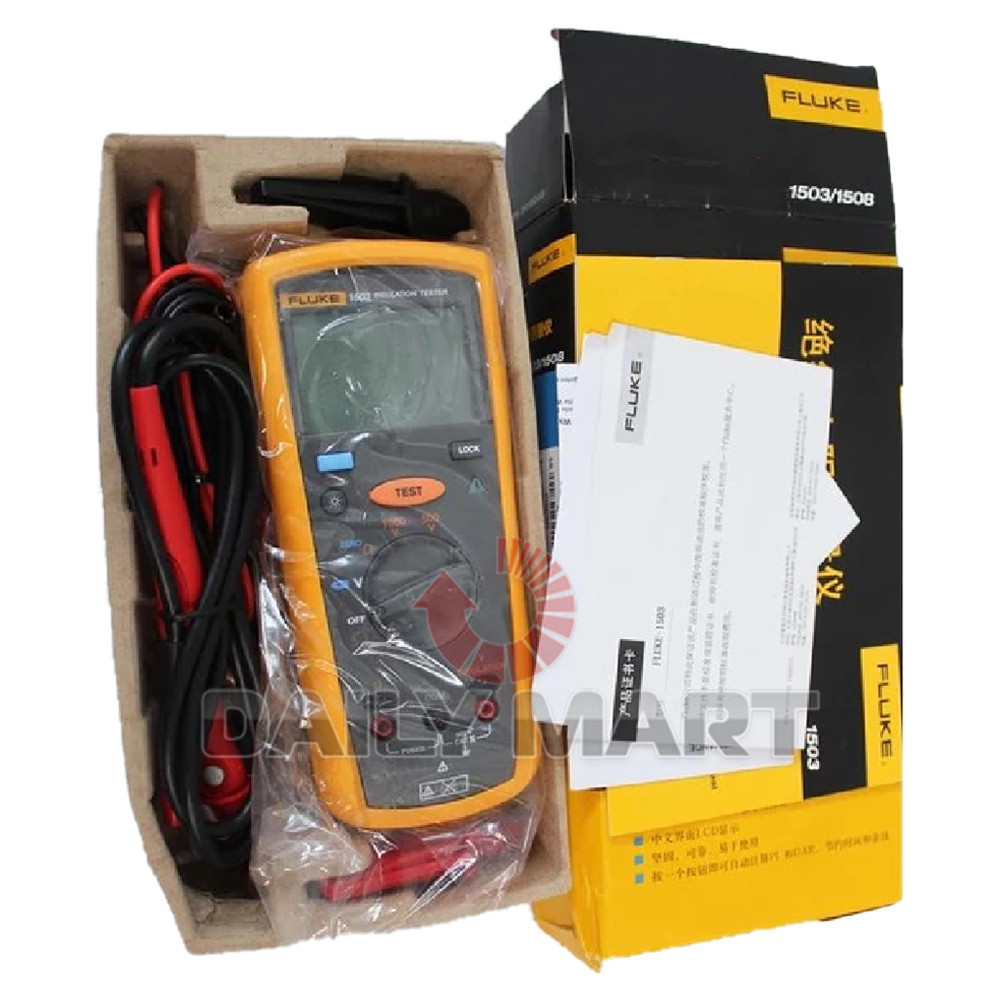

Photos from current listings. Actual item, color, and included accessories may vary.
Fluke Meter Buying Guide
Fluke meters are professional-grade electrical test instruments defined by true-RMS measurement, CAT III/IV safety ratings, and long-term calibration stability. The core trade-off is between handheld multimeters (117, 87V) for general diagnostics and specialty testers (insulation, power quality, clamp) for dedicated tasks. Buy a Fluke only if you need IEC 61010 safety certification and lifetime accuracy; otherwise a mid-tier CAT III meter covers basic residential work at lower cost.
Key takeaways
- Fluke 117/87V use true-RMS AC/DC sensing with 0.5% basic DC accuracy and CAT III 600V / CAT IV 600V safety ratings for commercial and industrial panels
- Insulation testers like the 1503 apply 250/500/1000V test voltages and measure resistance to 2 GΩ, with PI/DAR ratios for predictive motor maintenance
- Clamp meters such as the 345 measure single-phase power quality, harmonics, and DC current to 2000A via Hall-effect jaws without breaking the circuit
At a glance
- Category
- Multimeters & Electrical Testers
- Last updated
- Nov 28, 2026
Current offers
Highlights
- Fluke 117/87V use true-RMS AC/DC sensing with 0.5% basic DC accuracy and CAT III 600V / CAT IV 600V safety ratings for commercial and industrial panels
- Insulation testers like the 1503 apply 250/500/1000V test voltages and measure resistance to 2 GΩ, with PI/DAR ratios for predictive motor maintenance
- Clamp meters such as the 345 measure single-phase power quality, harmonics, and DC current to 2000A via Hall-effect jaws without breaking the circuit
- Rugged models (87V, 28II) are IP67 dust/water-rated and survive 3-meter drops, while bench/compact lines (107, 115) trade environmental sealing for portability
Best use cases
- Residential and light-commercial electricians: pick the Fluke 117 true-RMS multimeter with non-contact voltage and CAT III 600V for panel and outlet diagnostics; skip insulation testers unless troubleshooting motors.
- Motor and cable maintenance: choose the Fluke 1503 insulation tester for 250/500/1000V megger tests on windings and feeders; a standard multimeter cannot substitute for insulation resistance measurement.
- Industrial power quality: select the Fluke 345 clamp meter for load studies, harmonics, and inrush on single-phase circuits; for three-phase logging, step up to the 1730 series power logger.
- Field service in wet/dusty environments: specify an IP67-rated 87V or 28II; compact 107/115 models lack ingress protection and are indoor/bench-only.
Buying tips
- Match the CAT safety rating to the panel: CAT III 600V covers distribution boards and fixed wiring; CAT IV 600V is required for utility service entrances and outdoor feeders.
- Check measurement functions before buying: a true-RMS meter (117, 87V) reads distorted AC accurately, while averaging meters misread VFD and harmonic loads.
- For insulation testing, confirm test voltage steps (250/500/1000V) and resistance range (up to 2 GΩ on 1503); lower-tier testers often cap at 500V and 200 MΩ.
- Verify jaw size and DC current capability on clamp meters: the 345 handles 2000A DC via Hall effect, while smaller AC-only clamps cannot measure DC or inrush.
Specs
| Meter Type | Handheld DMM / Clamp / Insulation |
|---|---|
| Safety Rating | CAT III 600V to CAT IV 600V |
| True RMS | Yes on 117/87V; no on 107 |
| Insulation Test | 250/500/1000V, to 2 GΩ |
Related searches
What to check before buying
- Confirm the meter's CAT rating matches your panel's voltage and location (CAT III for distribution, CAT IV for service entrance).
- Check probe and accessory compatibility: Fluke meters use standard 4mm banana jacks, but specialty testers may require dedicated leads or clamps.
- Verify environmental sealing (IP rating) if working outdoors or in wet/dusty sites; non-IP models are bench-use only.
- Ensure the meter's battery type and fusing are serviceable in your region; Fluke meters typically use 9V or AA cells with user-replaceable HRC fuses.
FAQ
Data sources: eBay / Amazon listings and product attribute feeds. Updated Nov 28, 2026.
Some links on this page are affiliate links. If you buy after clicking one, we may earn a commission at no extra cost to you. This does not change which products appear here or their order. Affiliate disclosure.