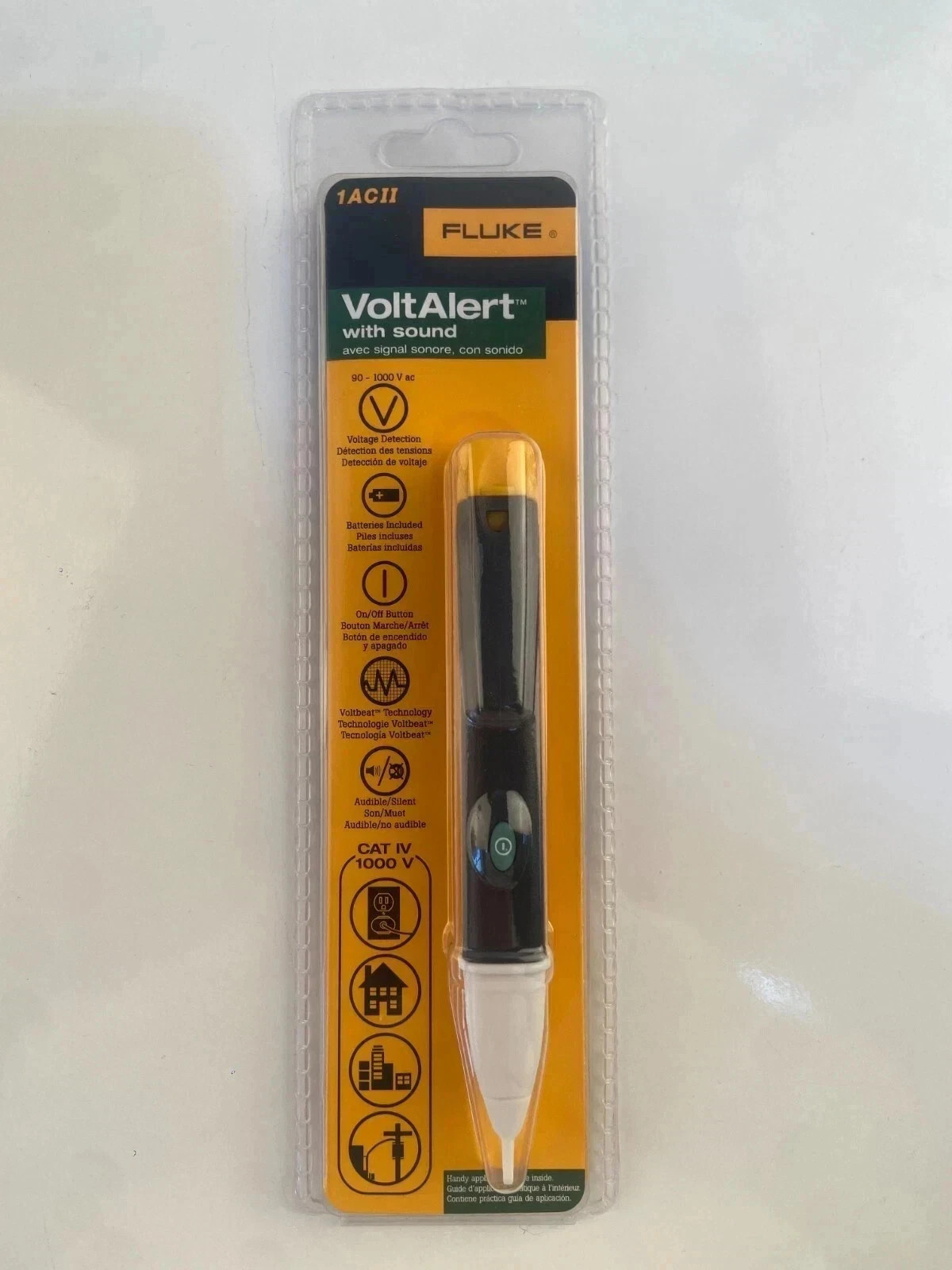

Photos from current listings. Actual item, color, and included accessories may vary.
Fluke Non Contact Voltage Tester Buying Guide
A non-contact voltage tester detects AC live conductors without metal-to-metal contact, and the key trade-off is sensitivity/voltage range versus false-positive rejection and CAT safety rating. The Fluke VoltAlert line splits into the pocket 1AC II (90–1000V AC, always-on) and the 2AC (90–1000V AC, dual sensitivity with silent mode), while CAT IV 1000V rating distinguishes it from generic pens. Buy the 1AC II for fast outlet/switch checks; step to the 2AC only when you need adjustable sensitivity near bundled wiring.
Key takeaways
- Fluke 1AC II VoltAlert detects 90–1000V AC and is CAT IV 1000V rated, suitable for industrial and outdoor distribution panels.
- Dual-sensitivity 2AC model adds a low-sensitivity mode and silent vibrate alert, reducing false positives from adjacent live wires.
- Pocket pen form factor runs on 2 AAA batteries with a always-on design; no power button, so it activates when the tip nears a live conductor.
At a glance
- Category
- Multimeters & Electrical Testers
- Last updated
- Nov 28, 2026
Current offers
Highlights
- Fluke 1AC II VoltAlert detects 90–1000V AC and is CAT IV 1000V rated, suitable for industrial and outdoor distribution panels.
- Dual-sensitivity 2AC model adds a low-sensitivity mode and silent vibrate alert, reducing false positives from adjacent live wires.
- Pocket pen form factor runs on 2 AAA batteries with a always-on design; no power button, so it activates when the tip nears a live conductor.
- Generic non-contact pens often stop at CAT II 1000V or lack a defined voltage threshold; Fluke's threshold and safety rating are the durability differentiator.
Best use cases
- Best fit: residential electricians and DIYers checking outlets, switches, and breakers at 120/230V — pick the 1AC II for its fixed 90–1000V range and pocket clip.
- Best fit: commercial/industrial work near bundled or shielded conductors — choose the 2AC's low-sensitivity mode to isolate the target wire and avoid ghost voltage.
- Wrong fit: low-voltage DC automotive or 12V landscape lighting diagnostics — a non-contact AC tester will not respond; use a DC multimeter or dedicated DC tester instead.
- Wrong fit: precise voltage measurement or circuit loading — a non-contact tester only indicates presence; pair it with a CAT-rated digital multimeter for actual readings.
Buying tips
- Confirm the voltage threshold: Fluke VoltAlert 1AC II and 2AC both cover 90–1000V AC; a tester rated only 50–600V will miss 277V commercial lighting circuits.
- Check the CAT safety rating: CAT IV 1000V is required for outdoor service drops and distribution panels; CAT II is acceptable only for portable plug-in loads.
- Prefer dual-sensitivity (2AC) when working in tight panels where always-on high sensitivity triggers on neighboring live conductors.
- Battery type matters: the 1AC II uses 2 AAA cells; verify the housing is sealed and the tip is replaceable for long-term durability.
Specs
| Voltage Range | 90–1000V AC |
|---|---|
| Safety Rating | CAT IV 1000V |
| Sensitivity Modes | Fixed (1AC II) / Dual (2AC) |
| Alert Type | Audible + visual; 2AC adds vibrate |
Related searches
What to check before buying
- Verify your expected circuit voltage falls within 90–1000V AC; below 90V the Fluke VoltAlert will not alert.
- Confirm the environment: CAT IV 1000V rating is needed for outdoor/utility work; CAT II suffices for in-home outlet checks.
- Check the form factor fits your pouch or pocket: the 1AC II is pen-sized with a clip; the 2AC adds a slightly larger body for the mode switch.
- Ensure you have a companion CAT-rated multimeter for actual voltage readings; the non-contact tester is a presence indicator only.
FAQ
Data sources: eBay / Amazon listings and product attribute feeds. Updated Nov 28, 2026.
Some links on this page are affiliate links. If you buy after clicking one, we may earn a commission at no extra cost to you. This does not change which products appear here or their order. Affiliate disclosure.