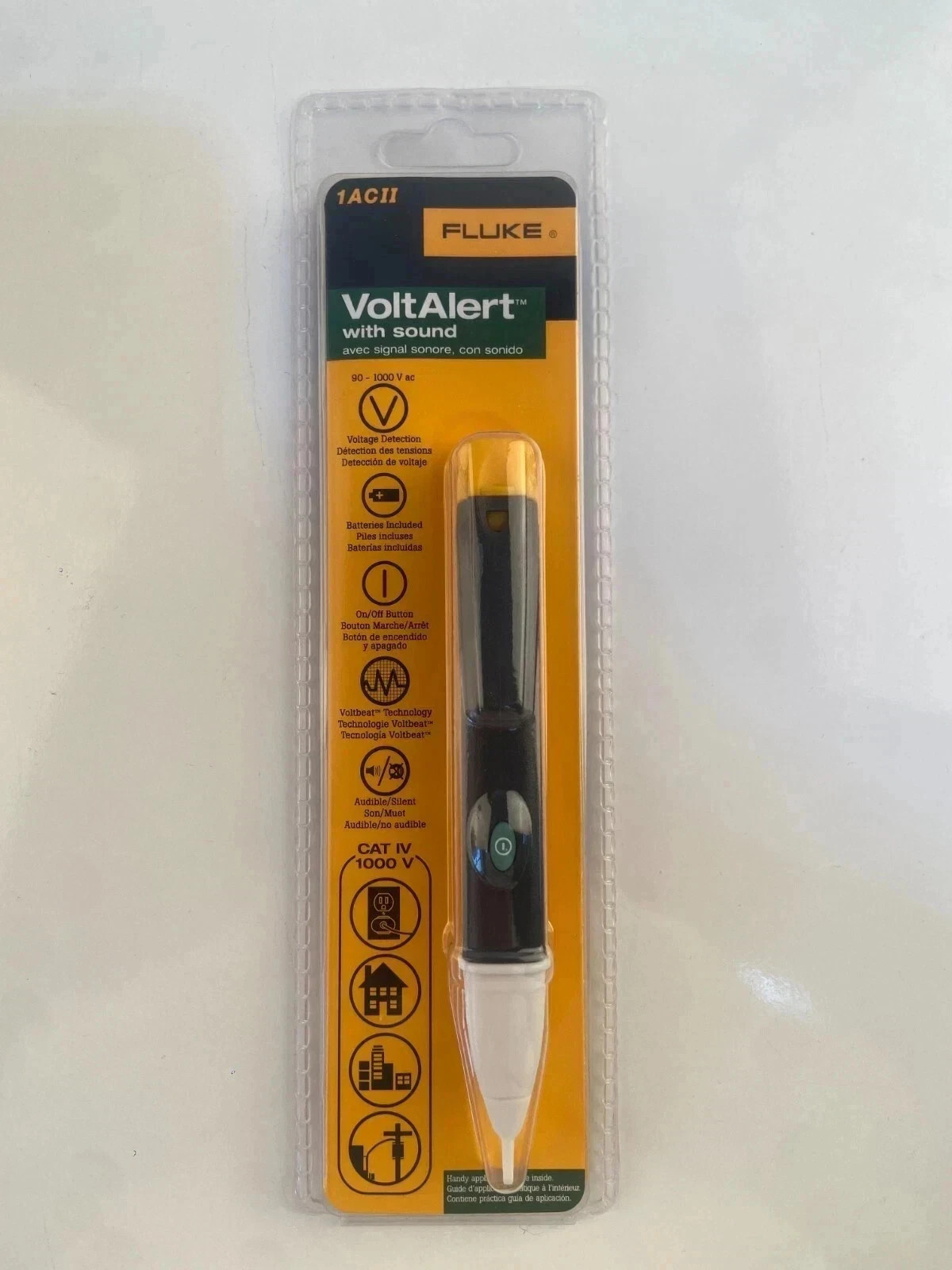

Photos from current listings. Actual item, color, and included accessories may vary.
Fluke Voltage Tester Buying Guide
A Fluke voltage tester is a non-contact or contact voltage detection tool used to verify live AC circuits before work; the segment splits into pocket pen-style non-contact detectors and full multimeter-style testers. The primary trade-off is detection reliability and safety rating versus convenience and price. The decision rule: choose a true Fluke VoltAlert or T-series tester with a CAT safety rating and self-test for daily electrical work; avoid unrated pocket pens for anything beyond quick presence checks.
Key takeaways
- Fluke 1AC II VoltAlert detects 90–1000V AC via capacitive sensing with a continuous self-test circuit and flashing red LED plus beeper; no contact, no CAT rating.
- Fluke 2AC VoltAlert adds a longer probe tip and 200–1000V AC range with the same non-contact architecture; neither model measures voltage numerically.
- Fluke T5-1000 and T6-1000 are electrical testers with CAT III 1000V / CAT IV 600V rating, OpenJaw current measurement, and auto AC/DC voltage to 1000V.
At a glance
- Category
- Multimeters & Electrical Testers
- Last updated
- Nov 28, 2026
Current offers
Highlights
- Fluke 1AC II VoltAlert detects 90–1000V AC via capacitive sensing with a continuous self-test circuit and flashing red LED plus beeper; no contact, no CAT rating.
- Fluke 2AC VoltAlert adds a longer probe tip and 200–1000V AC range with the same non-contact architecture; neither model measures voltage numerically.
- Fluke T5-1000 and T6-1000 are electrical testers with CAT III 1000V / CAT IV 600V rating, OpenJaw current measurement, and auto AC/DC voltage to 1000V.
- Fluke 117 True-RMS multimeter carries CAT III 600V, VoltAlert non-contact detection built in, and low-impedance mode to reject ghost voltage—a full meter, not a pen.
Best use cases
- Best fit: Fluke 1AC II or 2AC for electricians and homeowners doing quick live-wire presence checks at outlets, switches, and fixtures before cutting power—pick the 2AC if you need a longer tip for recessed terminals.
- Best fit: Fluke T5-1000 or T6-1000 for service techs who need voltage, continuity, and current in one hand-held tester with CAT III/IV safety at panels and feeders—skip pen-style VoltAlerts for any measurement task.
- Wrong fit: Using any non-contact pen as the sole verification before touching conductors; a VoltAlert indicates presence, not absence of voltage—pair it with a CAT-rated contact tester or multimeter.
- Wrong fit: Buying a Fluke 117 when you only need non-contact detection; the 117 is a full True-RMS multimeter with CAT III 600V and costs significantly more than a VoltAlert pen for basic presence checks.
Buying tips
- Match the safety category to the panel: CAT III 600V minimum for distribution boards and fixed wiring; CAT IV 600V for service entrance and outdoor feeders—VoltAlert pens carry no CAT rating and are indicators only.
- Choose the voltage range that covers your work: 1AC II covers 90–1000V AC; 2AC covers 200–1000V AC—if you test 120V control circuits, the 1AC II's lower threshold is the safer pick.
- Decide between detection and measurement: VoltAlert 1AC/2AC only indicate live AC; T5-1000/T6-1000 and 117 measure voltage, continuity, and current—buy the tester tier that matches the task, not the brand name alone.
- Confirm probe and lead compatibility: T-series testers use integrated fixed leads with CAT-rated tips; the 117 uses standard 4mm safety banana jacks—pick the form factor that fits your existing lead set and pouch.
Specs
| Detection Type | Non-contact capacitive vs contact probe |
|---|---|
| Voltage Range | 90–1000V AC (1AC II) / 200–1000V (2AC) |
| Safety Rating | Unrated pen vs CAT III 1000V tester |
| Measurement | Presence-only indicator vs full multimeter |
Related searches
What to check before buying
- Verify the circuit voltage and category before buying: residential 120/240V AC panels need at least CAT III 600V; service entrances need CAT IV 600V—VoltAlert pens are not rated for either.
- Check physical access: recessed outlet boxes and deep terminal blocks favor the 2AC's longer tip; flush receptacles and tight junction boxes favor the shorter 1AC II pen.
- Confirm you have a verified reference source: test your tester on a known-live circuit before and after every use—non-contact pens can false-negative on shielded or wet cables.
- Match the tester to your existing kit: if you already carry 4mm banana leads and a case, the 117 multimeter integrates; if you want pocket carry, the 1AC II clips to a shirt pocket and needs no leads.
FAQ
Data sources: eBay / Amazon listings and product attribute feeds. Updated Nov 28, 2026.
Some links on this page are affiliate links. If you buy after clicking one, we may earn a commission at no extra cost to you. This does not change which products appear here or their order. Affiliate disclosure.