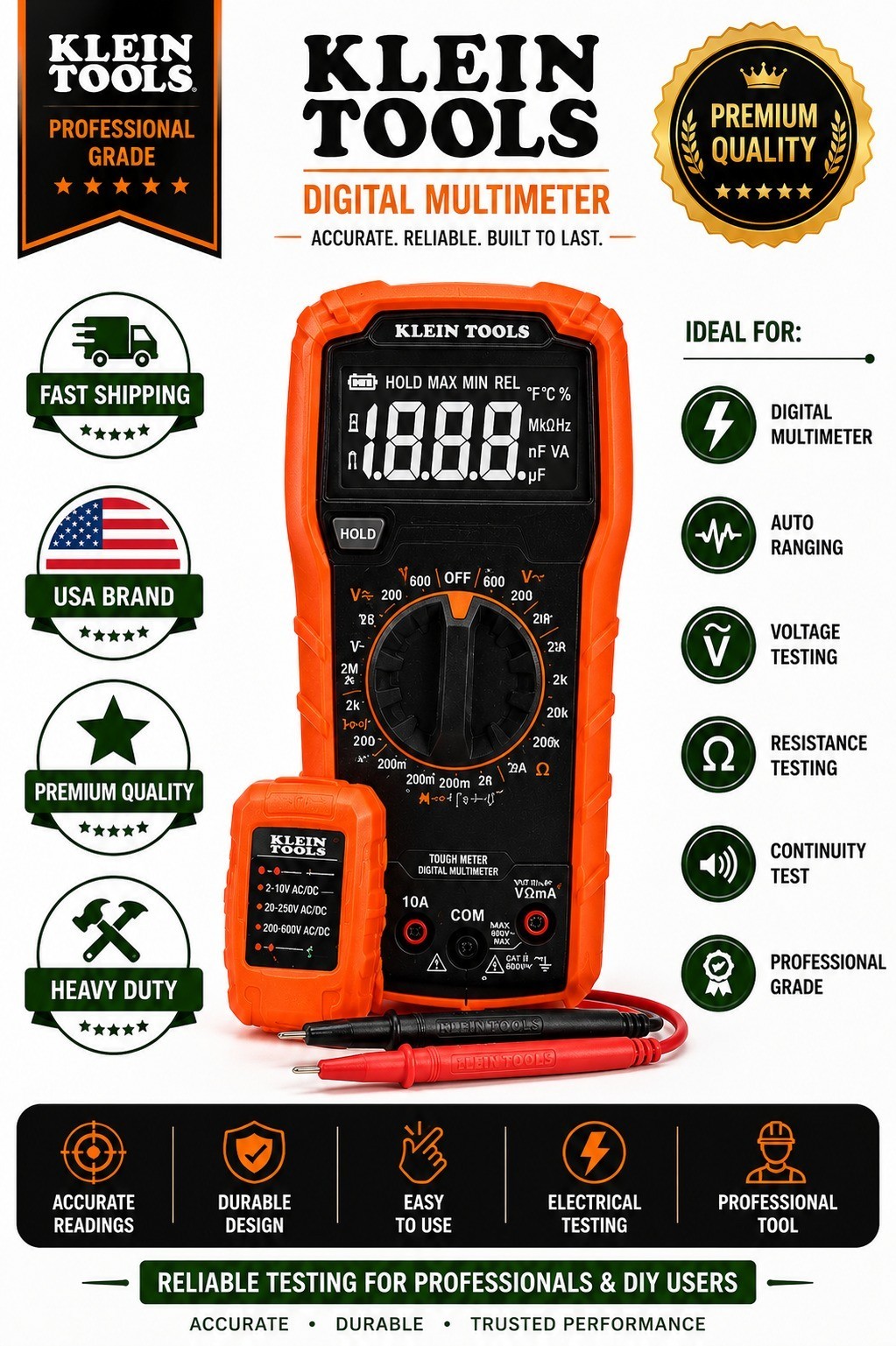

Photos from current listings. Actual item, color, and included accessories may vary.
Klein Tool Voltage Tester Buying Guide
Klein Tools voltage testers are non-contact and contact voltage detection tools built for electricians and serious DIYers who need reliable safety verification before touching a circuit. The core trade-off is between basic non-contact pens with fixed sensitivity and dual-range or combo kits that add GFCI testing, load checks, and CAT safety ratings. Buy the highest CAT III/IV rating and widest voltage range you will actually work near—anything less is a compromise on arc-flash safety.
Key takeaways
- Non-contact voltage tester pens detect 12–1000V AC via capacitive sensing; dual-range models like the NCVT-3 add low-voltage (12–48V) and standard (48–1000V) modes for thermostat and doorbell work.
- CAT safety ratings are the hard durability metric: CAT III 1000V or CAT IV 600V units survive transient overvoltage in distribution panels; CAT II-only pens are for receptacle-level diagnostics only.
- Klein combo kits (e.g., 69149P) pair a digital multimeter, non-contact pen, and GFCI outlet tester—each tool serves a distinct verification step rather than duplicating function.
At a glance
- Category
- Multimeters & Electrical Testers
- Last updated
- Nov 28, 2026
Current offers
Highlights
- Non-contact voltage tester pens detect 12–1000V AC via capacitive sensing; dual-range models like the NCVT-3 add low-voltage (12–48V) and standard (48–1000V) modes for thermostat and doorbell work.
- CAT safety ratings are the hard durability metric: CAT III 1000V or CAT IV 600V units survive transient overvoltage in distribution panels; CAT II-only pens are for receptacle-level diagnostics only.
- Klein combo kits (e.g., 69149P) pair a digital multimeter, non-contact pen, and GFCI outlet tester—each tool serves a distinct verification step rather than duplicating function.
- Built-in flashlight and audible beeper on premium pens (NCVT-4IR, NCVT-5A) improve detection in dark panels; basic NCVT-1 lacks these and relies on visual/audible alert only.
Best use cases
- Best fit: residential electricians and remodelers—choose a CAT III 1000V non-contact pen plus a separate GFCI outlet tester for code-compliant receptacle verification.
- Best fit: HVAC and low-voltage technicians—pick a dual-range tester (12–48V and 48–1000V) so thermostat wiring and 240V disconnect checks use one tool.
- Wrong fit: industrial cabinet work above 1000V or CAT IV service-entrance testing—skip handheld pens entirely and use a properly rated CAT IV multimeter with fused leads.
- Wrong fit: bench electronics and DC circuit debugging—a non-contact AC pen cannot read DC voltage or current; choose a digital multimeter instead.
Buying tips
- Match the CAT rating to your work location: CAT III 1000V for panel feeders and distribution boards, CAT II 300V for cord-connected appliances and receptacles.
- For dual-range pens, confirm the low-voltage threshold is 12–48V—this covers thermostat and doorbell circuits that standard 90–1000V pens miss.
- Combo kits save cost only if you need all three tools; if you already own a multimeter, buy the standalone NCVT pen and GFCI tester separately.
- Check the pen's detection distance spec—premium models sense through insulation and conduit at greater distance, reducing false negatives in tight boxes.
Specs
| Detection Type | Non-contact AC / contact / combo kit |
|---|---|
| Voltage Range | 12–1000V AC (dual-range) or 50–1000V |
| CAT Safety Rating | CAT II 300V to CAT IV 1000V |
| Alert Mode | Visual + audible / flashlight models |
Related searches
What to check before buying
- Confirm your panel's maximum voltage and choose a tester rated at least CAT III for that voltage—never use a CAT II pen on a service panel.
- Verify the tester's voltage range covers your lowest working circuit (12V for thermostats, 24V for controls) if you do low-voltage work.
- Ensure the kit includes a GFCI outlet tester if you inspect receptacles—a non-contact pen alone cannot verify GFCI trip function.
- Check battery type and replacement access (AAA or coin cell) and whether the pen has a self-test function before each use.
FAQ
Data sources: eBay / Amazon listings and product attribute feeds. Updated Nov 28, 2026.
Some links on this page are affiliate links. If you buy after clicking one, we may earn a commission at no extra cost to you. This does not change which products appear here or their order. Affiliate disclosure.