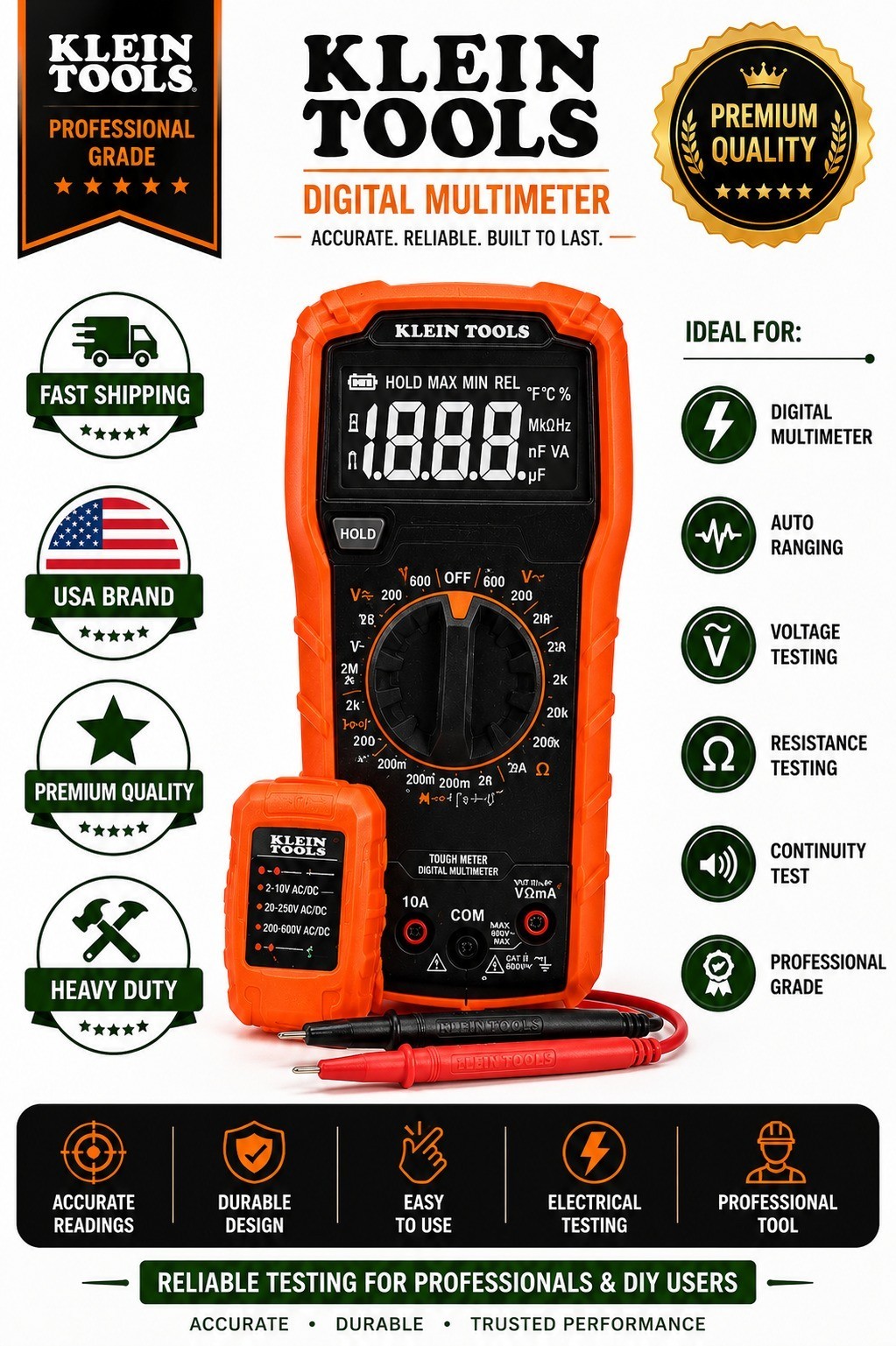

Photos from current listings. Actual item, color, and included accessories may vary.
Klein Voltage Tester Buying Guide
A Klein voltage tester is a non-contact or contact voltage detector (often bundled with a multimeter and outlet tester) used to quickly verify live conductors, identify breakers, and confirm safe isolation before work. The key trade-off is sensitivity and safety rating versus false triggers: basic non-contact pens are fast but can ghost on capacitive coupling, while CAT III/IV rated units with load-mode testing are decisive but cost more. The rule: choose a tester whose CAT safety rating and voltage range match your panel and environment, and skip any unit without a self-test or load-check function.
Key takeaways
- Non-contact pens sense 12–1000 V AC via capacitive field; they cannot detect DC or verify current-carrying capacity, so pair with a multimeter for dead-circuit confirmation.
- CAT III 1000 V / CAT IV 600 V ratings are the real durability benchmark for panel and service-entrance work; unrated pens are for receptacle-level checks only.
- Klein's dual-range models (e.g., NCVT-3P) offer low/high sensitivity modes to distinguish hot from ghost voltage on long runs and bundled cables.
At a glance
- Category
- Multimeters & Electrical Testers
- Last updated
- Nov 28, 2026
Current offers
Highlights
- Non-contact pens sense 12–1000 V AC via capacitive field; they cannot detect DC or verify current-carrying capacity, so pair with a multimeter for dead-circuit confirmation.
- CAT III 1000 V / CAT IV 600 V ratings are the real durability benchmark for panel and service-entrance work; unrated pens are for receptacle-level checks only.
- Klein's dual-range models (e.g., NCVT-3P) offer low/high sensitivity modes to distinguish hot from ghost voltage on long runs and bundled cables.
- Bundled kits like the 69149P combine a digital multimeter, non-contact pen, and GFCI outlet tester—each covers a distinct test (voltage, proximity, wiring fault) that a single pen cannot.
Best use cases
- Best fit: a homeowner or DIYer mapping breakers and checking receptacles—pick a non-contact pen with self-test plus a GFCI outlet tester; skip CAT IV lab-grade meters.
- Best fit: an electrician working inside panels—choose a CAT III 1000 V rated pen or clamp meter with load-mode proving; skip unrated pens and single-range detectors.
- Best fit: a maintenance tech verifying dead circuits before service—use a contact voltage tester or multimeter with LoZ mode; skip non-contact pens as sole verification.
- Wrong fit: automotive 12 V DC diagnostics—non-contact AC pens will not read DC; use a dedicated DC voltage tester or multimeter instead.
Buying tips
- Match CAT rating to location: CAT III 1000 V for distribution panels and feeders, CAT IV 600 V for service entrances; receptacle-only checks tolerate CAT II 300 V.
- Sensitivity matters: dual-range or adjustable-sensitivity pens (low/high) reduce ghost-voltage false positives on bundled wires and long runs better than fixed-sensitivity pens.
- A self-test button and audible/visual dual alert are non-negotiable; a pen that cannot prove its own function before use is a safety liability.
- For dead-circuit verification, choose a tester with load or LoZ mode (or a solenoid tester) rather than relying on a capacitive pen alone.
Specs
| Detection Type | Non-contact AC / contact / combo |
|---|---|
| Voltage Range | 12-1000 V AC (typical pen) |
| Safety Rating | CAT II 300 V to CAT IV 600 V |
| Kit Contents | Pen only vs pen + meter + outlet tester |
Related searches
What to check before buying
- Confirm your panel voltage (120/240 V North American split-phase vs 230 V single-phase) so the tester's rated range covers the highest conductor you will touch.
- Verify the pen's CAT rating is printed on the body and meets or exceeds the environment: CAT III for panel interiors, CAT IV for service drops.
- Check whether the kit includes an outlet/GFCI tester and multimeter—if not, budget for those separate tools for full receptacle and wiring verification.
- Ensure the tester uses standard replaceable batteries (AAA/9V) and has a low-battery indicator; sealed non-replaceable cells shorten service life.
FAQ
Data sources: eBay / Amazon listings and product attribute feeds. Updated Nov 28, 2026.
Some links on this page are affiliate links. If you buy after clicking one, we may earn a commission at no extra cost to you. This does not change which products appear here or their order. Affiliate disclosure.