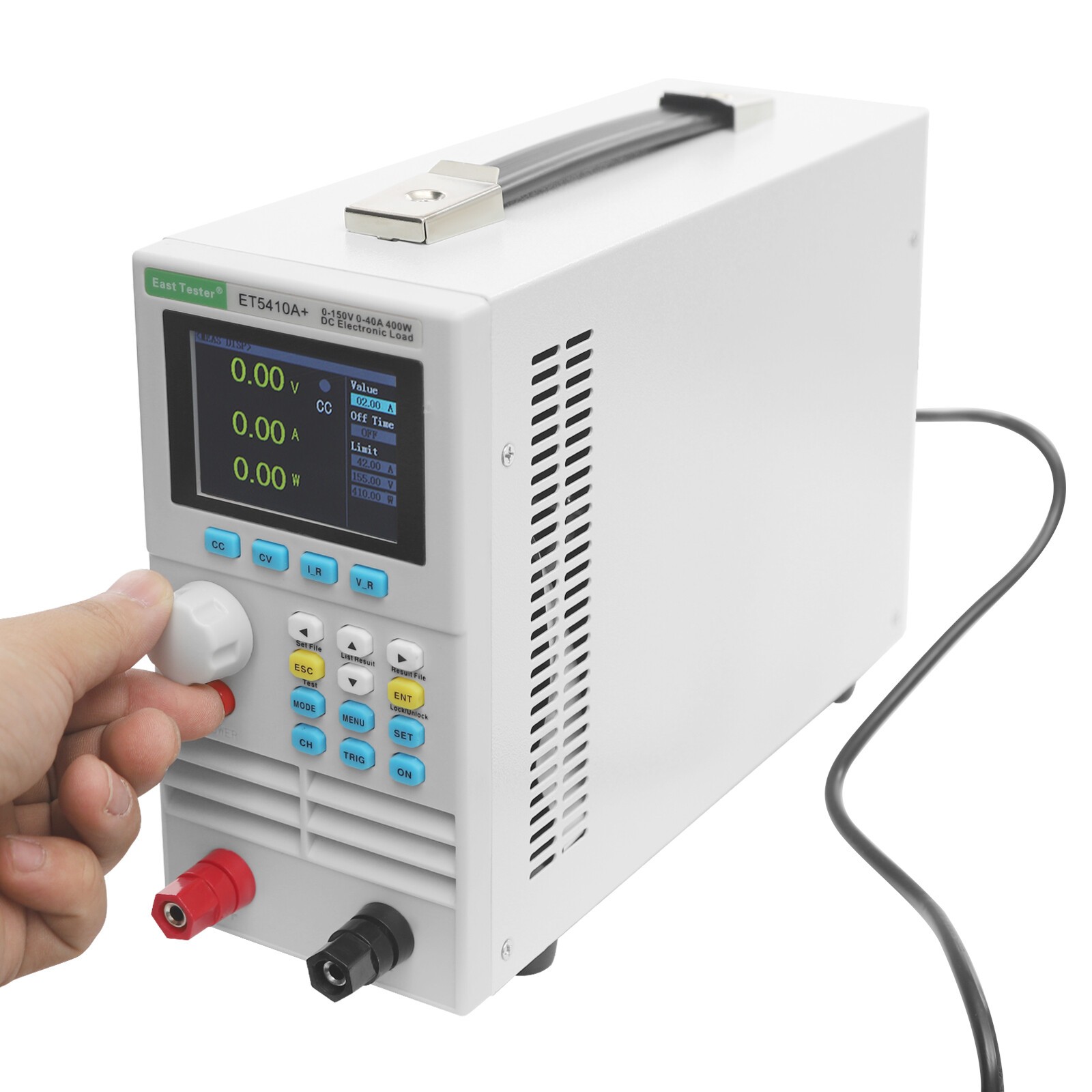

Photos from current listings. Actual item, color, and included accessories may vary.
Load Tester Buying Guide
A load tester is the only way to verify real battery capacity, power-supply stability, and USB-C cable resistance under controlled current. Buyers often ruin cells or misread results by choosing a tester whose voltage, current, or interface cannot match the device under test. Select by load type (resistive vs electronic), maximum discharge power, and the measurement resolution you actually need.
Key takeaways
- Electronic loads use MOSFET constant-current circuits for 0–40 A discharge, while resistive testers rely on fixed power resistors and cannot hold current as voltage sags.
- Discharge power rating is the true ceiling: a 400 W load at 150 V is limited to 2.6 A, even if the current dial claims 40 A.
- Four-wire Kelvin sensing eliminates lead resistance, which otherwise adds 0.1–0.5 V error on 1–5 A battery tests.
At a glance
- Category
- Multimeters & Electrical Testers
- Last updated
- Nov 28, 2026
Current offers
Highlights
- Electronic loads use MOSFET constant-current circuits for 0–40 A discharge, while resistive testers rely on fixed power resistors and cannot hold current as voltage sags.
- Discharge power rating is the true ceiling: a 400 W load at 150 V is limited to 2.6 A, even if the current dial claims 40 A.
- Four-wire Kelvin sensing eliminates lead resistance, which otherwise adds 0.1–0.5 V error on 1–5 A battery tests.
- USB-C PD testers add protocol triggering (5–20 V) but typically cap at 100 W, so they complement rather than replace a 150 V bench load.
Best use cases
- Pick a 150 V / 40 A single-channel electronic load for 12–48 V battery packs, solar panels, and bench PSU validation—skip it for 100 W USB-C phone charging, where a PD trigger tester is cheaper and safer.
- Choose a 100–150 W resistive load tester for occasional 12 V car battery and alternator checks—avoid it for lithium pack capacity graphs that need constant-current discharge.
- Buy a USB-C PD load tester with 0.01 V / 0.01 A resolution for cable and charger QA—do not use it to test 24 V lead-acid banks above its 20 V input limit.
- For production or lab use, select a programmable electronic load with remote sense and SCPI/USB control—skip knob-only loads if you need repeatable automated discharge curves.
Buying tips
- Check the derating curve: most 400 W electronic loads only reach full power below 40 V, so 150 V testing is limited to roughly 2.6 A.
- Prioritize four-wire measurement terminals on any tester expected to read below 1 Ω or above 5 A; two-wire leads add measurable error.
- Avoid single-button resistive testers if you need constant-current, constant-resistance, or constant-voltage modes—those require an electronic load.
- Compare input polarity protection and reverse-voltage tolerance; a reversed 48 V pack can destroy a load tester without a blocking diode or fuse.
Specs
| Load Type | Electronic CC/CV vs Resistive |
|---|---|
| Max Power | 100 W / 150 W / 400 W / 600 W |
| Voltage Range | 0–20 V USB-C to 0–150 V bench |
| Current Range | 0–10 A to 0–40 A single-channel |
Related searches
What to check before buying
- Measure your maximum device voltage and current (e.g., 48 V pack, 10 A) and confirm the tester’s voltage and current ranges exceed both with headroom.
- Verify the load’s power derating at your test voltage—do not assume the headline wattage applies across the full voltage range.
- Confirm lead/terminal types (banana, alligator, XT60, USB-C) match your battery or PSU connectors without adapters that add resistance.
- Check whether the tester requires an external power supply or USB adapter for its control electronics, and that your bench outlet matches its input voltage.
FAQ
Data sources: eBay / Amazon listings and product attribute feeds. Updated Nov 28, 2026.
Some links on this page are affiliate links. If you buy after clicking one, we may earn a commission at no extra cost to you. This does not change which products appear here or their order. Affiliate disclosure.