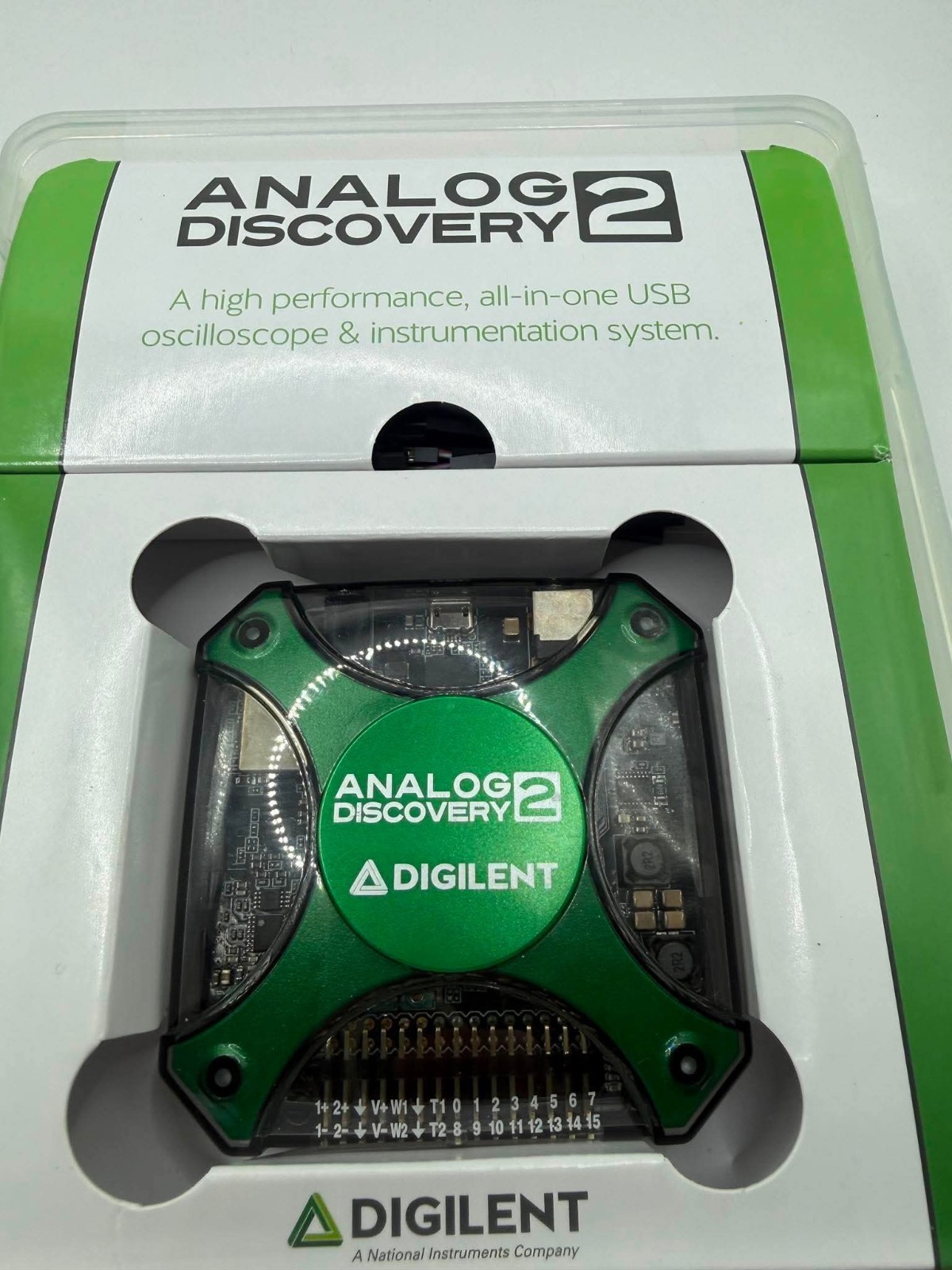

Photos from current listings. Actual item, color, and included accessories may vary.
Digilent Analog Discovery 2 Buying Guide
The Digilent Analog Discovery 2 is a USB-powered, pocket-sized multi-instrument that combines a 2-channel 30 MHz oscilloscope, 14-bit 100 MSa/s digitizer, arbitrary waveform generator, logic analyzer, and programmable power supplies into one portable device. The core trade-off is between the convenience of a low-cost, PC-tethered all-in-one and the raw bandwidth, sample rate, and channel isolation of a dedicated benchtop scope. Buy the AD2 for low-frequency embedded work, education, and mixed-signal debug; skip it for high-speed digital, RF, or high-voltage power electronics.
Key takeaways
- 14-bit, 100 MSa/s ADC delivers 16384-level vertical resolution, far cleaner than 8-bit scopes for small-signal and sensor work, but analog bandwidth caps at 30 MHz (with BNC adapter).
- Dual-channel arbitrary waveform generator at 100 MSa/s with 14-bit output, plus 16-channel logic analyzer and two programmable 0–5 V/±5 V supplies in one USB peripheral.
- Requires the free WaveForms software (Windows, macOS, Linux) — no onboard display, buttons, or standalone operation; all controls and measurements run on the host PC.
At a glance
- Category
- Oscilloscopes, Signal & Spectrum Analyzers
- Status
- Listings available
- Last updated
- Nov 28, 2026
Current offers
Highlights
- 14-bit, 100 MSa/s ADC delivers 16384-level vertical resolution, far cleaner than 8-bit scopes for small-signal and sensor work, but analog bandwidth caps at 30 MHz (with BNC adapter).
- Dual-channel arbitrary waveform generator at 100 MSa/s with 14-bit output, plus 16-channel logic analyzer and two programmable 0–5 V/±5 V supplies in one USB peripheral.
- Requires the free WaveForms software (Windows, macOS, Linux) — no onboard display, buttons, or standalone operation; all controls and measurements run on the host PC.
- Original Analog Discovery (1) is 100 MSa/s at 8-bit with 5 MHz analog bandwidth and different I/O; the AD2 doubles resolution and bandwidth but uses the same BNC adapter board accessory.
Best use cases
- Best fit: embedded firmware and mixed-signal debug — pick the AD2 when you need simultaneous scope + logic analyzer + pattern generator on a USB port for MCU buses, sensors, and audio-range signals.
- Best fit: education, field service, and portable labs — choose the AD2 with the BNC adapter board when bench space is tight and signals stay below 30 MHz and within ±25 V.
- Wrong fit: RF, spectrum, or high-speed digital work above 30 MHz — skip the AD2 for a dedicated spectrum analyzer or a scope with 100+ MHz bandwidth and 1 GSa/s.
- Wrong fit: mains-referenced or high-voltage power electronics — the AD2 inputs are not isolated and are rated for low-voltage only; choose a differential probe/isolated scope instead.
Buying tips
- Budget for the BNC adapter board and probes: the bare AD2 uses 2-pin MTE header I/O, so standard BNC scope probes require the official adapter accessory.
- Match bandwidth to your fastest signal: 30 MHz analog bandwidth means usable sine/clock measurement to roughly 30 MHz, but digital edge fidelity degrades well before that — stay under ~5 MHz for clean rise-time work.
- Buy the AD2 over the original Analog Discovery only if you need 14-bit resolution or 30 MHz bandwidth; otherwise the older unit covers audio and low-speed logic at lower cost.
- Confirm your PC meets WaveForms requirements (USB 2.0 high-speed port, modern 64-bit OS); the AD2 is bus-powered and needs no external supply for standard use.
Specs
| Analog Bandwidth | 30 MHz (-3 dB, with BNC adapter) |
|---|---|
| ADC Resolution | 14-bit, 100 MSa/s per channel |
| Logic Analyzer | 16 channels, 100 MSa/s shared |
| Host Interface | USB 2.0 high-speed, bus-powered |
Alternatives to compare
Related searches
What to check before buying
- Confirm your signals stay within the AD2's low-voltage input range (±25 V max with adapter, typically ±5 V scope range) and are earth-referenced or safely floating — no mains-referenced measurements.
- Verify you have a USB 2.0 high-speed port and permission to install WaveForms; the device will not run without the host software.
- Check that your bench setup includes the BNC adapter board and 10× probes if you plan to use standard scope probes rather than the supplied MTE flywires.
- Ensure your target bandwidth is below 30 MHz analog and your digital buses are below the 16-channel logic analyzer's sample limits (100 MSa/s shared).
FAQ
Data sources: eBay / Amazon listings and product attribute feeds. Updated Nov 28, 2026.
Some links on this page are affiliate links. If you buy after clicking one, we may earn a commission at no extra cost to you. This does not change which products appear here or their order. Affiliate disclosure.