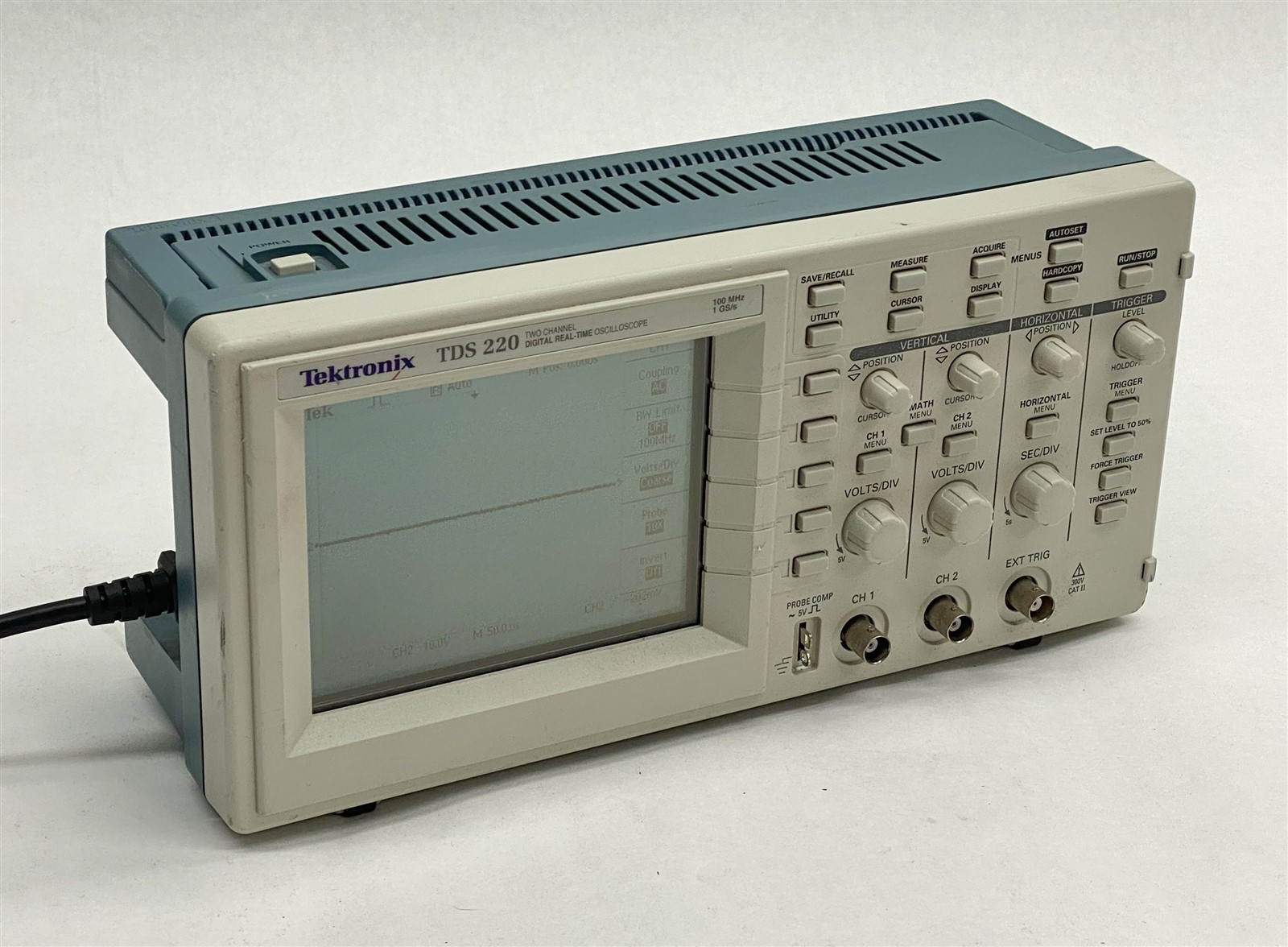

Photos from current listings. Actual item, color, and included accessories may vary.
Tektronix Oscilloscope Buying Guide
Tektronix oscilloscopes span three distinct eras: legacy analog CRT scopes, early digital real-time (DSO) models, and modern mixed-signal/DPO instruments. The core trade-off is bandwidth and sample rate versus repairability, calibration status, and acquisition age—analog scopes offer unbeatable X-Y and low-noise viewing but no storage, while early DSOs add single-shot capture at the cost of shallow memory and aging capacitors. The decision rule: buy only models with documented calibration or service history and avoid any unit whose CRT or power supply cannot be tested before purchase.
Median $172.50
Key takeaways
- Analog 2200-series (2215A): 60 MHz dual-channel, 1 mV/div sensitivity, no digital storage or readout—CRT and sweep integrity are the only performance metrics.
- TDS 200-series (TDS220): 100 MHz, 1 GS/s real-time, 2 channels, monochrome LCD, 1 k-point record length per channel—adequate for repetitive signals but marginal for single-shot glitches.
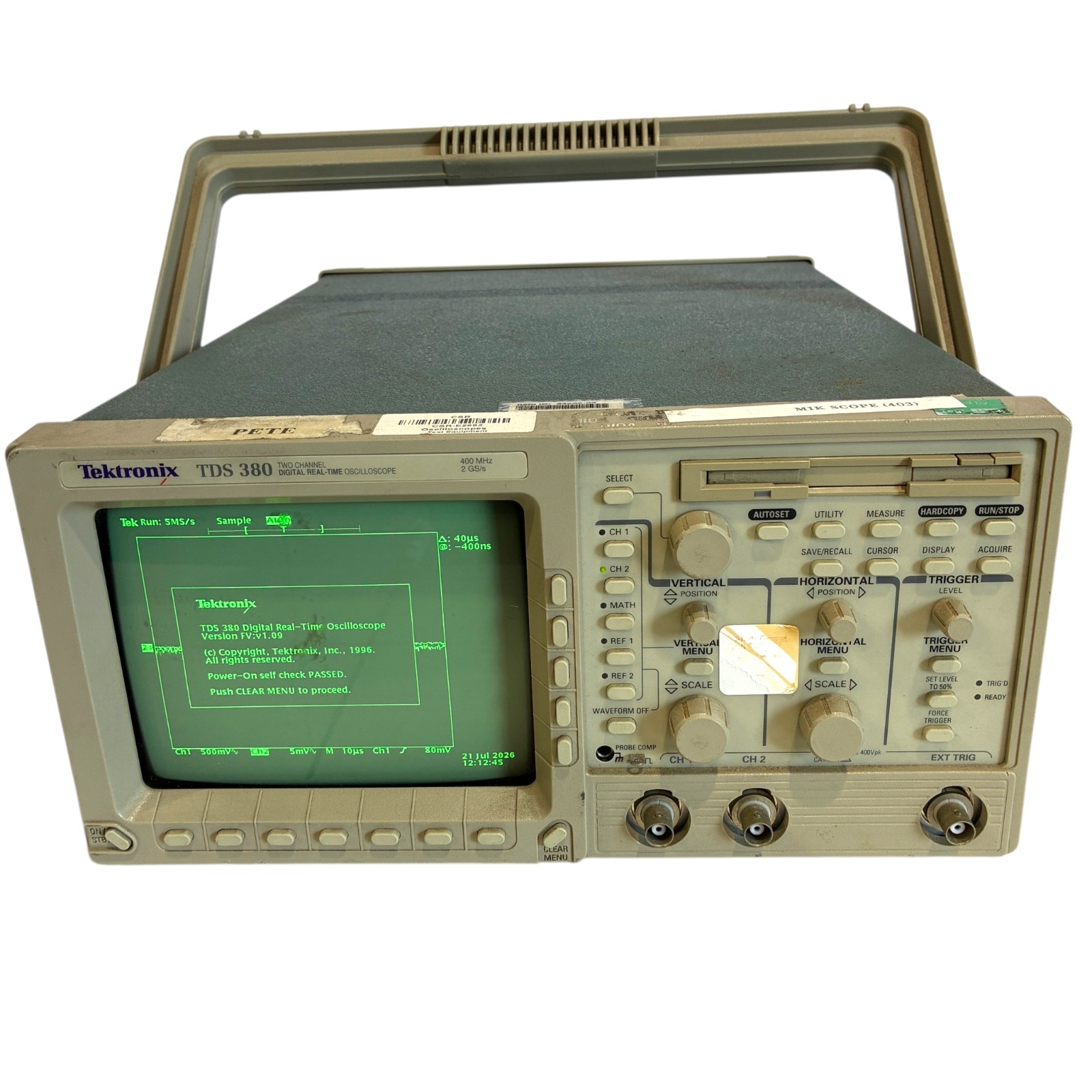
- TDS 300-series (TDS380): 400 MHz, 2 GS/s, 2 channels, 1 k-point memory—higher bandwidth demands active probes and careful grounding to avoid false readings.
At a glance
- Category
- Oscilloscopes, Signal & Spectrum Analyzers
- Last updated
- Nov 28, 2026
Current offers
Highlights
- Analog 2200-series (2215A): 60 MHz dual-channel, 1 mV/div sensitivity, no digital storage or readout—CRT and sweep integrity are the only performance metrics.
- TDS 200-series (TDS220): 100 MHz, 1 GS/s real-time, 2 channels, monochrome LCD, 1 k-point record length per channel—adequate for repetitive signals but marginal for single-shot glitches.
- TDS 300-series (TDS380): 400 MHz, 2 GS/s, 2 channels, 1 k-point memory—higher bandwidth demands active probes and careful grounding to avoid false readings.
- All three use passive 10x probes with 1 MΩ input; analog units need 50 Ω termination only for high-speed work, while digital units add FFT and cursor measurements.
Best use cases
- Best fit: hobbyist or educator needing inexpensive 60 MHz analog viewing for audio, power-supply ripple, and X-Y curves—choose the 2215A only if CRT brightness and sweep are verified.
- Best fit: bench technician capturing repetitive digital buses up to 100 MHz with single-shot needs—pick the TDS220 over any analog unit for its storage and cursors.
- Wrong fit: anyone debugging modern serial buses (USB, HDMI) or signals above 200 MHz—skip both 2215A and TDS220; the TDS380's 400 MHz is the minimum, and even it lacks deep memory for long captures.
- Wrong fit: field or portable use—all are boat-anchor CRT/LCD units requiring AC mains; choose a modern battery-powered scope instead.
Buying tips
- Verify bandwidth against your fastest signal: a 60 MHz scope accurately displays sine waves to ~60 MHz but needs 5x bandwidth for digital edges—choose 100 MHz (TDS220) for 20 MHz clocks, 400 MHz (TDS380) for 80 MHz logic.
- Demand proof of calibration or a recent adjustment sticker; analog scopes drift with age, and TDS units with dead NVRAM batteries lose calibration constants.
- Inspect CRT condition for the 2215A: a dim or burned phosphor cannot be economically restored; for TDS units, confirm the LCD backlight and all front-panel encoders work.
- Match probe and termination: all models need 10x passive probes rated above the scope bandwidth; avoid 1x probes above 20 MHz, and ensure the seller includes the original Tektronix probe or a compatible 100 MHz+ equivalent.
Specs
| Bandwidth | 60 / 100 / 400 MHz by model |
|---|---|
| Sample Rate | Analog n/a / 1 / 2 GS/s |
| Channels | 2 analog channels |
| Record Length | 1 k-point (digital models) |
Related searches
What to check before buying
- Measure your bench depth and weight capacity: the 2215A is a deep, heavy CRT chassis requiring ~18 inches of depth and 15+ lbs support; TDS units are shallower but still bench-only.
- Confirm your AC mains voltage and plug type match the scope's fixed power cord—none of these models have universal input; 120 V North American units need a step-down transformer elsewhere.
- Check that your signal source impedance and probe compensation range align: Tektronix 10x probes compensate 10–25 pF, so third-party probes must be adjustable to the scope's input capacitance.
- Plan for companion parts: budget for a pair of 100 MHz or 400 MHz passive probes (matching model), plus a BNC cable and 50 Ω feedthrough termination if you test fast edges.
FAQ
Data sources: eBay / Amazon listings and product attribute feeds. Updated Nov 28, 2026.
Some links on this page are affiliate links. If you buy after clicking one, we may earn a commission at no extra cost to you. This does not change which products appear here or their order. Affiliate disclosure.