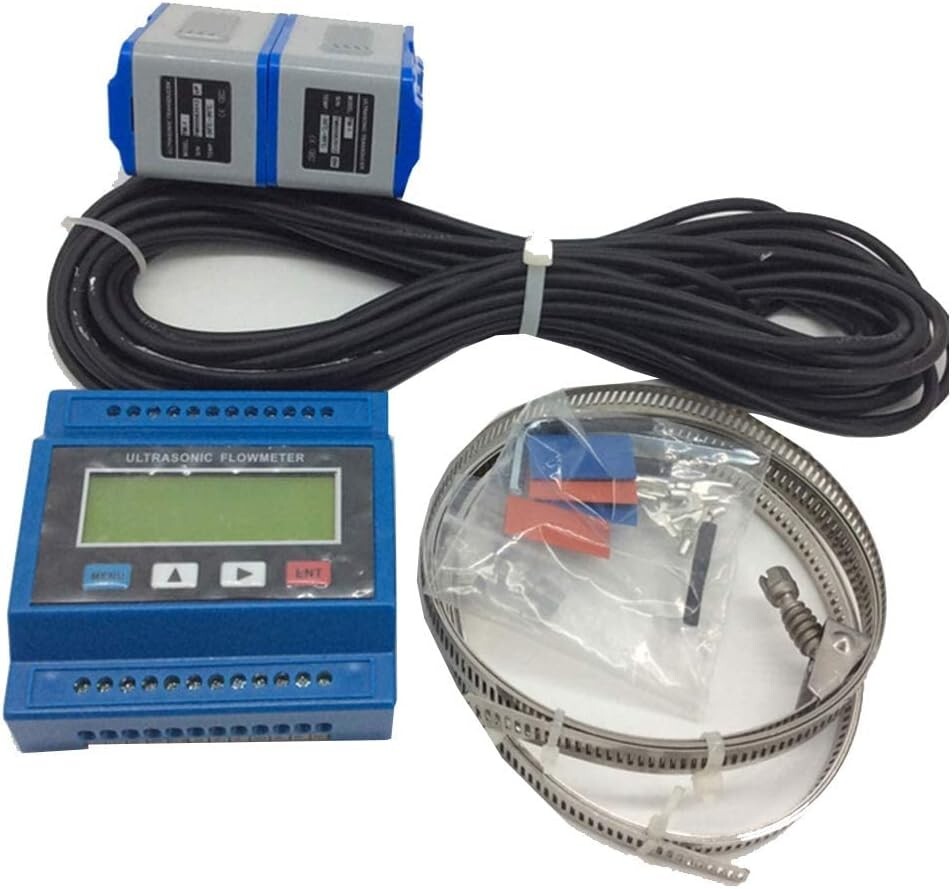

Photos from current listings. Actual item, color, and included accessories may vary.
Portable Ultrasonic Flow Meter Buying Guide
A portable ultrasonic flow meter is a clamp-on transit-time or Doppler device used to measure liquid flow non-invasively in existing pipes. The core trade-off is measurement accuracy and pipe-size range versus portability, battery life, and transducer coupling quality. Buy transit-time meters with selectable transducer sets for clean liquids and known pipe schedules; skip low-cost Doppler-only units unless the fluid carries sufficient suspended solids or bubbles.
Median $195.01
Key takeaways
- Transit-time meters require acoustically clean liquids and accurate pipe-wall thickness plus liner data; Doppler meters need at least roughly 100 ppm suspended solids or entrained gas.
- Clamp-on accuracy typically ranges ±1% to ±2% of reading for transit-time versus ±2% to ±5% for Doppler, with repeatability around ±0.5%.
- Transducer frequency pairing must match pipe diameter: high-frequency small transducers for DN15–DN50, lower-frequency large transducers for DN300+.
At a glance
- Category
- Pressure, Flow & Process Measurement
- Last updated
- Nov 28, 2026
Current offers
Highlights
- Transit-time meters require acoustically clean liquids and accurate pipe-wall thickness plus liner data; Doppler meters need at least roughly 100 ppm suspended solids or entrained gas.
- Clamp-on accuracy typically ranges ±1% to ±2% of reading for transit-time versus ±2% to ±5% for Doppler, with repeatability around ±0.5%.
- Transducer frequency pairing must match pipe diameter: high-frequency small transducers for DN15–DN50, lower-frequency large transducers for DN300+.
- Battery runtime scales with pulse repetition and backlight; typical handheld units run 8–24 hours per charge and often support USB-C or 12V DC charging.
Best use cases
- Best fit: HVAC chilled/hot water and clean process lines in DN25–DN600 — choose a transit-time meter with selectable small/large transducers and pipe-wall thickness input.
- Best fit: field surveys where pipes cannot be drained or cut — clamp-on external mounting with acoustic couplant and stainless mounting straps is required.
- Wrong fit: slurry, wastewater, or aerated lines with low suspended solids — use a Doppler meter only if solids/gas exceed roughly 100 ppm; otherwise skip ultrasonic and use a magnetic or insertion meter.
- Wrong fit: thin-walled or non-standard plastic/PPR pipes without verified wall thickness and liner data — transit-time accuracy collapses; skip unless pipe schedule and liner are known.
Buying tips
- Match transducer frequency to pipe size: small high-frequency pairs for DN15–DN50, large low-frequency pairs for DN300 and above; a single universal pair sacrifices accuracy at both extremes.
- Confirm pipe material and liner entry: PVC, carbon steel, stainless, cast iron, and HDPE have different sound speeds; meters that cannot store liner material and thickness lose transit-time accuracy.
- Choose transit-time for clean liquids and Doppler for dirty liquids; dual-mode meters cost more but cover both, while single-mode Doppler units fail on clean water.
- Verify output and logging needs: 4–20 mA, pulse, and RS-485/Modbus outputs matter for integration; internal datalogging with SD or USB export matters for field surveys.
Specs
| Measurement Principle | Transit-time / Doppler / Dual-mode |
|---|---|
| Typical Accuracy | ±1–2% RD (transit-time); ±2–5% RD (Doppler) |
| Pipe Size Range | DN15–DN600 clamp-on (varies by transducer) |
| Battery Runtime | 8–24 hr per charge; USB-C or 12V DC |
Related searches
What to check before buying
- Measure outer pipe diameter and wall thickness with a caliper or ultrasonic thickness gauge; confirm the meter's pipe-size range covers your OD and schedule.
- Confirm fluid is single-phase and acoustically clean; verify suspended solids or gas content before selecting transit-time versus Doppler.
- Check transducer mounting space: at least 10D upstream and 5D downstream straight run, plus clearance for clamp straps and cable routing.
- Verify power and environment: battery runtime for the survey duration, charging voltage, IP rating for wet or outdoor use, and operating temperature range of transducers.
FAQ
Data sources: eBay / Amazon listings and product attribute feeds. Updated Nov 28, 2026.
Some links on this page are affiliate links. If you buy after clicking one, we may earn a commission at no extra cost to you. This does not change which products appear here or their order. Affiliate disclosure.