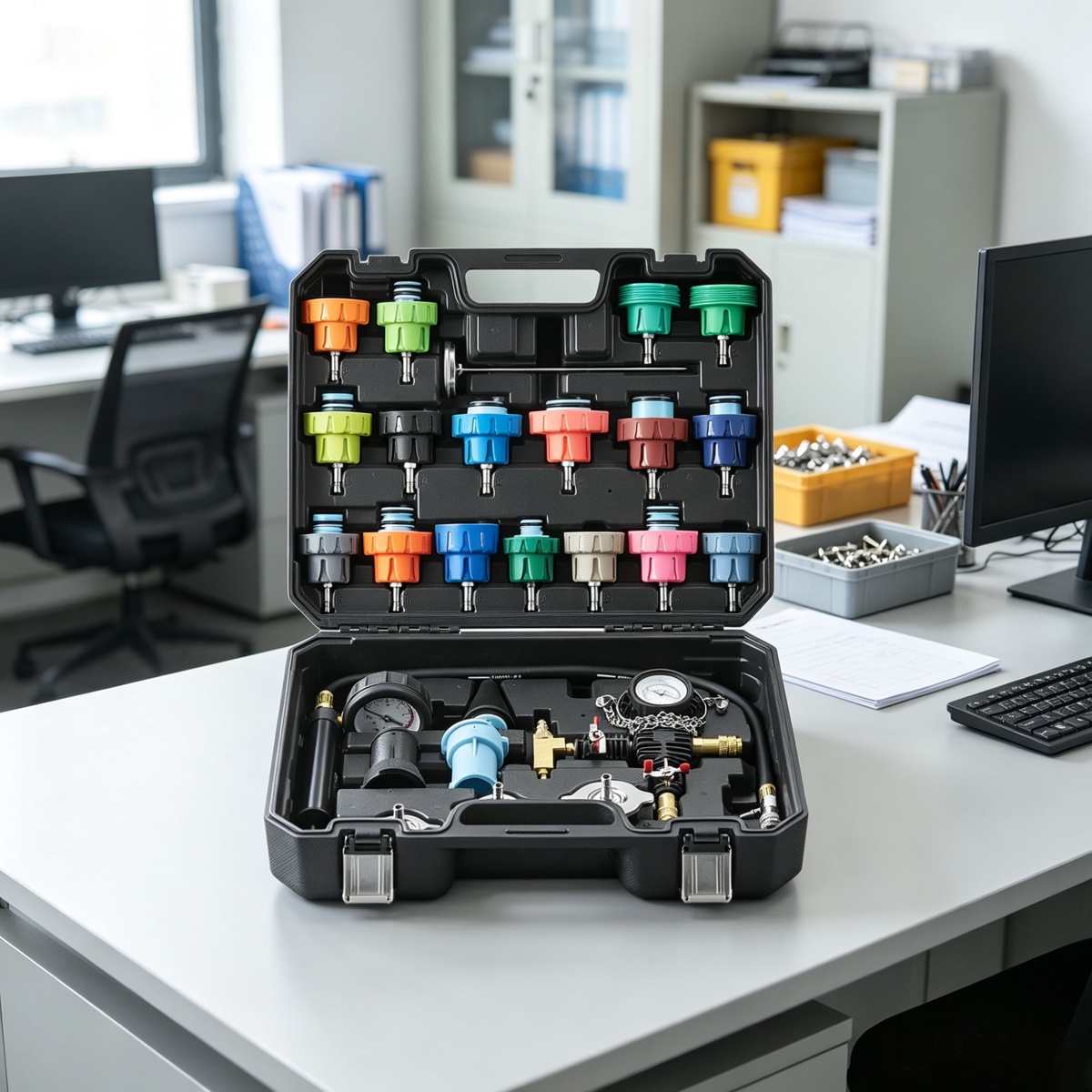

Photos from current listings. Actual item, color, and included accessories may vary.
Radiator Cap Pressure Tester Buying Guide
A radiator cap pressure tester is a hand-pump gauge assembly that pressurizes a cap on a bench to verify its relief-valve opening pressure and sealing integrity. The core trade-off is between a universal kit with a broad adapter set and a dedicated OEM-style tester with a matched cap adapter and finer gauge resolution. Buyers should choose a kit only when its adapter range explicitly covers their cap neck diameter and its gauge reads to at least 30 psi (2 bar) with 1 psi graduations.
Key takeaways
- Bench testers read cap relief pressure directly; a cap rated 15 psi should open within roughly 13-16 psi, and a cap that fails to hold 1 psi below rating is weak.
- Gauge resolution matters more than dial size: 1 psi graduations on a 0-30 psi scale reveal a lazy cap, while coarse 5 psi markings hide marginal failures.
- Adapter fit is the real compatibility spec—measure the cap's inner seal diameter and neck OD; rubber-cone universal adapters seal on many necks but can skew readings on deeply recessed caps.
At a glance
- Category
- Pressure, Flow & Process Measurement
- Last updated
- Nov 28, 2026
Current offers
Highlights
- Bench testers read cap relief pressure directly; a cap rated 15 psi should open within roughly 13-16 psi, and a cap that fails to hold 1 psi below rating is weak.
- Gauge resolution matters more than dial size: 1 psi graduations on a 0-30 psi scale reveal a lazy cap, while coarse 5 psi markings hide marginal failures.
- Adapter fit is the real compatibility spec—measure the cap's inner seal diameter and neck OD; rubber-cone universal adapters seal on many necks but can skew readings on deeply recessed caps.
- Hand-pump assemblies with a bleed valve and check valve hold pressure for a leak-down test; kits without a bleed valve cannot isolate cap seal leaks from pump losses.
Best use cases
- Best fit: a universal kit with 3-5 rubber adapters and a 0-30 psi gauge for home mechanics servicing multiple vehicles—choose it when cap neck diameters span roughly 28-45 mm.
- Best fit: a dedicated cap adapter matched to one cap family for fleet or single-platform work—pick it when repeatable pass/fail readings on the same cap style matter more than coverage.
- Wrong fit: using a tire-pressure gauge or compressor blow-gun to test a cap—neither regulates pressure precisely nor seals the cap's relief valve, so results are meaningless.
- Wrong fit: buying a tester without a bleed valve for diagnostic work—you cannot perform a controlled leak-down or confirm the cap reseats after opening.
Buying tips
- Match the gauge range to the cap: most automotive caps relieve at 13-16 psi (0.9-1.1 bar), so a 0-30 psi (0-2 bar) gauge covers the common range with usable resolution.
- Confirm adapter coverage by cap seal diameter, not vehicle make—measure the rubber seal ring's outer diameter and the cap's inner neck; adapters step in roughly 2-3 mm increments.
- Prefer metal-bodied pumps and brass or stainless fittings over molded plastic; repeated pressurization cycles crack plastic pump heads and distort readings.
- Choose a tester with a built-in check valve and release trigger so the gauge holds peak pressure—this lets you read the cap's opening point hands-free.
Specs
| Gauge Range | 0-30 psi / 0-2 bar common |
|---|---|
| Gauge Resolution | 1 psi graduations preferred |
| Adapter Coverage | Stepped rubber, ~28-45 mm necks |
| Pump Body | Metal with check + bleed valve |
Related searches
What to check before buying
- Measure your cap's inner seal diameter and neck outer diameter with calipers; compare against the kit's adapter step range before buying.
- Confirm the gauge scale covers your cap's rated pressure with at least 1 psi resolution and reads in both psi and bar if you service mixed vehicles.
- Verify the pump assembly includes a bleed/release valve and check valve—essential for leak-down testing and safe pressure release.
- Check that adapter materials are fuel- and coolant-resistant rubber or silicone, not soft vinyl that deforms and leaks under pressure.
FAQ
Data sources: eBay / Amazon listings and product attribute feeds. Updated Nov 28, 2026.
Some links on this page are affiliate links. If you buy after clicking one, we may earn a commission at no extra cost to you. This does not change which products appear here or their order. Affiliate disclosure.