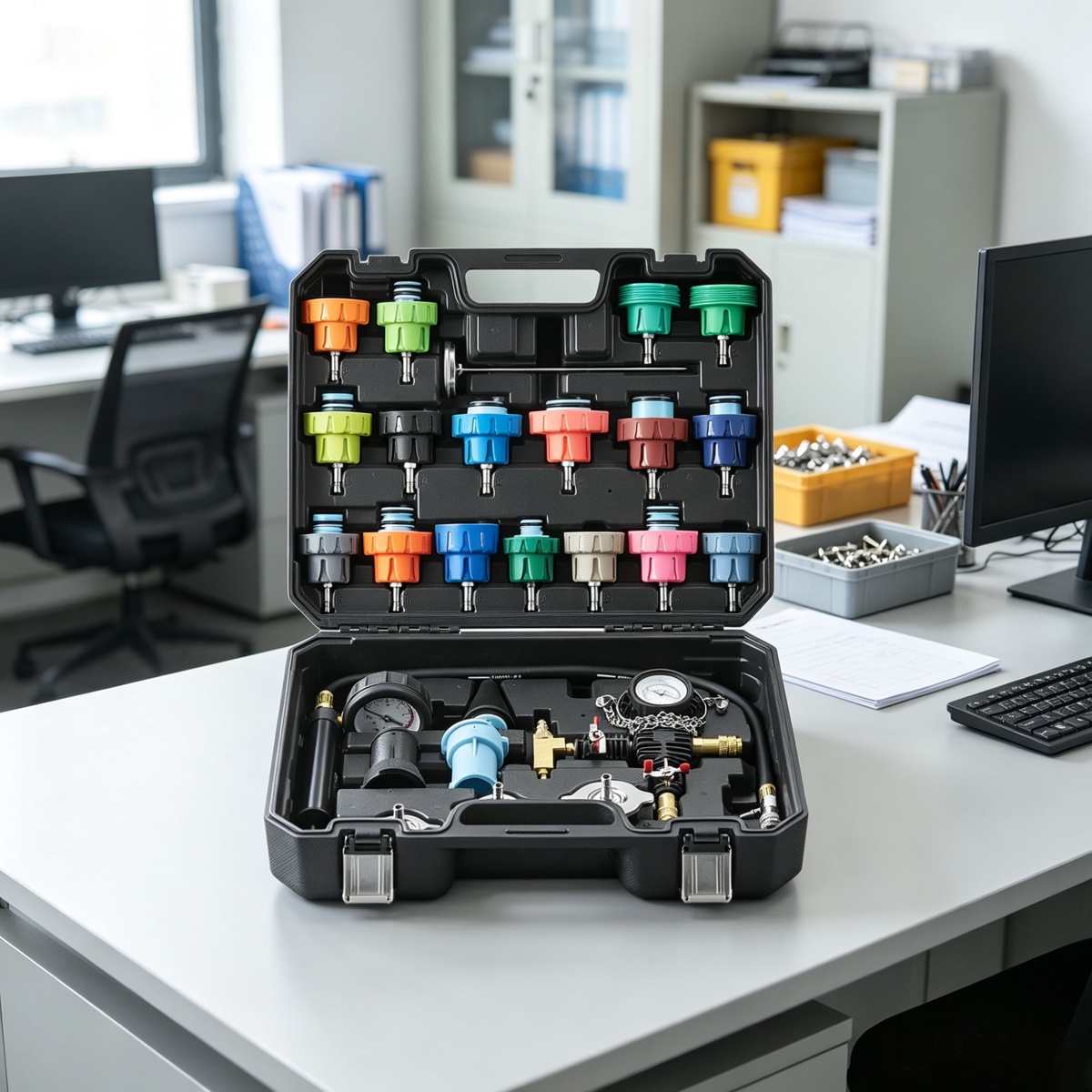

Photos from current listings. Actual item, color, and included accessories may vary.
Radiator Tester Kit Buying Guide
A radiator tester kit is a pressurized leak-detection set that clamps onto a radiator or cooling-system port to reveal cracks, failed seams, and head-gasket leaks without running the engine. The core trade-off is between a universal cone-adapter kit with a hand pump and a vehicle-specific cap-adapter kit that matches your expansion-tank thread; the decision rule is to buy the kit whose adapter set explicitly lists your cap thread and whose gauge covers at least 30 psi.
Key takeaways
- Hand-pump kits typically pressurize to 30-35 psi; confirm the gauge scale reaches at least 30 psi and includes a relief valve to avoid over-pressurizing plastic tanks.
- Aluminum cone adapters with rubber O-rings seal round filler necks; plastic cones crack at high pressure and are the first failure point in budget kits.
- Cap-adapter kits use color-coded threaded caps (common sizes: 28mm, 32mm, 36mm, 44mm) that screw onto the expansion tank in place of the radiator cap.
At a glance
- Category
- Pressure, Flow & Process Measurement
- Last updated
- Nov 28, 2026
Current offers
Highlights
- Hand-pump kits typically pressurize to 30-35 psi; confirm the gauge scale reaches at least 30 psi and includes a relief valve to avoid over-pressurizing plastic tanks.
- Aluminum cone adapters with rubber O-rings seal round filler necks; plastic cones crack at high pressure and are the first failure point in budget kits.
- Cap-adapter kits use color-coded threaded caps (common sizes: 28mm, 32mm, 36mm, 44mm) that screw onto the expansion tank in place of the radiator cap.
- A built-in pressure gauge with a hold valve lets you watch for needle drop over 15-30 minutes; a leaking system will lose pressure visibly.
Best use cases
- Best fit: DIY coolant-loss diagnosis on a single vehicle — pick a cap-adapter kit listing your exact cap diameter and thread pitch; skip universal cone-only kits if your tank uses a threaded cap.
- Best fit: Shop or multi-vehicle use — choose a master kit with at least 8-12 cap adapters plus cone adapters, covering Asian, European, and domestic cap standards.
- Wrong fit: Testing a pressurized cooling system on a hot engine — always test cold; hot coolant can spray and plastic tanks are softer and more prone to cracking under test pressure.
- Wrong fit: Using a radiator tester as a compression tester — these are separate tools; a cooling-system kit will not thread into spark-plug holes.
Buying tips
- Match adapter to cap: measure the expansion-tank cap's outer thread diameter and pitch; a 32mm cap will not seal on a 28mm neck even with a cone adapter.
- Prefer metal-bodied pumps with a brass or stainless cylinder over all-plastic pumps; plastic pump seals wear out after a few dozen pressurizations.
- Check gauge resolution: a 0-30 psi gauge with 1-2 psi increments reads slow leaks better than a 0-100 psi gauge with 10 psi increments.
- Buy a kit with a quick-release coupling between pump and hose; threaded-only connections are slower to swap between adapters and strip over time.
Specs
| Pump Type | Hand pump / pneumatic |
|---|---|
| Max Test Pressure | 30-35 psi typical |
| Adapter Set | Cone + threaded cap adapters |
| Gauge Range | 0-30 psi (1-2 psi increments) |
Related searches
What to check before buying
- Measure your radiator or expansion-tank cap thread diameter and pitch before ordering — the kit's cap list must include that exact size.
- Confirm the kit's maximum test pressure exceeds your system's rated cap pressure by at least 5 psi but stays below the tank's burst rating (typically 30-35 psi for plastic tanks).
- Check that the hose and adapters are rated for coolant contact (EPDM or nitrile rubber), not plain PVC that hardens and cracks.
- Verify the pump handle and gauge are positioned so you can read the needle while pumping in a cramped engine bay.
FAQ
Data sources: eBay / Amazon listings and product attribute feeds. Updated Nov 28, 2026.
Some links on this page are affiliate links. If you buy after clicking one, we may earn a commission at no extra cost to you. This does not change which products appear here or their order. Affiliate disclosure.