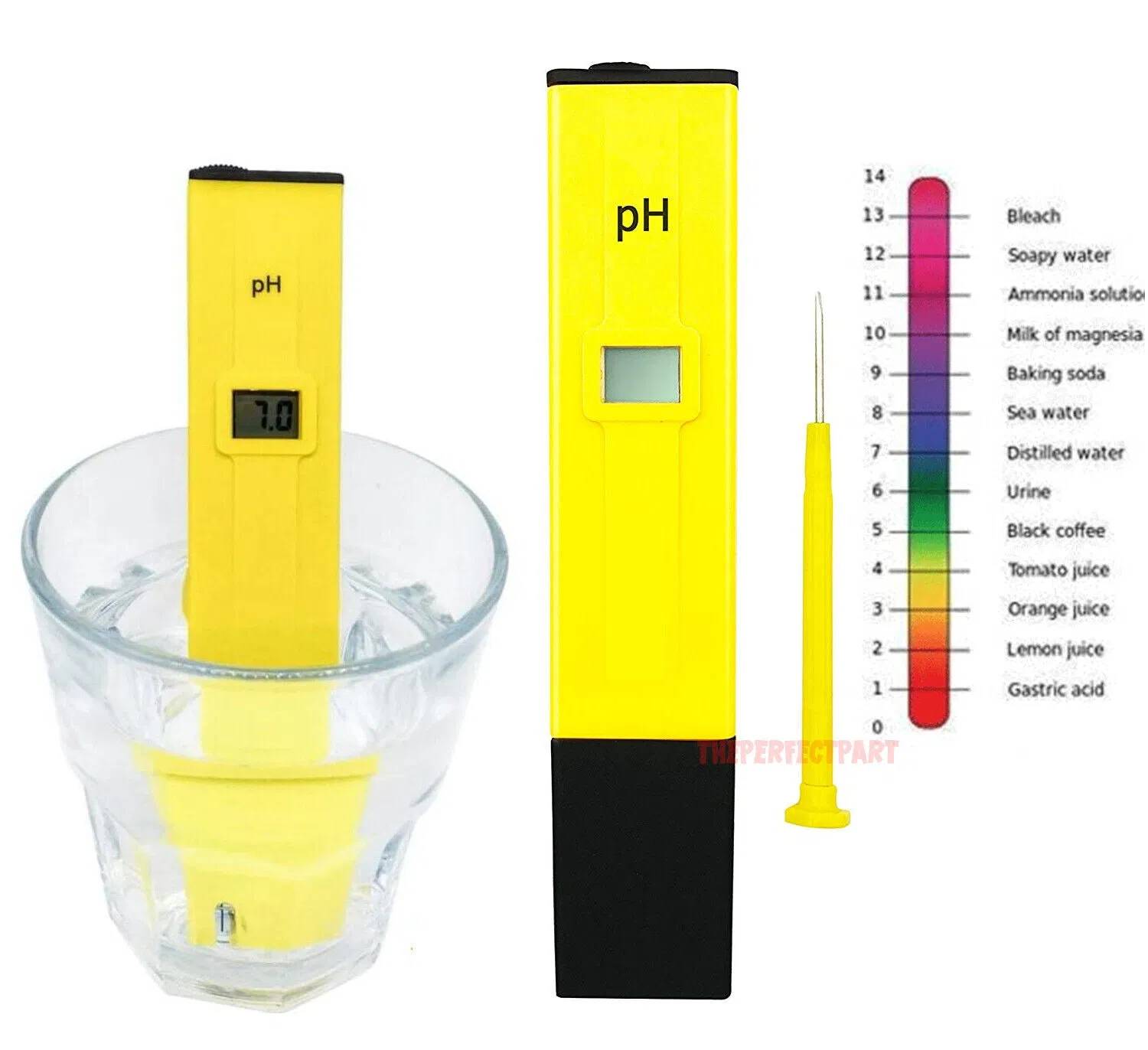

Photos from current listings. Actual item, color, and included accessories may vary.
Aquarium Ph Meter Buying Guide
An aquarium pH meter is a digital pen or benchtop instrument that measures hydrogen-ion concentration in fresh or salt water to keep fish, plants, and invertebrates within safe ranges. The core trade-off is between inexpensive glass-bulb pocket pens with ±0.1 pH accuracy and user-replaceable electrodes versus sealed, non-replaceable units that drift and fail once the junction clogs. Buy a meter with a replaceable probe, two-point or three-point calibration, and a stated accuracy of ±0.01 to ±0.1 pH; skip any sealed pen that offers only one-point calibration and no electrode replacement path.
Key takeaways
- Replaceable glass-bulb electrodes with a refillable KCl junction last years; sealed plastic-body probes are disposable once clogged or dried out.
- Two-point calibration at pH 4.00 and 7.00 (or 7.00 and 10.00 for marine) corrects slope error; one-point offset-only calibration cannot fix a worn electrode.
- Pocket pens commonly claim ±0.1 pH resolution and ±0.1 accuracy, while benchtop and replaceable-probe pens reach ±0.01 pH resolution for reef and breeding use.
At a glance
- Category
- Spectroscopy, Analysis & Detection Instruments
- Last updated
- Nov 28, 2026
Current offers
Highlights
- Replaceable glass-bulb electrodes with a refillable KCl junction last years; sealed plastic-body probes are disposable once clogged or dried out.
- Two-point calibration at pH 4.00 and 7.00 (or 7.00 and 10.00 for marine) corrects slope error; one-point offset-only calibration cannot fix a worn electrode.
- Pocket pens commonly claim ±0.1 pH resolution and ±0.1 accuracy, while benchtop and replaceable-probe pens reach ±0.01 pH resolution for reef and breeding use.
- ATC (automatic temperature compensation) matters because pH shifts roughly 0.01–0.03 per °C; pens without ATC read wrong in unheated or variable-temperature tanks.
Best use cases
- Freshwater community and planted tanks: pick a pocket pen with ±0.1 pH accuracy, two-point calibration, and ATC; skip benchtop units unless you run many tanks.
- Reef and marine aquariums: choose a meter with ±0.01 pH resolution, replaceable probe, and calibration buffers at 7.00 and 10.00; skip single-point pen-style meters that cannot resolve 0.05 pH swings.
- Breeding, quarantine, and shrimp tanks: use a replaceable-electrode pen plus fresh pH 4/7 buffer sachets; skip sealed pens because drifting readings cause false alarms during sensitive molts and fry stages.
- Continuous monitoring and controller integration: select a BNC-output pH electrode or probe module that connects to a controller; skip standalone LCD pens that cannot log or trigger alarms.
Buying tips
- Match resolution to livestock: ±0.1 pH suits hardy freshwater fish, while ±0.01 pH is required for reef, shrimp, and discus where a 0.2 swing is significant.
- Demand a replaceable electrode or BNC connector; a pen with a sealed probe becomes landfill the moment calibration slope falls below about 80%.
- Buy fresh pH 4.00, 7.00, and 10.00 buffer solutions and calibrate before first use and monthly thereafter; stored dry electrodes need soaking in KCl storage solution.
- For saltwater, choose a probe rated for high-chloride environments and calibrate with 7.00 and 10.00 buffers, since marine pH runs 8.0–8.4 and 4.00 calibration wastes the useful slope.
Specs
| Accuracy Class | ±0.01 pH (lab) / ±0.1 pH (pen) |
|---|---|
| Electrode Type | Replaceable glass bulb vs sealed |
| Calibration Points | 2-point (4.00/7.00) or 3-point |
| Temp Compensation | ATC vs manual / none |
Related searches
What to check before buying
- Confirm tank water type (fresh, brackish, marine) and target pH range so you buy the correct buffer set and probe chemistry.
- Measure the probe diameter and cable length for sump, tank, or benchtop placement; pocket pens need clearance to immerse the bulb fully.
- Verify the meter ships with or accepts standard BNC probes if you plan controller or continuous-logging integration.
- Check that calibration buffer sachets or bottles are fresh-dated and that storage solution (KCl) is available for the electrode between uses.
FAQ
Data sources: eBay / Amazon listings and product attribute feeds. Updated Nov 28, 2026.
Some links on this page are affiliate links. If you buy after clicking one, we may earn a commission at no extra cost to you. This does not change which products appear here or their order. Affiliate disclosure.